Facts
The Petitioner Bank dismissed the Respondent No. 3 (Sri Tapan Kumar Dey) on August 4, 2014, following a disciplinary proceeding
Source reference: para. 2Simultaneously, the Bank ordered the "Forfeiture of Gratuity" under Clause 72(e) of the Bank’s Service Regulations
Source reference: para. 2The Respondent No. 3 did not challenge the dismissal but approached the Controlling Authority under the Payment of Gratuity Act after three years
Source reference: para. 4The Controlling Authority and Appellate Authority ruled in favor of the employee, directing payment of gratuity
Source reference: para. 15The Bank challenged these orders, contending that the forfeiture was valid as per their service regulations and that the employee had accepted the punishment by not challenging the dismissal
Source reference: paras. 5-6Issues
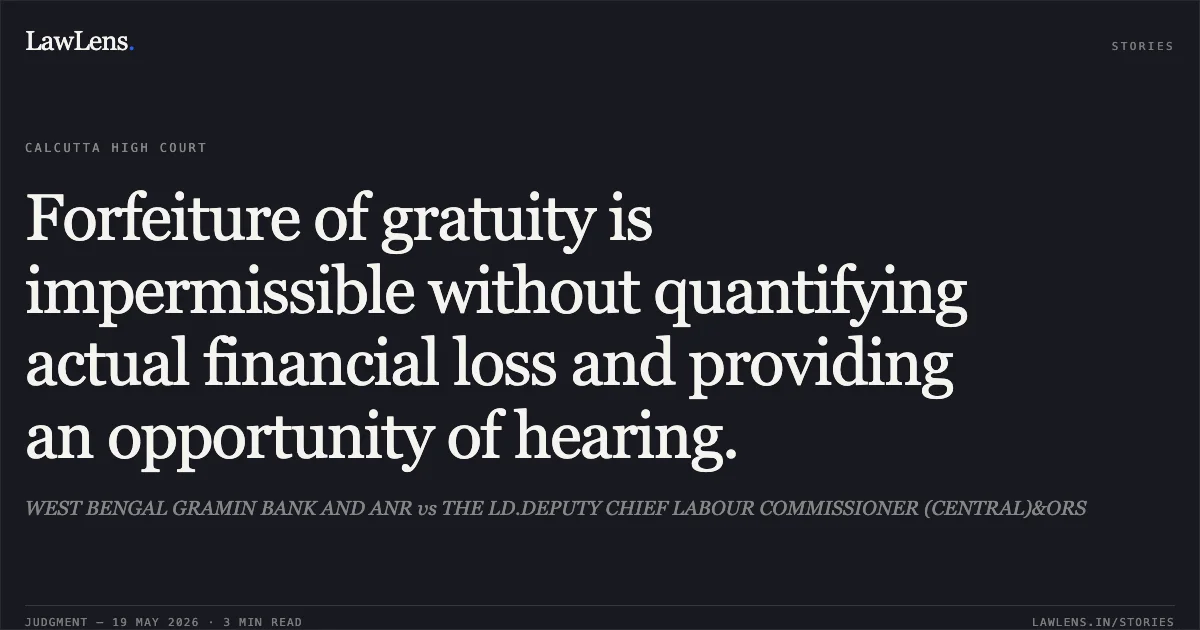
1. Whether an employer can forfeit the gratuity of an employee based on service regulations without quantifying the actual financial loss caused by the employee’s misconduct
Source reference: para. 31, 352. Whether the Payment of Gratuity Act, 1972, overrides internal Bank Service Regulations in matters of forfeiture when no exemption under Section 5 has been granted
Source reference: paras. 27, 37Law Applied
Section 4(6) of the Payment of Gratuity Act, 1972, which mandates that gratuity can only be forfeited to the "extent of the damage or loss so caused" for acts of negligence or willful omission
Source reference: para. 26Section 14 of the Act, which gives the statute overriding effect over inconsistent regulations
Source reference: para. 37The Court followed the precedent of UCO Bank & Ors. vs Nityananda Paul (MAT 1298 of 2012), which established that quantification of loss is a prerequisite for forfeiture and that a second enquiry to fix such liability post-dismissal is impermissible
Source reference: para. 37It also referenced Union Bank of India & Ors. Vs. C. G. Ajay Babu regarding the necessity of following statutory procedures for forfeiture
Source reference: para. 23Reasoning
The Court noted that while the Bank relied on Regulation 72(e) to justify forfeiture, the Bank admitted that the Payment of Gratuity Act is applicable to it
Source reference: para. 39Under Section 4(6)(a) of the Act, forfeiture is permissible only to the extent of quantified damage
Source reference: para. 26The Court found that no quantification of loss was mentioned in the charge sheet, show cause notice, enquiry report, or the final dismissal order
Source reference: paras. 24, 25, 35Since the loss was never quantified or put to the employee during the disciplinary proceedings, he had no opportunity to counter the claim
Source reference: para. 34The Court clarified that internal service regulations cannot be used to bypass the statutory protections of the Act unless a specific exemption under Section 5 exists
Source reference: paras. 27, 37Furthermore, the Court observed that the authorities below had overstepped by commenting on the validity of the enquiry proceedings itself, which was not the subject of the challenge
Source reference: para. 40Holding
The Court dismissed the writ application and upheld the award of gratuity to the employee
It held that the Bank cannot forfeit gratuity without quantifying the loss and following the principles of natural justice under Section 4(6) of the Act
Source reference: para. 37However, the Court set aside the observations made by the Controlling and Appellate Authorities regarding the validity of the underlying disciplinary/enquiry proceedings, as those findings were beyond their jurisdiction
Source reference: para. 41The Controlling Authority was directed to release the deposited gratuity amount with interest to the Respondent No. 3 within 30 days
Source reference: para. 43Acts & Sections Cited
3 provisions across 1 statute referred to in this judgment. Linked provisions open on LawLens.
PAYMENT OF GRATUITY ACT, 19723
Original Court PDF
WEST BENGAL GRAMIN BANK AND ANRvsTHE LD.DEPUTY CHIEF LABOUR COMMISSIONER (CENTRAL)&ORS
Click to open original judgment
Original judgment, available to read, download and summarize on LawLens.in