Facts
The applicant’s late husband, Anil Kalita, a railway employee, was compulsorily retired on 10.11.2004.
Source reference: p. 3, 6On 17.04.2008, the Revisional Authority reduced the penalty to a reduction in grade and ordered reinstatement.
Source reference: p. 3, 6Mr. Kalita died on 02.02.2009 while in service.
Source reference: p. 3In a previous litigation (O.A. 425/2015), the Tribunal directed the respondents to fix his pay as per the 6th CPC and regularize his absence as leave without pay.
Source reference: p. 9This was upheld by the Gauhati High Court in WP(C) 5002/2017, except for the relief of compassionate appointment.
Source reference: p. 10-11Despite these final judgments, the respondents issued fresh orders on 10.05.2019 and 13.05.2019, declaring the period as dies non (non-service) and refusing the full financial benefits previously mandated.
Source reference: p. 4, 8Issues
1. Whether the respondent authorities are legally permitted to issue fresh orders of dies non and altered pay fixation after the issues were settled by a final judgment of the Tribunal and High Court.
Source reference: p. 112. Whether the applicant is entitled to the implementation of the directions in O.A. 425/2015 regarding pay fixation from 2004-2008 and regularization of the period till the employee's death.
Source reference: p. 11-12Law Applied
The doctrine of finality of judgments and res integra, noting that once a matter is settled by a superior court, it cannot be reopened by administrative orders.
Source reference: p. 4, 11Rule 2044-A R II (F.R. 54 A) of the Railway Servants (Discipline & Appeal) Rules regarding the regularization of pay and service upon reinstatement.
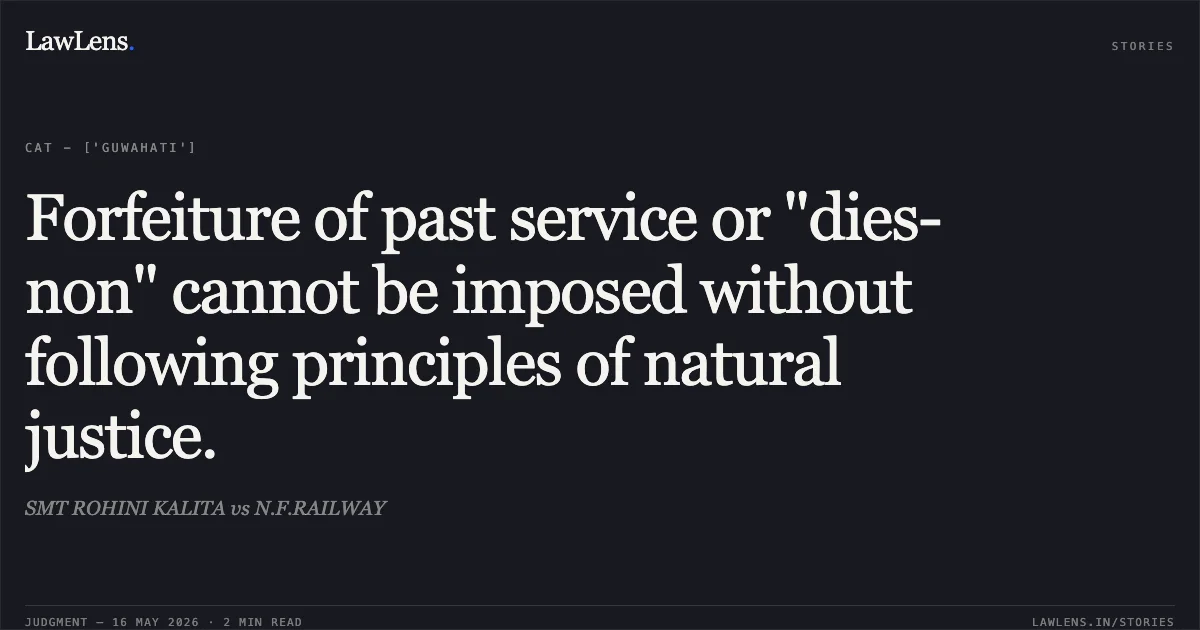
Source reference: p. 9, 11The principles established in Dayal Saran Sanan v. Union of India and Shiv Shanker v. Union of India, which establish that forfeiture of past service (dies non) cannot be made without following principles of natural justice.
Source reference: p. 4Reasoning
The Tribunal observed that the respondents were attempting to circumvent a final judicial mandate.
Source reference: p. 10-11The Gauhati High Court had already upheld the Tribunal’s earlier directions to treat the deceased as reinstated and to fix his pay according to the 6th CPC.
Source reference: p. 10-11By subsequently issuing orders of dies non and a "non-est" pay fixation in 2019, the respondents acted in "gross violation" of the court's orders.
Source reference: p. 4The Tribunal reasoned that since the High Court judgment was not challenged in a higher forum, it attained finality; therefore, the respondents had no authority to unilaterally deny the consequential benefits through internal administrative memos.
Source reference: p. 11The action of declaring dies non against a deceased employee without procedure was deemed arbitrary and malicious.
Source reference: p. 5Holding
The Tribunal allowed the O.A., quashing the impugned orders dated 10.05.2019 and 13.05.2019 as void ab initio.
The court held that the respondents must strictly comply with the previous judicial directions.
Source reference: p. 11-12The respondents were ordered to: (i) calculate and fix the deceased husband's pay from 10.11.2004 to 23.04.2008; (ii) regularize the period from 24.04.2008 to 01.02.2009 by adjusting available leave under FR 54(A); and (iii) grant all consequential benefits, including increments and re-fixation of the applicant’s family pension, within four months.
Source reference: p. 11-12Acts & Sections Cited
1 provisions across 1 statute referred to in this judgment. Each provision opens on LawLens.
Administrative Tribunals Act, 19851
Original Court PDF
SMT ROHINI KALITAvsN.F.RAILWAY
Click to open original judgment
Original judgment, available to read, download and summarize on LawLens.in