Facts
Mukesh Corporation (Plaintiff), a partnership firm, was awarded a contract in 1981 for the construction of a Circuit House annexe in Ahmedabad for ₹12,96,057.80
Source reference: p. 2The work was to be completed by 28.12.1982
Source reference: p. 2The Plaintiff failed to complete the work, leading the State (Defendants) to terminate the contract on 09.12.1983 and execute the remaining work at the Plaintiff's "risk and cost"
Source reference: p. 3, 5The State imposed daily penalties totaling several thousand rupees and adjusted these against the Plaintiff’s security deposit
Source reference: p. 3, 5The Plaintiff sued for recovery of the security deposit, unpaid work, and loss of profit (₹2,20,000), alleging the State failed to provide materials and site access
Source reference: p. 3The Trial Court partly allowed the suit, ordering the refund of the security deposit and certain dues (₹46,234.34) but rejected the claim for loss of profit
Source reference: p. 2, 11Issues
1. Whether the termination of the contract and the imposition of penalty/compensation by the State were legal and justified.
Source reference: para. 6, Issue 12. Whether time was the essence of the contract under Clause 2 of the agreement.
Source reference: para. 6, Issue 43. Whether the Plaintiff is entitled to recover the security deposit and damages for loss of profit.
Source reference: para. 6, Issues 2 & 6Law Applied
The court relied on Section 55 of the Indian Contract Act, 1872, regarding the effect of failure to perform at a fixed time when time is/is not of the essence
Source reference: p. 3It applied the principle of audi alteram partem (natural justice), requiring a show-cause notice before penal action
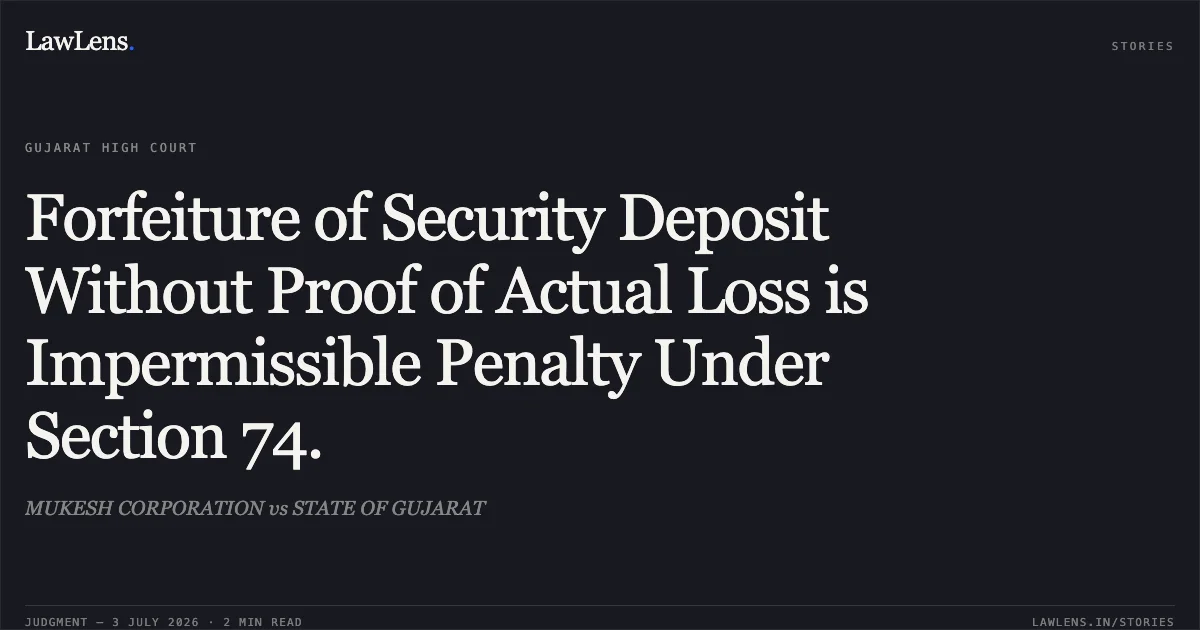
Source reference: p. 3Establishing that security deposits for due performance are in the nature of a penalty; if actual loss can be determined in money, the party claiming compensation must prove the exact loss suffered rather than forfeiting the deposit automatically
Source reference: Maula Bux v. Union of India (AIR 1970 SC 1955), p. 9, 13An appellate court concurring with a trial court need not restate all reasons in detail
Source reference: Laliteshwar Prasad Singh v. S.P. Srivastava (2017 2 SCC 415), para. 11Reasoning
The Court observed that although the contract stipulated a 12-month limit, the State’s conduct in granting extensions and the absence of a notice making time "of the essence" meant that Section 55 regarding strict time limits did not apply to justify automatic forfeiture
Source reference: p. 7, 10The Court found the Plaintiff had abandoned the work after completing less than 1/4th of the project despite receiving materials
Source reference: p. 8, 12The Court held that the State failed to prove the actual loss incurred by executing the work departmentally; thus, following Maula Bux, the forfeiture of the security deposit was illegal
Source reference: p. 9, 13The Court held that since the Plaintiff was primarily responsible for the slow progress and eventual abandonment, they were not entitled to "loss of profit," as awarding such damages would amount to giving a "premium" for their own breach
Source reference: p. 11, 12Holding
The High Court dismissed both appeals and confirmed the Trial Court’s judgment
While the termination of the contract was valid due to the Plaintiff's abandonment, the order levying daily compensation and forfeiting the security deposit was illegal due to lack of proof of actual loss and breach of natural justice
Source reference: p. 11, 13The Plaintiff is entitled to a refund of ₹46,234.34 (security deposit and unpaid work) with 6% interest p.a., but the claim for loss of profit is rejected
Source reference: p. 2, 11-12Acts & Sections Cited
1 provisions across 1 statute referred to in this judgment. Each provision opens on LawLens.
Indian Contract Act, 18721
Original Court PDF
MUKESH CORPORATIONvsSTATE OF GUJARAT
Click to open original judgment
Original judgment, available to read, download and summarize on LawLens.in