Facts
The plaintiff filed a suit against her brother concerning property bearing No. 71, Mayfair Apartment, New Delhi, claiming that although the property stood in the defendant’s name, it had been acquired for the benefit of the plaintiff and her parents and subsequently constituted property of the Draupadi Dream Trust.
Source reference: p.2The defendant filed his written statement on 19 September 2022, accompanied by an application seeking condonation of delay; that application remained pending and was never dismissed, nor was the written statement taken off the record.
Source reference: pp.3, 16–17The plaintiff later obtained leave to amend the plaint. The amendment impleaded the Draupadi Dream Trust as plaintiff no. 2 and introduced a substantive prayer seeking a declaration that the Trust was the absolute and sole owner of the suit property.
Source reference: p.4The defendant thereafter filed an amended written statement with an application seeking condonation of an eight-day delay. By order dated 29 January 2026, the Joint Registrar condoned the delay, directed that the amended written statement be taken on record, closed the plaintiff’s right to file a rejoinder in another interlocutory application, and disposed of the defendant’s earlier condonation application as infructuous.
Source reference: p.2The plaintiff filed the present Chamber Appeal on 11 August 2026, beyond the fifteen-day period prescribed under Chapter II Rule 5 of the Delhi High Court (Original Side) Rules, 2018, and sought condonation of a delay computed by her at 179 days.
Source reference: pp.1, 5, 8She also challenged the amended written statement separately under Order VI Rule 16 CPC, contending that it travelled beyond the scope of the plaint amendment; that application remained pending.
Source reference: p.5Issues
Whether the delay in filing the Chamber Appeal under Chapter II Rule 5 of the Delhi High Court (Original Side) Rules, 2018 ought to be condoned under Section 5 of the Limitation Act, 1963?
Source reference: paras. 27–43Whether the Joint Registrar had jurisdiction to condone the delay in filing the amended written statement and to take it on record?
Source reference: paras. 45–47Whether the defendant was entitled to file a written statement in response to the amended plaint, particularly after the impleadment of a new plaintiff and introduction of a substantive declaratory relief?
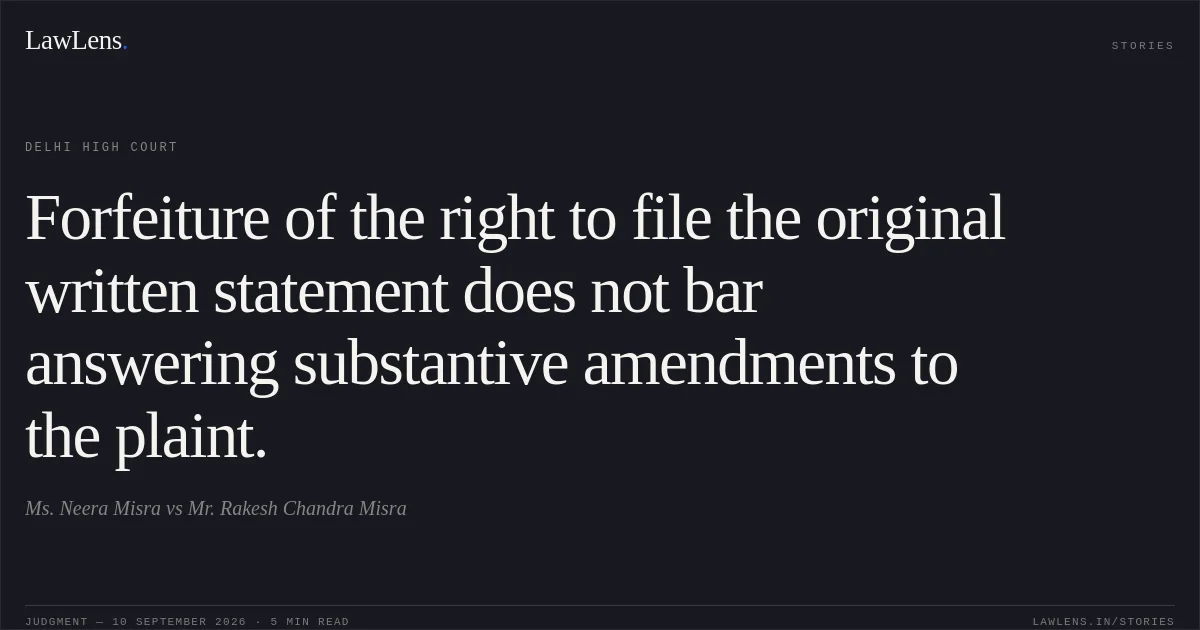
Source reference: paras. 48–52Whether the alleged forfeiture or invalidity of the original written statement prevented the defendant from responding to matters newly introduced by amendment?
Source reference: paras. 53–61Law Applied
Chapter II Rule 5 of the Delhi High Court (Original Side) Rules permits an appeal against an order of the Registrar within fifteen days; since it contains no express outer bar, Section 5 of the Limitation Act is not excluded, but condonation requires “sufficient cause”.
Source reference: paras. 27–29Under Basawaraj v. Special Land Acquisition Officer and Pathapati Subba Reddy v. Special Deputy Collector, sufficient cause requires diligence and a satisfactory explanation, and inordinate delay, negligence, or inactivity may justify refusal even where some explanation is offered.
Source reference: paras. 31–32Chapter VII Rule 4 of the DHC OS Rules permits extension of time for filing a written statement by up to ninety days beyond the initial thirty days, but not thereafter, and authorises the Registrar to close the defendant’s right where the written statement is not filed within the extended period.
Source reference: paras. 38, 45The mandatory nature of this limit in Original Side proceedings was recognised in Ram Sarup Lugani v. Nirmal Lugani and Delhi Gymkhana Club Ltd. v. Col. Ashish Khanna.
Source reference: para. 38However, Oku Tech Pvt. Ltd. v. Sangeet Agarwal, concerning the stricter statutory regime applicable to commercial disputes, was distinguished in light of Desh Raj v. Balkishan.
Source reference: paras. 53–56Under Gurdial Singh v. Raj Kumar Aneja, when a pleading is amended, the opposite party must ordinarily be afforded an opportunity to make a consequential response, though such response must remain confined to the amendment.
Source reference: para. 51A subsequent judgment or change in legal understanding does not ordinarily furnish sufficient cause for condoning an already-expired limitation period, as explained in Delhi Development Authority v. Tejpal.
Source reference: para. 40Reasoning
The Court held that the plaintiff had not explained the critical period between the expiry of limitation on 13 February 2026 and the filing of the appeal on 11 August 2026.
Source reference: paras. 34–36Her later application under Order VI Rule 16 was an independent proceeding and did not prevent her from filing a Chamber Appeal within time; similarly, the pendency of her Order VIII Rule 10 application did not disable her from challenging the Registrar’s order.
Source reference: paras. 34–36Reliance on Shiva Buildtech was also rejected because the legal position concerning the applicable limitation for written statements had already been settled before the impugned order, the plaintiff had herself raised the 120-day objection in 2022, and she still waited nearly four months after that decision before filing the appeal.
Source reference: paras. 37–41On merits, the Court found that the Registrar acted within jurisdiction under Chapter II Rule 3 and Chapter VII Rule 4.
Source reference: paras. 45–47The defendant’s original written statement had been filed and recorded, had never been directed to be removed, and had been treated as existing by the Court in the earlier amendment judgment.
Source reference: paras. 45–47More importantly, the amendment was substantive: it introduced a new plaintiff and a declaration of the Trust’s absolute ownership. Natural justice therefore required that the defendant be permitted to answer the case newly introduced by the amended plaint.
Source reference: paras. 48–51The Court clarified that this did not automatically validate every part of the amended written statement; the plaintiff’s objection that the pleading exceeded the scope of the amendment remained pending before the Joint Registrar.
Source reference: para. 52Even assuming that the defendant had forfeited the right to file a written statement to the original plaint, that forfeiture could not extend to matters introduced only through the subsequent amendment. Allowing a confined response to the amended portion would not revive the lost right but would provide an opportunity to meet a new case.
Source reference: paras. 59–61Holding
The Court dismissed the application for condonation of delay under Section 5 of the Limitation Act, holding that no sufficient cause had been shown for the 179-day delay.
Consequently, the Chamber Appeal was dismissed as barred by limitation.
Source reference: paras. 43, 62The Court further held, in the alternative, that the appeal failed on merits: the Joint Registrar had jurisdiction to deal with the defendant’s delayed amended written statement, and the defendant was entitled to respond to the substantive amendments introducing the Trust as a plaintiff and seeking a declaration of its ownership.
Source reference: paras. 45–61The Court expressly left open the plaintiff’s pending objection that the amended written statement travelled beyond the permitted amendments, and made no determination on the merits of that objection or the underlying suit.
Source reference: para. 63Acts & Sections Cited
5 provisions across 3 statutes referred to in this judgment. Each provision opens on LawLens.
Code of Civil Procedure, 19081
Commercial Courts Act, 20152
Original Court PDF
Ms. Neera MisravsMr. Rakesh Chandra Misra
Click to open original judgment
Original judgment, available to read, download and summarize on LawLens.in