Facts
Respondent No. 1 filed a complaint under Section 200 of the Code of Criminal Procedure alleging an offence under Section 138 of the Negotiable Instruments Act after a cheque for ₹3,00,000 issued by respondent No. 2 was dishonoured for insufficient funds.
Source reference: no citationThe petitioner was arrayed as accused No. 2 and summoned by the Magistrate.
Source reference: no citationShe sought quashing under Section 482 CrPC, contending that she had not signed the cheque, had retired from the company in 2015, and was not involved in its affairs when the cheque was issued in 2018.
Source reference: p. 2–4The High Court examined the cheque and retirement deed.
Source reference: p. 4Issues
1. Whether the proceedings under Section 138 of the Negotiable Instruments Act could continue against the petitioner, who was not the cheque’s signatory and had retired from the company before the cheque was issued.
Source reference: p. 3–4, 72. Whether continuation of the proceedings against the petitioner amounted to an abuse of the process of the court warranting relief under Section 482 CrPC.
Source reference: p. 7Law Applied
Section 138 of the Negotiable Instruments Act concerns the offence of dishonour of a cheque.
Source reference: no citationUnder Section 141, where the offence is committed by a company, a person is not liable merely by virtue of holding a designation; the person must have been in charge of, and responsible to the company for, the conduct of its business at the relevant time.
Source reference: no citationThe Court relied on S.M.S. Pharmaceuticals Ltd. v. Neeta Bhalla, (2005) 8 SCC 89, for this requirement.
Source reference: p. 5–6The Court relied on K.K. Ahuja v. V.K. Vora, (2009) 10 SCC 48, for the requirement that the person be both legally responsible to the company and factually in charge of its business.
Source reference: p. 6The Court considered the petition under Section 482 CrPC, which empowers the High Court to prevent abuse of the process of court.
Source reference: p. 2, 7Reasoning
The cheque was issued by respondent No. 2 in his individual capacity, and the petitioner was not its signatory.
Source reference: p. 4The retirement deed showed that she had left the company in 2015, before the cheque was issued in 2018; the Court therefore found that she was neither a director nor actively involved in the company’s affairs at the relevant time.
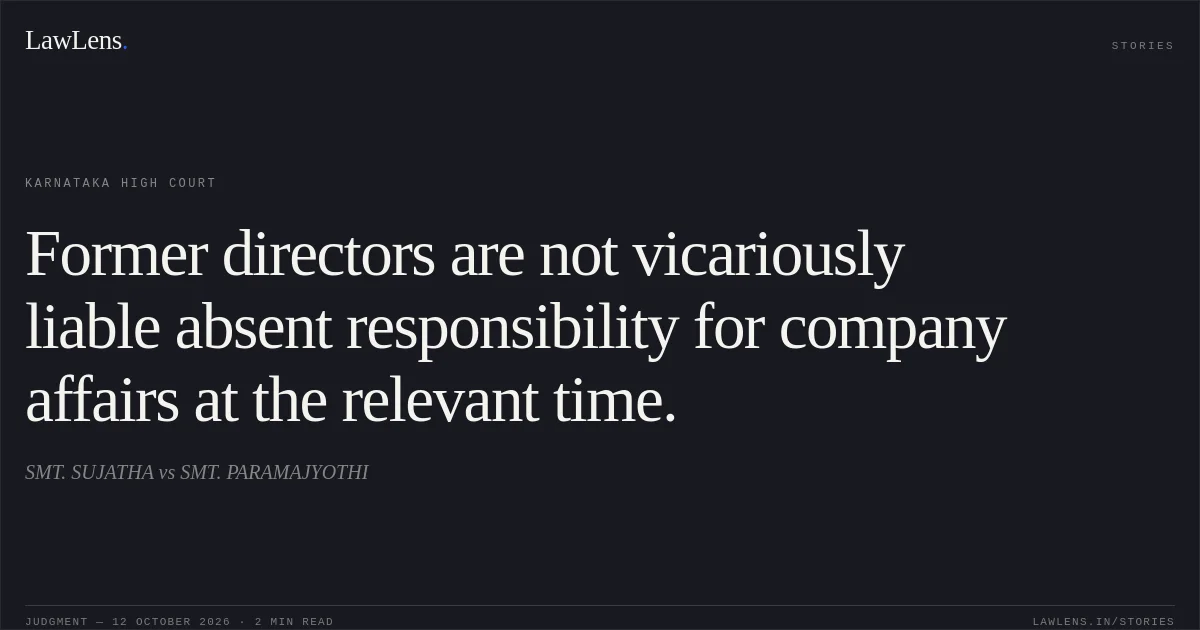
Source reference: p. 4Applying the principles in S.M.S. Pharmaceuticals and K.K. Ahuja, the Court held that the petitioner could not be held vicariously liable without the required connection to the company’s business when the alleged offence occurred.
Source reference: p. 5–7It concluded that continuing the proceedings against her would amount to an abuse of process.
Source reference: p. 7Holding
The High Court allowed the petition and quashed the proceedings in C.C. No. 3984/2019, arising from P.C.R. No. 84/2019, against the petitioner for the offence under Section 138 of the Negotiable Instruments Act.
Acts & Sections Cited
4 provisions across 2 statutes referred to in this judgment. Each provision opens on LawLens.
Code of Criminal Procedure, 19732
Negotiable Instruments Act, 18812
Original Court PDF
SMT. SUJATHAvsSMT. PARAMAJYOTHI
Click to open original judgment
Original judgment, available to read, download and summarize on LawLens.in


