Facts
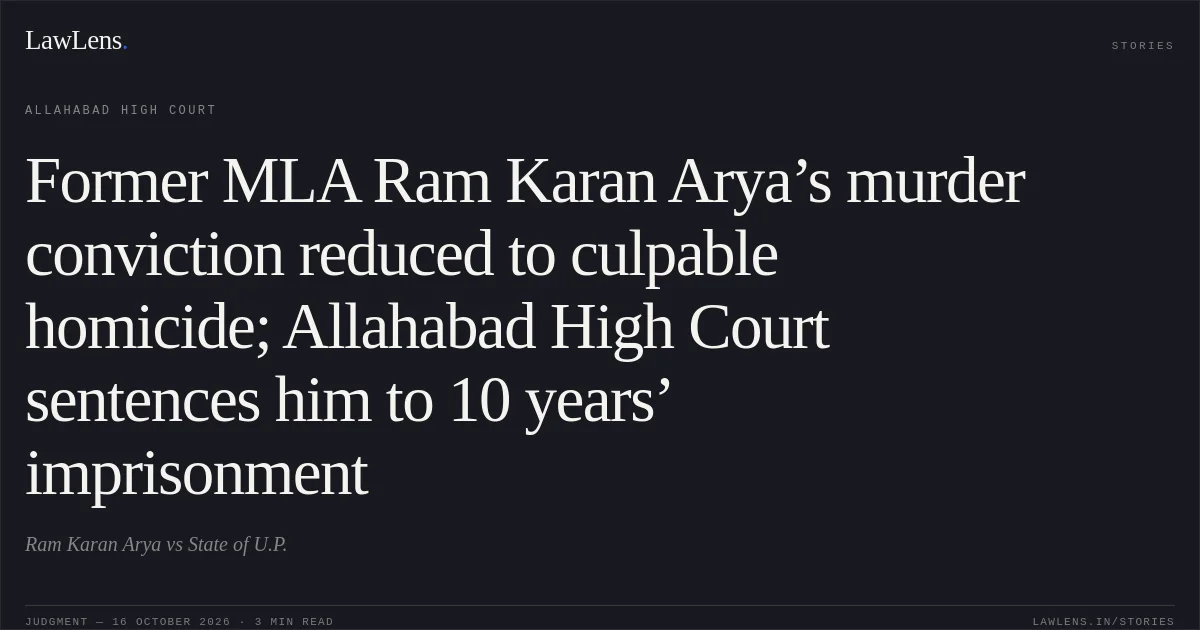
On 23 November 1994, after the deceased’s jeep collided with MLA Ram Karan Arya’s jeep, an altercation followed and Arya shot the deceased in the neck with a gun taken from co-accused Ram Ujagir. The deceased died from the firearm injury.
Source reference: para. 4–6The Sessions Court convicted Arya under Sections 302, 504 and 506 IPC, but acquitted the other accused. Arya appealed his conviction, and the State appealed the acquittals.
Source reference: para. 7–11, 39Issues
Whether the evidence established Arya’s guilt for the fatal shooting beyond reasonable doubt.
Source reference: para. 40, 43–55Whether the shooting, committed during a sudden altercation, fell within Exception 4 to Section 300 IPC and therefore amounted to culpable homicide not amounting to murder under Section 304 Part I rather than murder under Section 302.
Source reference: para. 56–67Whether the acquittals of the other accused should be reversed on the basis of common object or participation in the offence.
Source reference: para. 41, 54, 69Law Applied
Section 300 Exception 4 IPC excludes culpable homicide from murder where the act is committed without premeditation, in a sudden fight in the heat of passion upon a sudden quarrel, and without the offender taking undue advantage or acting cruelly or unusually; all requirements must be established.
Source reference: para. 58Whether the accused intended to cause death is assessed from the circumstances, including the weapon, the part of the body targeted, the force used, and whether the incident arose spontaneously (Pulicherla Nagaraju v. State of A.P., para 59; State of Rajasthan v. Dhool Singh, para 60).
Source reference: para. 59–60A single fatal blow does not, by itself, determine whether Exception 4 applies; the nature and circumstances of the incident are material (Surinder Kumar v. Union Territory, Chandigarh, para 62; Ghapoo Yadav v. State of M.P., para 63; Sukhbir Singh v. State of Haryana, para 64; Mahesh v. State of M.P., para 65).
Source reference: para. 62–65Section 304 Part I applies where the act is done with intention to cause death or such bodily injury as is likely to cause death, but falls within an exception to Section 300 IPC.
Source reference: para. 58, 67Section 149 IPC requires proof that the offence was committed in furtherance of the unlawful assembly’s common object; mere presence together is insufficient where that common object is not established.
Source reference: para. 54, 69Reasoning
The Court found the eyewitness accounts consistent on the shooting and corroborated by the medical evidence, which recorded a fatal firearm wound to the deceased’s neck. It rejected the challenges to the FIR, the place of occurrence and the witnesses’ presence, finding no material infirmity that undermined the prosecution case.
Source reference: para. 46–55However, the evidence showed that the confrontation arose spontaneously from the jeep collision, with no prior enmity or premeditation; Arya fired during the ensuing quarrel and did not continue the assault or otherwise take undue advantage. The Court therefore applied Exception 4, while recognising that the shooting was committed with the intention required for Section 304 Part I.
Source reference: para. 66–67As to the other accused, the Court found no established common object or assigned overt act sufficient to make them liable for Arya’s individual act.
Source reference: para. 54, 69Holding
The appeal was partly allowed: Arya’s conviction under Section 302 IPC was substituted with a conviction under Section 304 Part I IPC, and his sentence was reduced to ten years’ rigorous imprisonment.
The fines and default sentences remained unchanged; the other convictions and sentences were not disturbed. The State’s appeal against the acquittals was dismissed.
Source reference: para. 68–69Acts & Sections Cited
12 provisions across 2 statutes referred to in this judgment. Each provision opens on LawLens.
Code of Criminal Procedure, 19732
Original Court PDF
Ram Karan AryavsState of U.P.
Click to open original judgment
Original judgment, available to read, download and summarize on LawLens.in