Facts
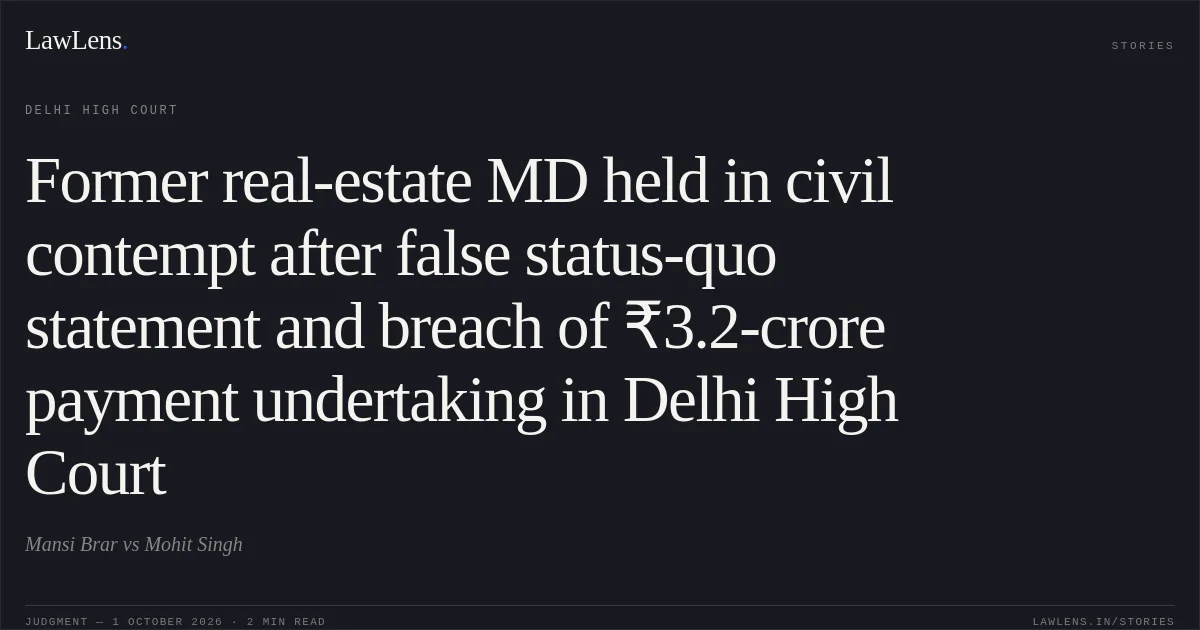
In orders dated 28 March 2022 disposing of the petitioner’s Section 9 applications, the Court recorded the respondent’s statement that the properties covered by the parties’ MoUs would remain under status quo as to title and possession until the applications were decided by the arbitrator under Section 17 of the Arbitration and Conciliation Act, 1996.
Source reference: pp. 2, 9The petitioner later alleged that third-party rights had been created in the properties.
Source reference: pp. 5–6, 10–15The respondent initially relied on a subsequent settlement agreement and other grounds; affidavits filed in 2025 disclosed that the relevant flats had been sold before the 28 March 2022 order.
Source reference: pp. 5–6, 10–15The respondent subsequently undertook by affidavit to pay the petitioner ₹3.2 crore by 31 March 2026. He paid ₹1 crore but did not pay the remaining ₹2.2 crore despite further opportunities.
Source reference: pp. 16–17Issues
1. Whether the respondent’s statements and non-disclosure concerning the status of the properties, which had been sold before the 28 March 2022 order, amounted to contempt of court.
Source reference: pp. 13–16, 24–262. Whether the respondent’s failure to honour his undertaking to pay ₹3.2 crore by 31 March 2026 amounted to civil contempt.
Source reference: pp. 16–17, 21–22, 25–26Law Applied
Sections 2(b), 10 and 12 of the Contempt of Courts Act, 1971, read with Article 215 of the Constitution, governed the contempt petition; civil contempt under Section 2(b) includes wilful disobedience of a court order or breach of an undertaking given to a court.
Source reference: p. 1, 26Relying on In Re, Perry Kansagra, which discussed Chandra Shashi v. Anil Kumar Verma, the Court applied the principle that a person who makes a false statement or attempts to deceive the court thereby interferes with the administration of justice and may be dealt with for contempt.
Source reference: pp. 18–20Reasoning
The Court found that the respondent knew of the 28 March 2022 order, had executed the MoUs as the firms’ authorised signatory, and had also given personal guarantees concerning their performance.
Source reference: pp. 14–15Although the flats had been sold before the order, the respondent’s earlier response did not disclose that fact; it emerged only after the Court directed him to provide a specific account of the properties. The Court treated the inaccurate statement and material non-disclosure concerning the properties as conduct that misled the Court.
Source reference: pp. 15–16, 24Separately, the respondent gave a clear undertaking to pay ₹3.2 crore despite being aware of his personal insolvency proceedings, paid only ₹1 crore, and failed to pay the balance despite repeated opportunities. The Court held that this also constituted wilful breach of the undertaking.
Source reference: pp. 16–17, 21–22, 25Holding
The Court held the respondent guilty of civil contempt under Section 2(b) of the Contempt of Courts Act, 1971, based on his conduct concerning the property-status statement and his failure to honour the payment undertaking.
The judgment excerpt records the finding of guilt but does not specify a sentence or further consequential order.
Source reference: para. 26Acts & Sections Cited
9 provisions across 4 statutes referred to in this judgment. Each provision opens on LawLens.
Contempt of Courts Act, 19713
Arbitration and Conciliation Act, 19963
Indian Penal Code, 18602
Code of Criminal Procedure, 19731
Original Court PDF
Mansi BrarvsMohit Singh
Click to open original judgment
Original judgment, available to read, download and summarize on LawLens.in