01Facts
Respondent No. 1 sanctioned a housing loan of ₹8,50,000 to the Petitioners against the mortgage of a residential property situated at Faridabad, Haryana; the Petitioners asserted that only ₹6,16,000 was disbursed and disputed the outstanding amount.
p. 2 · ¶ 4Following initiation of proceedings under the SARFAESI Act, the Petitioners challenged the demand notice under Section 13(2), possession notice under Section 13(4), auction, valuation, reserve price, sale certificate, and proposed physical possession of the secured asset.
p. 2 · ¶ 5Proceedings under Section 14 were undertaken before the competent authority at Faridabad, which passed an order dated 08.04.2026 fixing 28.04.2026 for taking physical possession.
pp. 2–3 · ¶ 6The Petitioners filed S.A. No. 232/2026 before DRT-II, Chandigarh under Section 17 of the SARFAESI Act. The DRT dismissed the application on limitation grounds on 16.07.2026, and the DRAT, Delhi dismissed the Petitioners’ appeal on 05.08.2026.
p. 3 · ¶ 7The Petitioners invoked Articles 226 and 227 before the Delhi High Court, relying principally on the fact that the appellate order had been passed by the DRAT, Delhi.
p. 3 · ¶ 8, 1202Issues
i.Whether the Delhi High Court possessed territorial jurisdiction under Article 226(2) merely because the DRAT, Delhi passed the impugned appellate order?
p. 4 · ¶ 14 · p. 7 · ¶ 17(c)ii.Whether, notwithstanding the existence of territorial jurisdiction, the Court should decline to exercise its discretionary jurisdiction on the ground of forum conveniens?
p. 4 · ¶ 14–15 · p. 7 · ¶ 17(f)iii.Whether the Petitioners should be relegated to the Punjab and Haryana High Court at Chandigarh, having regard to the location of the secured asset, the Section 14 proceedings, and the original DRT proceedings?
pp. 8–9 · ¶ 18–2003Law Applied
The Court applied Article 226(2) of the Constitution, under which a High Court may exercise jurisdiction where the cause of action arises wholly or partly within its territorial limits; the passing of an appellate order within the territory may constitute part of the cause of action.
p. 4 · ¶ 14 · p. 7 · ¶ 17(c)However, territorial jurisdiction does not compel exercise of the Court’s discretionary writ jurisdiction. Under the doctrine of forum conveniens, recognised in Kusum Ingots & Alloys Ltd. v. Union of India, (2004) 6 SCC 254, and reiterated in Ambica Industries v. Commissioner of Central Excise, (2007) 6 SCC 769, the Court may decline to entertain a petition where another forum is more appropriate.
pp. 5–6 · ¶ 15–16Relying on the Full Bench decision in Sterling Agro Industries Ltd. v. Union of India, 2011 SCC OnLine Del 3162, the Court held that although an appellate order may create a part of the cause of action, it is not necessarily the sole or determinative factor; the Court must examine the nature of the dispute, the principal territorial nexus, the location of the subject matter, the situs of the original proceedings, and the authorities involved.
pp. 6–7 · ¶ 17Provisions in the judgment · 3 · Linked ones open on LawLens
Securitisation and Reconstruction of Financial Assets and Enforcement of Security Interest Act, 2002 Section 13Section 14Section 17
04Reasoning
The Court accepted that the DRAT’s order dated 05.08.2026, having been passed in Delhi, gave rise to part of the cause of action under Article 226(2).
p. 4 · ¶ 14 · p. 8 · ¶ 19Nevertheless, the substantive dispute was principally connected with Haryana and Chandigarh: the secured asset was situated in Faridabad; the SARFAESI enforcement and proposed physical possession concerned that property; the Section 14 proceedings and possession order originated from Faridabad; and the Securitisation Application had been filed before DRT-II, Chandigarh.
pp. 7–8 · ¶ 18The DRAT’s appellate order could not be considered in isolation from the underlying proceedings.
Since the only substantial connection with Delhi was the situs of the appellate tribunal, the balance of territorial convenience favoured the Punjab and Haryana High Court at Chandigarh.
pp. 8–9 · ¶ 19–20The prior Delhi High Court decisions cited by the Petitioners were found unhelpful because the issue of territorial jurisdiction or forum conveniens had not been raised or adjudicated in those cases.
p. 9 · ¶ 2105Holding
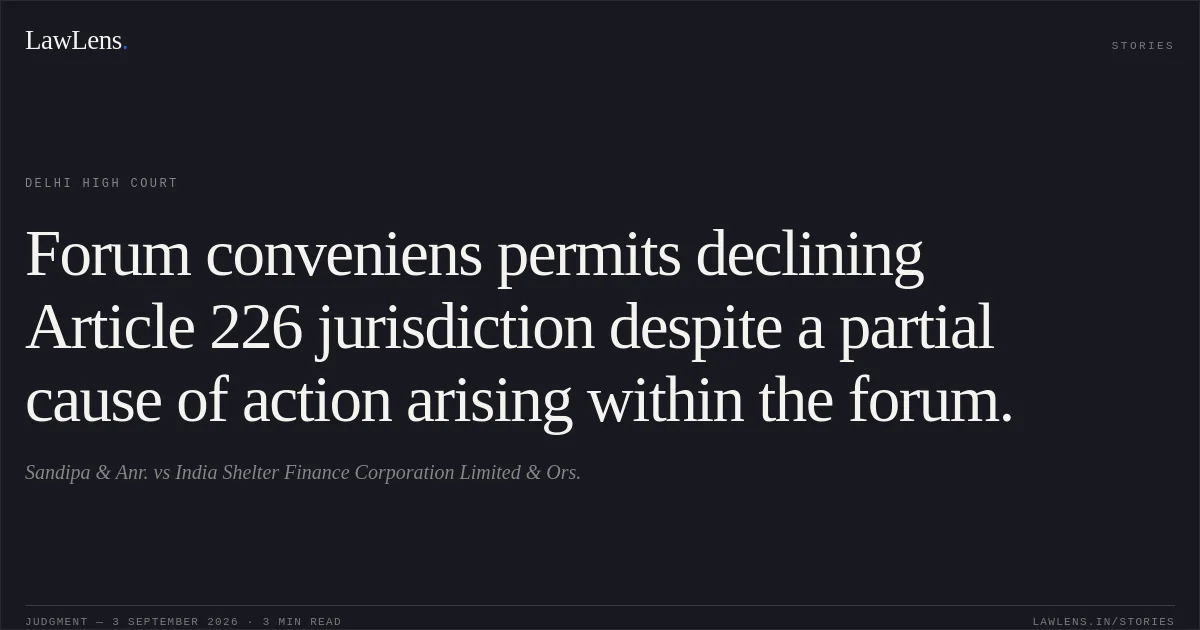
The Delhi High Court held that, although the impugned DRAT order constituted part of the cause of action and the petition was technically maintainable under Article 226(2), the Court should not exercise its discretionary jurisdiction because the principal and substantial territorial nexus lay with Haryana and Chandigarh.
pp. 9–10 · ¶ 22The writ petition was accordingly dismissed on the ground of forum conveniens, with liberty to the Petitioners to approach the Punjab and Haryana High Court at Chandigarh in accordance with law. Pending applications were also disposed of.
p. 10 · ¶ 23Original Court PDF
Sandipa & Anr.vsIndia Shelter Finance Corporation Limited & Ors.
Click to open original judgment
Original judgment, available to read, download and summarize on LawLens.in