Facts
On 22.10.2019, Hitesh Manunbhai Savaliya (the deceased) allegedly fell from a passenger train between Vadodara D cabin and Bajva station while traveling from Surat to Ahmedabad.
Source reference: para. 2.1, 2.2He died on the spot. A journey ticket from Godhra to Anand was found on his person.
Source reference: para. 3.1The Railway Claims Tribunal (RCT) awarded the parents (claimants) Rs. 8,00,000/- plus interest, holding the incident to be "untoward".
Source reference: para. 1.1The Railway Administration appealed, contending that the route where the body was found was inconsistent with the Surat-Ahmedabad journey and that the ticket found (Godhra to Anand) suggested the deceased was not a bona fide passenger on the route of the incident.
Source reference: para. 3.1Issues
1. Whether the deceased was traveling on a valid journey ticket and was a bona fide passenger at the relevant time.
Source reference: para. 42. Whether the death resulted from an "untoward incident" (accidental fall) under Section 123(c)(2) of the Railways Act, 1989.
Source reference: para. 4Law Applied
Section 123(c)(2) and Section 124-A of the Railways Act, 1989, which define "untoward incidents" and establish the liability of the Railway Administration to pay compensation on "strict liability" principles regardless of fault.
Source reference: para. 2.2, 5Supreme Court precedent Union of India v. Rina Devi, which clarifies that the initial burden of proving a bona fide status is discharged by the claimant filing an affidavit; the burden then shifts to the Railways.
Source reference: para. 5Rajni and Another v. Union of India (2025), establishing that proceedings under this Act are governed by the "preponderance of probabilities" in a welfare statute context, rather than the "beyond reasonable doubt" standard of criminal law.
Source reference: para. 5Reasoning
The Court noted that the deceased’s body was found on the railway track at km 401/3, a fact supported by the Station Master's memo and RPF Roznamcha.
Source reference: para. 4.1The Court observed that the Railway failed to lead oral evidence to prove the Train Signal Register (TSR) or rebut the claimant's testimony.
Source reference: para. 3.2, 4.1The Court found that Vadodara and Bajva indeed fall on the Surat-Ahmedabad route.
Source reference: para. 6.1Applying the principle of a "beneficial piece of legislation," the Court held that the presence of a ticket for a different route does not automatically imply the deceased was a trespasser or that the injury was "self-inflicted".
Source reference: para. 6, 6.1Since the Railway could not prove any statutory exceptions under the Proviso to Section 124-A (such as suicide or criminal act), the foundational facts supported an accidental fall.
Source reference: para. 14, 15Holding
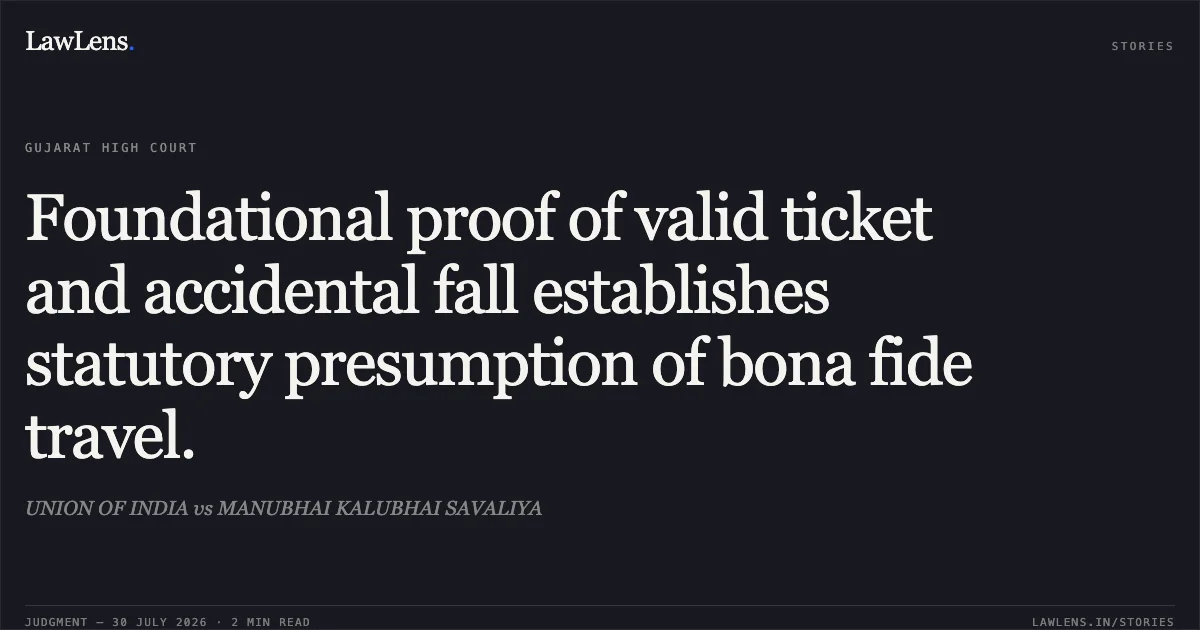
The High Court held that once a valid ticket (even if for an intersecting route) and an accidental fall are established through the totality of circumstances, the statutory presumption of bona fide travel operates in favor of the claimant.
The High Court dismissed the appeal, upheld the RCT’s judgment, and directed the Railway Claims Tribunal, Ahmedabad, to disburse the entire compensation amount and interest to the claimants via RTGS/NEFT.
Source reference: para. 7, 1.1Acts & Sections Cited
2 provisions across 2 statutes referred to in this judgment. Each provision opens on LawLens.
Railway Claims Tribunal Act, 19871
Railways Act, 19891
Original Court PDF
UNION OF INDIAvsMANUBHAI KALUBHAI SAVALIYA
Click to open original judgment
Original judgment, available to read, download and summarize on LawLens.in