01Facts
In FY 2018–19, the Appellant executed works contracts for four co-operative spinning mills and charged GST at 12%.
¶ 2–7Following an audit, the State Tax Officer issued a notice under Section 73 and demanded differential tax on the basis that the supplies were taxable at 18%, disallowed input tax credit (ITC) of Rs. 4,19,476 for mismatch with GSTR-2A, and raised other demands.
¶ 2–7The first appellate authority set aside the demand under Section 16(4) and nullified the Section 122 penalty, but otherwise upheld tax, interest and penalty, including the differential-rate demand and ITC disallowance.
¶ 2–7The Appellant appealed to the Tribunal, relying, among other things, on Government involvement in the projects and supplier-side reporting failures to support its claims for the concessional rate and ITC.
¶ 8–2002Issues
i.1. Whether the Appellant’s additional grounds and later-filed documents should be taken on record
¶ 37(i) · ¶ 38ii.2. Whether the works contracts qualified for the 12% concessional rate under Sl. No. 3(vi) of Notification No. 11/2017-Central Tax (Rate), including whether the societies were Government Entities and whether the works were meant predominantly for non-commercial use
¶ 37(ii) · ¶ 39–63iii.3. Whether interest under Section 50(1) and the penalty under Section 73(9) should be interfered with, and whether the challenge to the Section 122 penalty remained live
¶ 37(iii) · ¶ 65–71iv.4. Whether the differential tax should be recomputed on a cum-tax basis
¶ 37(iv) · ¶ 72–73v.5. Whether the ITC disallowance of Rs. 4,19,476 and related interest under Section 50(3) should be set aside or remanded for verification
¶ 37(v) · ¶ 74–8303Law Applied
Section 9(1) of the CGST Act authorises the notified tax rates; under the version of Sl. No. 3(vi) of Notification No. 11/2017-Central Tax (Rate) applicable in 2018–19, the concessional rate required both an eligible recipient and works meeting the specified use condition.
¶ 22–36Paragraph 4(x) defined a “Government Entity” by reference to statutory constitution or establishment by Government with at least 90% participation by equity or control, for an entrusted function.
¶ 22–36Sections 15(1), 50(1), 50(3), 73(8)–(9), 16(2) and 155 govern valuation, interest, penalty and ITC eligibility; Section 16(2)(c) requires that the tax charged on the supply be paid to Government, and Section 155 places the burden of proving ITC eligibility on the claimant.
¶ 22–36Circular No. 183/15/2022-GST prescribed evidence, including supplier or professional certificates in specified mismatch cases, to verify that condition for FY 2017–18 and 2018–19.
¶ 22–36The Tribunal also applied the principles that interest is compensatory (Pratibha Processors v. Union of India, para. 66), promissory estoppel cannot compel conduct contrary to law (Kasinka Trading v. Union of India, para. 69), and the ITC claimant must prove the genuineness of the claim (State of Karnataka v. Ecom Gill Coffee Trading Pvt. Ltd., para. 74).
¶ 66, 69, 74An advance ruling binds only the applicant and the relevant officers in that case under Section 103(1).
¶ 22–36Provisions in the judgment · 20 · Linked ones open on LawLens
Central Goods and Services Tax Act, 2017 16 provisions
Section 9Section 11Section 15Section 16Section 39Section 41Section 42Section 50Section 51Section 73Section 74Section 103Section 112Section 113Section 122Section 155Maharashtra Goods and Services Tax Act, 2017 Section 112
Bharatiya Sakshya Adhiniyam, 2023 Section 119
Maharashtra Co-operative Societies Act, 1960 Section 9Section 12
04Reasoning
The Tribunal accepted the additional grounds and documents because they elaborated the existing case and were not opposed.
¶ 38The Government’s role in funding, sanctioning and supervising the projects did not make it the recipient or determine the statutory tax rate: the societies invited the tenders, contracted with the Appellant, were named as employers or owners, and were invoiced for the works.
¶ 41–49The record did not establish that the societies were set up by statute or established by Government as required by paragraph 4(x); independently, the factory buildings were intended for spinning cotton into yarn for sale and therefore for industry and commerce, not predominantly for non-commercial use.
¶ 50–63Interest under Section 50(1) followed from the unpaid tax irrespective of bona fides, while the Section 73(9) penalty applied in the absence of timely payment under Section 73(8); the separate Section 122 penalty had already been nullified.
¶ 65–71Cum-tax treatment was unavailable because the Appellant’s invoices and sales records described the receipts as exclusive of tax.
¶ 72–73On ITC, the Appellant supplied no invoice-wise reconciliation or certificates establishing that the tax on the disputed supplies had been paid; portal evidence that suppliers filed GSTR-3B did not prove payment of tax on the relevant supplies.
¶ 75–82The burden under Sections 16(2)(c) and 155 therefore remained undischarged, and the Appellant had already had an opportunity to provide the required evidence, so remand was unwarranted.
¶ 75–8205Holding
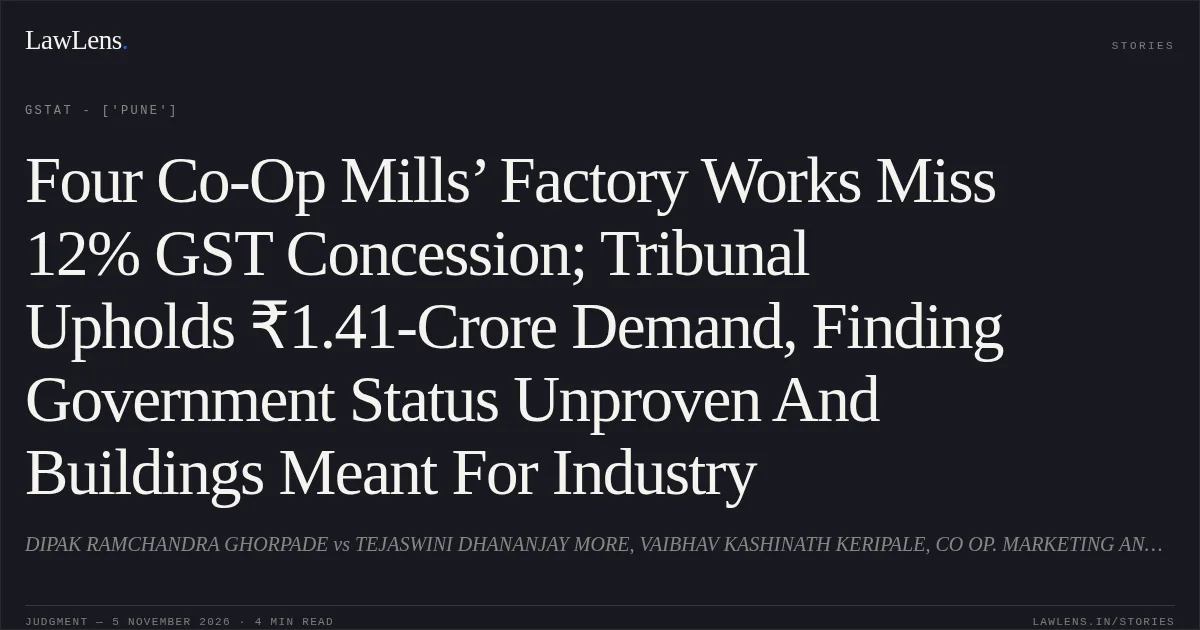
The Tribunal dismissed the appeal and upheld the Order-in-Appeal.
¶ 84It confirmed differential tax of Rs. 65,43,016, interest under Section 50(1) of Rs. 60,25,718, penalty under Section 73(9) of Rs. 6,96,250, disallowed ITC of Rs. 4,19,476, and confirmed Section 50(3) interest of Rs. 4,80,160, for a total demand of Rs. 1,41,64,620.
¶ 84The proper officer was directed to adjust the amounts already paid and communicate any balance payable; the first appellate authority’s holding regarding eligibility for refund of the balance IGST part-payment was left undisturbed.
¶ 84There was no order as to costs.
¶ 84Original Court PDF
DIPAK RAMCHANDRA GHORPADEvsTEJASWINI DHANANJAY MORE, VAIBHAV KASHINATH KERIPALE, CO OP. MARKETING AND TEXTILE DEPARTMENT DIRECTORATE OF TEXTILE NAGPUR
Click to open original judgment
Original judgment, available to read, download and summarize on LawLens.in