Facts
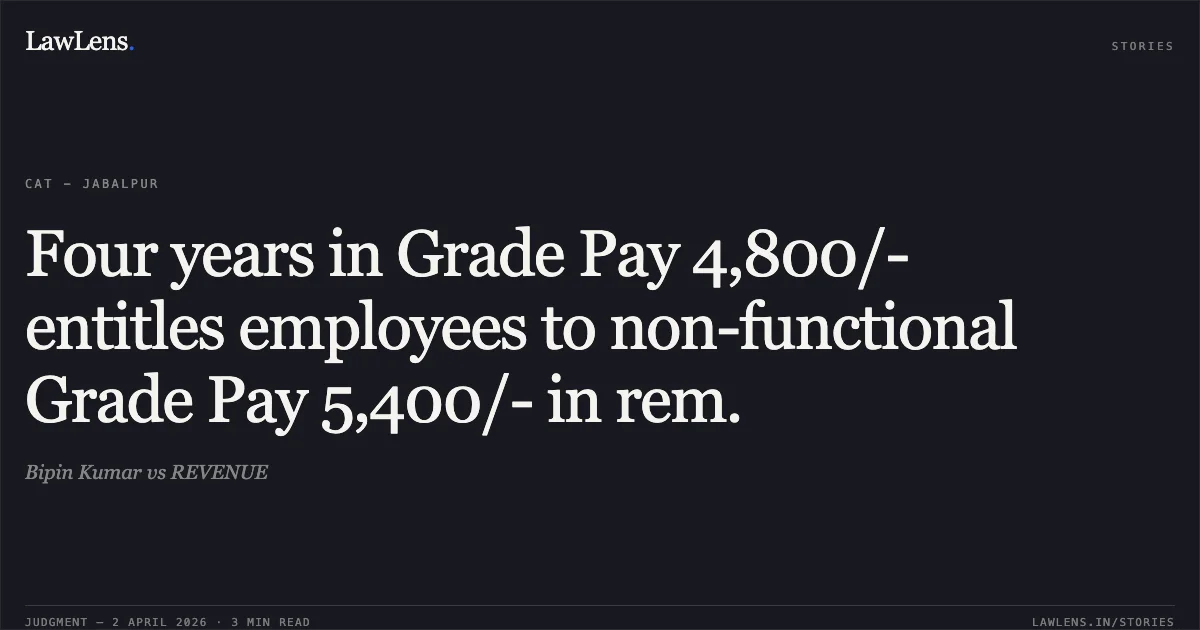
The four applicants, employees of the Central Bureau of Narcotics under the Ministry of Finance, filed this Original Application seeking the grant of Grade Pay (GP) of Rs. 5,400/- on a non-functional basis.
Source reference: p.1-2They claimed entitlement to this benefit effective from the date they completed four years of regular service in the Grade Pay of Rs. 4,800/-.
Source reference: p.2, para. 1The applicants relied on the implementation of the 6th Central Pay Commission recommendations and asserted that their case is identical to previous judicial precedents where such relief was granted to similarly situated Group-B officers.
Source reference: p.3, para. 7Issues
Whether the applicants are entitled to the Grade Pay of Rs. 5,400/- on a non-functional basis upon completion of four years of regular service in the Grade Pay of Rs. 4,800/-.
Source reference: p.2, para. 1Whether the legal principle established in M. Subramaniam v. Union of India operates as a judgment in rem, requiring the government to extend benefits to all similarly situated employees without forcing individual litigation.
Source reference: p.3, para. 7; p.6, para. 12Law Applied
The Tribunal primarily relied on the resolution dated 29.08.2008 issued by the Government of India regarding the 6th Central Pay Commission, which granted GP of Rs. 5,400/- to officers completing four years in the GP of Rs. 4,800/-.
Source reference: p.4, para. 10It followed the precedent set by the Madras High Court in M. Subramaniam v. Union of India (W.P. (C) No. 13225/2010), which was affirmed by the Supreme Court.
Source reference: p.3-4, para. 9-10The Tribunal also invoked Article 14 of the Constitution of India regarding the principle of equality and the doctrine that similarly situated persons must be treated alike, as established in State of Karnataka v. C. Lalitha (2006).
Source reference: p.8-9, para. 13-14Furthermore, it cited the National Litigation Policy and the Supreme Court's observation in Government of NCT v. Somvir Rana regarding the issuance of circulars for settled principles to save judicial time.
Source reference: p.7, para. 9-10Reasoning
The Tribunal observed that the legal issue regarding non-functional upgradation to GP Rs. 5,400/- is no longer res integra.
Source reference: p.3, para. 7By comparing the facts of the present case with M. Subramaniam and previous orders in OA 1004/2021, the Tribunal found the cases to be "squarely covered".
Source reference: p.2, para. 4The court reasoned that the four-year service period should be counted from the date an officer enters the GP of Rs. 4,800/-, regardless of whether that placement occurred through regular promotion or financial upgradation under the ACP/MACP schemes.
Source reference: p.4, para. 10; p.10, para. 15The Tribunal criticized the respondents for treating the M. Subramaniam judgment as in personam (applying only to the parties involved), holding instead that it is a judgment in rem.
Source reference: p.6, para. 12It concluded that denying these benefits to the applicants while granting them to others who approached the court constitutes arbitrary discrimination and a violation of the "equalising principle" of Article 14.
Source reference: p.9, para. 14Holding
The Tribunal allowed the Original Application.
It directed the respondents to grant the applicants the Grade Pay of Rs. 5,400/- on a non-functional basis starting from the date they completed four years of regular service in the GP of Rs. 4,800/-, including instances where that grade was reached via ACP/MACP.
Source reference: p.10-11, para. 15-16The order includes the provision of all consequential benefits and arrears of pay.
Source reference: p.11, para. 16For superannuated applicants, the respondents were directed to revise retiral dues and PPOs accordingly.
Source reference: p.11, para. 16Compliance was ordered within 90 days of receipt of the certified copy of the order.
Source reference: p.11, para. 16Original Court PDF
Bipin KumarvsREVENUE
Click to open original judgment
Original judgment, available to read, download and summarize on LawLens.in