Facts
The petitioner challenged, under Article 227 of the Constitution, the order dated 10 October 2024 passed by the Special Judge, NIA, Lucknow, in Sessions Trial No. 2126 of 2024 arising from Case Crime No. 2 of 2024, Police Station Anti-Terrorist Squad, Lucknow.
Source reference: para. 2The order framed a charge against the petitioner under Section 121-A IPC, along with offences under Sections 3, 5 and 9 of the Official Secrets Act, 1923.
Source reference: para. 2The State raised a preliminary objection that Section 21 of the National Investigation Agency Act, 2008 (“NIA Act”) provided a statutory appeal to the High Court against the order, and that the Article 227 petition was therefore not maintainable.
Source reference: para. 3The petitioner contended that an order framing charge was an interlocutory order under V.C. Shukla v. State , and consequently no appeal lay under Section 21 of the NIA Act.
Source reference: para. 5Issues
Whether an order framing a charge under Section 121-A IPC passed by a Special Court under the NIA Act is an “interlocutory order” within the meaning of Section 21 of the NIA Act.
Source reference: para. 6Whether the petitioner could invoke the High Court’s jurisdiction under Article 227 when a statutory appeal under Section 21 of the NIA Act was available.
Source reference: paras. 3, 30Law Applied
Section 21(1) of the NIA Act provides a right of appeal to the High Court from any judgment, sentence or order of a Special Court, except an interlocutory order; Section 21(3) bars any other appeal or revision from such orders, including interlocutory orders.
Source reference: para. 19The Court relied on Madhu Limaye v. State of Maharashtra , which held that orders framing charge are not purely interlocutory where they substantially affect the accused’s rights.
Source reference: para. 7Although the larger Bench decision in V.C. Shukla v. State treated an order framing charge as interlocutory under the Special Courts Act, 1979, the Court held that decision to be context-specific.
Source reference: paras. 8, 14–22It followed the subsequent three-Judge Bench decisions in Asian Resurfacing of Road Agency (P) Ltd. v. CBI , which held that an order framing charge is neither purely interlocutory nor final, and Sanjay Kumar Rai v. State of U.P. , which reaffirmed that orders framing charge or refusing discharge are not interlocutory for the purposes of Section 397(2) CrPC.
Source reference: paras. 23, 27Applying P.S. Sathappan v. Andhra Bank Ltd. , the Court held that a precedent must be understood in the context of the statute and issue actually decided.
Source reference: paras. 13, 22Under Iveco Magirus Brandschutztechnik GMBH v. Nirmal Kishore Bhartiya , a later decision of a smaller Bench that has noticed, considered and explained an earlier larger-Bench decision may constitute the binding law governing the field.
Source reference: para. 25Reasoning
The Court distinguished V.C. Shukla because it concerned Section 11 of the Special Courts Act, 1979, under which Special Courts were presided over by sitting High Court Judges and appeals lay directly to the Supreme Court.
Source reference: paras. 18–22The NIA Act operates under a materially different scheme: its Special Courts are presided over by Sessions Judges, and appeals lie to a Division Bench of the High Court.
Source reference: paras. 18–22The Court observed that Asian Resurfacing had expressly considered and explained V.C. Shukla , and had declared that an order framing charge is not purely interlocutory. This position was subsequently reaffirmed in Sanjay Kumar Rai .
Source reference: paras. 23–28Accordingly, the order framing charge against the petitioner was appealable under Section 21(1) of the NIA Act.
Source reference: para. 30Entertaining the Article 227 petition before a Single Judge, despite the statutory appeal before a Division Bench, would circumvent the statutory appellate structure and offend judicial discipline.
Source reference: para. 30Holding
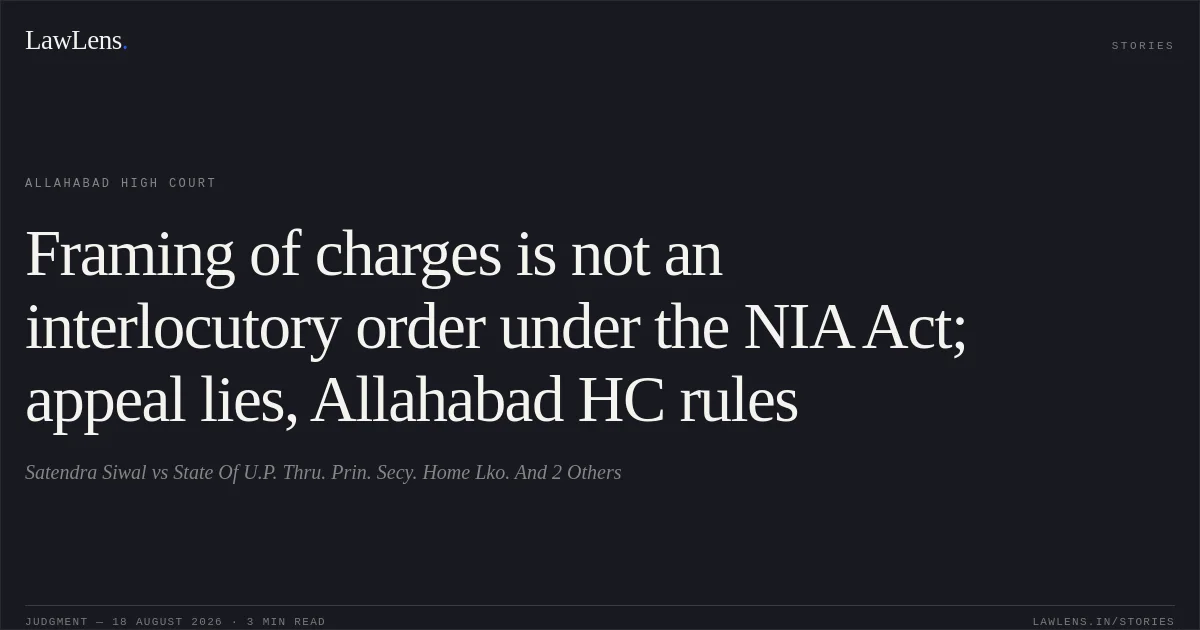
The Court held that an order framing charge is not an interlocutory order for the purposes of Section 21 of the NIA Act and is therefore appealable before the High Court.
Since the petitioner had an effective statutory remedy under Section 21, the Article 227 petition was not entertained.
Source reference: para. 31The petition was dismissed, with liberty to the petitioner to challenge the order dated 10 October 2024 by filing an appeal before the appropriate Division Bench under Section 21 of the NIA Act.
Source reference: para. 31Acts & Sections Cited
11 provisions across 3 statutes referred to in this judgment. Each provision opens on LawLens.
National Investigation Agency Act, 20082
Code of Criminal Procedure, 19736
Original Court PDF
Satendra SiwalvsState Of U.P. Thru. Prin. Secy. Home Lko. And 2 Others
Click to open original judgment
Original judgment, available to read, download and summarize on LawLens.in