01Facts
The petitioners initiated partition proceedings under Section 178 of the Madhya Pradesh Land Revenue Code, 1959, concerning several jointly held agricultural lands at Village Alapur, Tehsil Jaura, District Morena.
¶ 2During the pendency of the proceedings, the private respondents instituted Civil Suit No. 25-A/1993, and the revenue proceedings were kept in abeyance pursuant to an injunction granted in that suit.
¶ 8After dismissal of the civil suit on 12 May 1999, the partition proceedings were revived. The record showed that counsel for both parties were informed of the recommencement, their signatures were obtained on the order sheet, and the next date was fixed.
¶ 8The respondents’ counsel did not appear on the subsequent date, and the proceedings proceeded ex parte, culminating in a partition order dated 2 July 1999.
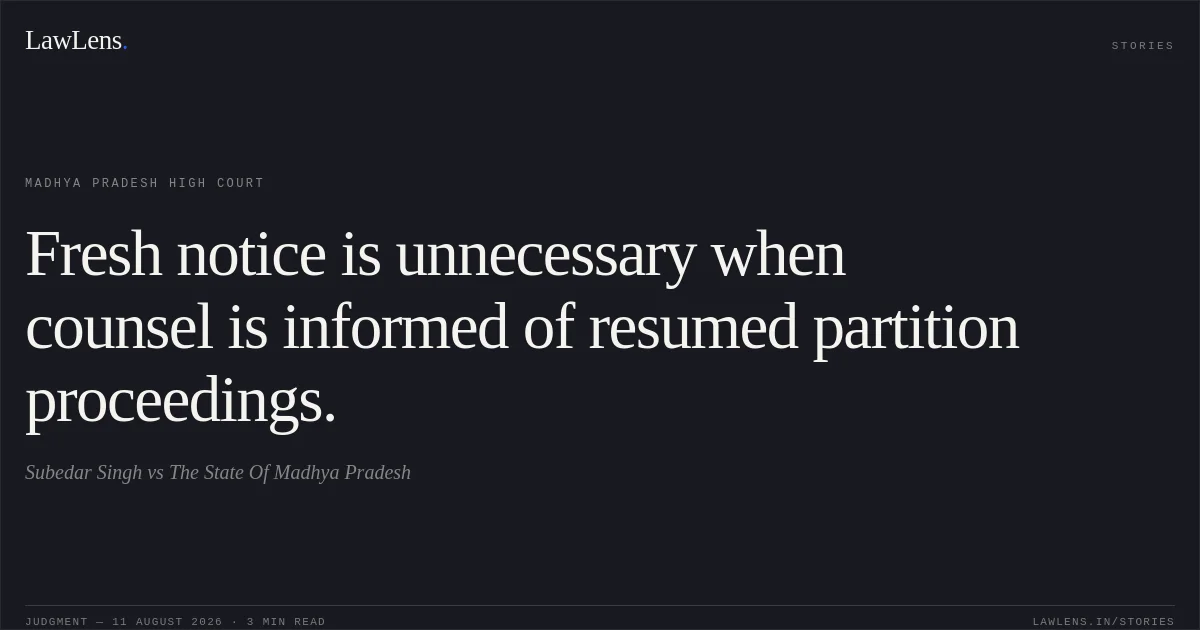
¶ 2, 8The respondents’ first appeal before the Sub-Divisional Officer was dismissed, but the Additional Commissioner allowed their second appeal and remanded the matter on the ground that no fresh notice had been issued after revival of the proceedings.
¶ 2, 9The Board of Revenue dismissed the petitioners’ revision and affirmed the remand order, leading to the present writ petition.
¶ 1–202Issues
i.Whether the Tehsildar was required to issue fresh notice to the respondents after the partition proceedings, which had been kept in abeyance during the civil suit, were revived.
¶ 8–11ii.Whether the respondents were denied a reasonable opportunity of hearing and whether the partition order dated 2 July 1999 was therefore contrary to the principles of natural justice.
¶ 9–11iii.Whether the Additional Commissioner and the Board of Revenue erred in setting aside or remanding the partition proceedings on the basis of alleged non-service of fresh notice.
¶ 1, 9, 1203Law Applied
The Court applied Section 178 of the Madhya Pradesh Land Revenue Code, 1959, which governs partition proceedings concerning joint holdings.
¶ 2It applied the principle of natural justice requiring notice and a reasonable opportunity of hearing before an adverse order is passed.
¶ 6, 9However, where a party is already represented through counsel, has knowledge of the proceeding and the next date of hearing, and thereafter chooses not to appear, the requirement of a further or fresh notice is not attracted.
¶ 8, 11The Court also proceeded on the settled principle that an order of remand may be interfered with in writ jurisdiction where it is founded on an erroneous or perverse finding.
¶ 5Provisions in the judgment · 1 · Linked ones open on LawLens
MP Land Revenue Code 1959 Section 178
04Reasoning
The Court found that the partition proceedings had not been terminated; they had merely been kept in abeyance because of the pending civil suit.
¶ 3, 8After the suit was dismissed, counsel representing both parties were informed that the proceedings had recommenced, and the respondents’ counsel noted the next date on the order sheet.
¶ 8Consequently, the respondents had actual knowledge and a meaningful opportunity to participate. Their counsel’s subsequent absence could not be treated as denial of natural justice or used to demand a fresh notice.
¶ 11The Court also noted that the alleged change of counsel did not assist the respondents because the asserted Vakalatnama of the new advocate did not bear his signature and therefore was not validly established on the record.
¶ 10The Additional Commissioner’s conclusion that the absence of fresh notice automatically invalidated the proceedings was therefore held to be perverse and unsustainable.
¶ 9, 1105Holding
The Court answered the issues in favour of the petitioners.
It held that no fresh notice was required because the respondents were duly represented when the partition proceedings were revived, had knowledge of the next hearing date, and failed to appear thereafter.
¶ 11The writ petition was allowed, and the Additional Commissioner’s order dated 28 February 2004 was set aside.
¶ 12Consequently, the basis for the Board of Revenue’s affirmance of the remand order was also displaced.
¶ 1, 12Original Court PDF
Subedar SinghvsThe State Of Madhya Pradesh
Click to open original judgment
Original judgment, available to read, download and summarize on LawLens.in