Facts
The appellant filed a suit in 2013 for specific performance regarding an agreement from 2011 involving a payment of Rs. 1,45,00,000/- to the second defendant (a company)
Source reference: p. 2The trial court declined specific performance but decreed a refund of the amount with 8% interest on 24.07.2017
Source reference: p. 1-2Upon non-payment, the appellant filed an execution petition, and the suit property was attached on 21.09.2017
Source reference: p. 3Multiple objections by the Judgment Debtor (JD-1) and his assignees were dismissed. Subsequently, the respondent (mother of JD-1 and a Director in the same company) filed an objection under Order XXI, Rule 97 of the CPC, claiming the property was joint family property in which she held a 1/3rd share
Source reference: p. 2The Execution Court and First Appellate Court dismissed her objection, but the High Court reversed these orders in a second appeal, directing that she be allowed to lead evidence
Source reference: p. 4Issues
1. Whether the High Court was justified in reversing the concurrent findings of the lower courts and requiring the framing of issues and evidence for a third-party objection under Order XXI, Rule 97 of the CPC
Source reference: p. 4-52. Whether the respondent's claim of being a bona fide third party ignorant of the proceedings was sustainable given her role as a Director in the defendant company
Source reference: p. 6Law Applied
The Court primarily applied Rules 97, 98, 99, and 101 of Order XXI of the Code of Civil Procedure (CPC), 1908, as amended in 1976
Source reference: p. 4These provisions constitute a "complete code" for resolving all questions relating to right, title, or interest in the property arising between the parties to an execution proceeding or their representatives, including third parties, without the need for a separate suit
Source reference: p. 4-5The Court also scrutinized the principle of "substantial question of law" required for interference in a second appeal
Source reference: p. 5Reasoning
The Supreme Court observed that the High Court’s decision rested on "surmises and conjectures" rather than a substantial question of law
Source reference: p. 5The Court noted that the respondent was a Director in the company (Defendant No. 2) to which the original sale consideration was paid, making her claim of "ignorance" regarding the 2013 suit and 2017 attachment legally untenable
Source reference: p. 6Furthermore, the court highlighted that other family properties had been transacted individually by the respondent and her other son, contradicting the claim that all acquisitions were from a "joint family nucleus"
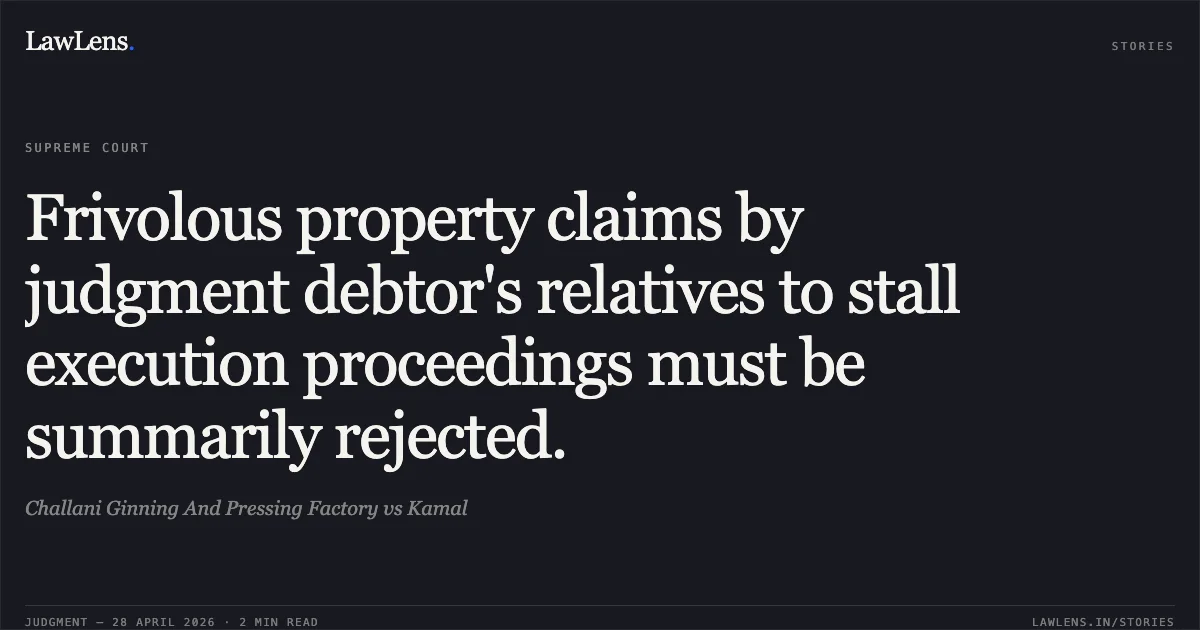
Source reference: p. 6-7The Supreme Court determined that the objection was a "deliberate attempt to stall recovery" after previous attempts by the JD-1 and his assignees had failed
Source reference: p. 7Since there was no prima facie evidence to substantiate the co-ownership claim and the facts demonstrated the respondent’s prior knowledge through her directorship, the Execution Court was correct in declining the objection without a full trial
Source reference: p. 7-8Holding
The Supreme Court allowed the appeal and set aside the High Court’s order, restoring the orders of the Executing Court and the First Appellate Court
The Court held that the objection was a frivolous attempt to frustrate the decree. It directed that the property be expeditiously vacated and handed over to the appellant/decree-holder
Source reference: p. 8Original Court PDF
Challani Ginning And Pressing FactoryvsKamal
Click to open original judgment
Original judgment, available to read, download and summarize on LawLens.in