01Facts
The petitioner, a proprietary concern, filed a writ petition under Article 226 of the Constitution of India challenging the freezing/holding of its bank account by HDFC Bank (Respondent No. 1).
¶ 1The petitioner sought a declaration that the freezing was illegal and arbitrary, and requested compensation for financial hardship.
¶ 1The petitioner contended that the matter was squarely covered by the precedent in Malcolm Murayis & Ors. v. State Bank of India and Others (W.P. No. 1100 of 2024), where bank accounts were frozen by authorities based on cyber cell intimations alleging cyber fraud without proper notice to the account holders or compliance with statutory seizure procedures.
¶ 2, 3(3), and 3(4)02Issues
i.1. Whether the continued freezing of the petitioner’s bank account by the respondent bank, acting on the instructions of investigating agencies, is legally sustainable.
¶ 1ii.2. Whether the petitioner is entitled to operate the account subject to safeguards regarding the specific disputed amounts allegedly linked to cybercrime.
¶ 3(9) and 503Law Applied
Article 226 of the Constitution of India regarding the protection of fundamental rights against arbitrary state action.
¶ 1Procedural requirements of Section 102 of the Code of Criminal Procedure (Cr.P.C.)—and its successor provisions under the Bharatiya Nagarik Suraksha Sanhita (BNSS)—which mandate that investigating agencies inform the concerned Magistrate regarding the seizure of property.
¶ 3(4) and 5The precedent established in Malcolm Murayis & Ors. v. State Bank of India and Others, which balances the interests of investigation with the account holder's right to operate their account by segregating disputed funds into fixed deposits.
¶ 2, 3(9)Provisions in the judgment · 1 · Linked ones open on LawLens
Code of Criminal Procedure, 1973 Section 102
04Reasoning
The court observed that the facts and grievances in the present case were identical to those in the Malcolm Murayis case, where cyber crime cells directed banks to freeze accounts via email but frequently failed to respond to judicial notices or follow the mandate of Section 102 Cr.P.C.
¶ 3(8) and 4The court noted that such "irresponsible approach[es]" by investigating agencies caused undue hardship to legitimate business operations.
¶ 3(8)The court determined that the principle of mutatis mutandis applied.
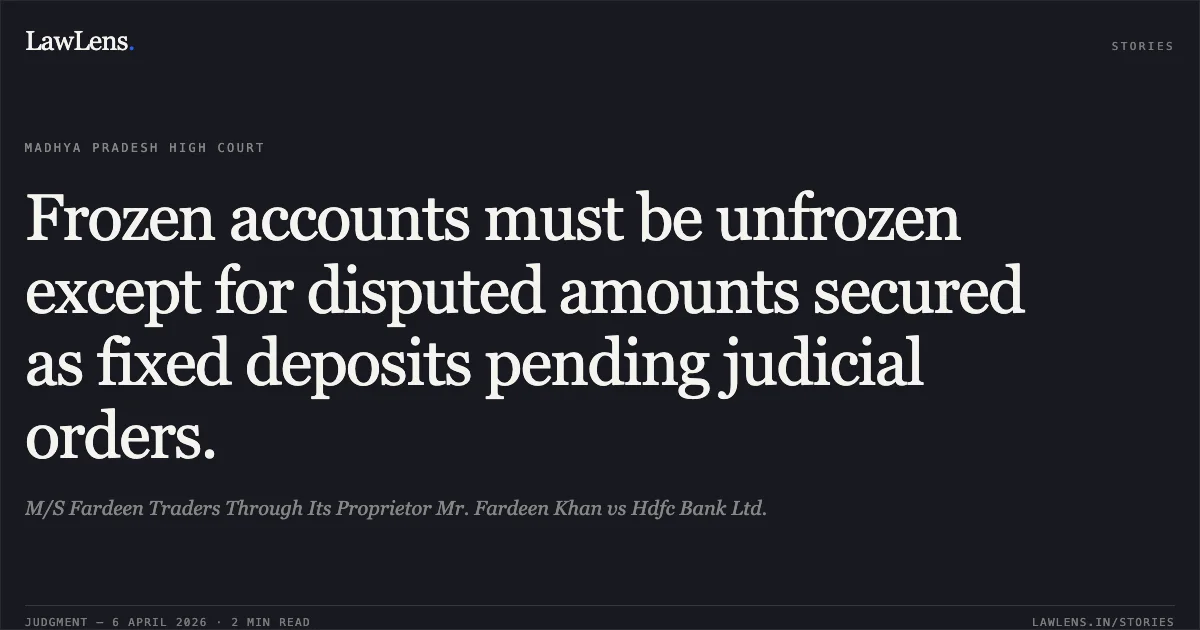
¶ 4It reasoned that the disputed amount (the specific sum alleged to be the proceeds of crime) should be secured in a fixed deposit to protect the integrity of the investigation, while the remainder of the account should be unfrozen to allow the petitioner to exercise their financial rights.
¶ 3(9) and 505Holding
The High Court allowed the petition in part and directed the respondent bank to unfreeze the petitioner’s bank account.
¶ 5The bank was ordered to keep only the specific "disputed amount," as identified by the crime agencies, in a fixed deposit.
¶ 5The court held that these funds may only be liquidated upon an order from a competent Judicial Magistrate.
¶ 5The court imposed a three-month deadline for the police agency to proceed in accordance with the law (BNSS/Cr.P.C.), failing which the petitioner is entitled to withdraw the amount kept in the fixed deposit under intimation to the agency.
¶ 5Original Court PDF
M/S Fardeen Traders Through Its Proprietor Mr. Fardeen KhanvsHdfc Bank Ltd.
Click to open original judgment
Original judgment, available to read, download and summarize on LawLens.in