Facts
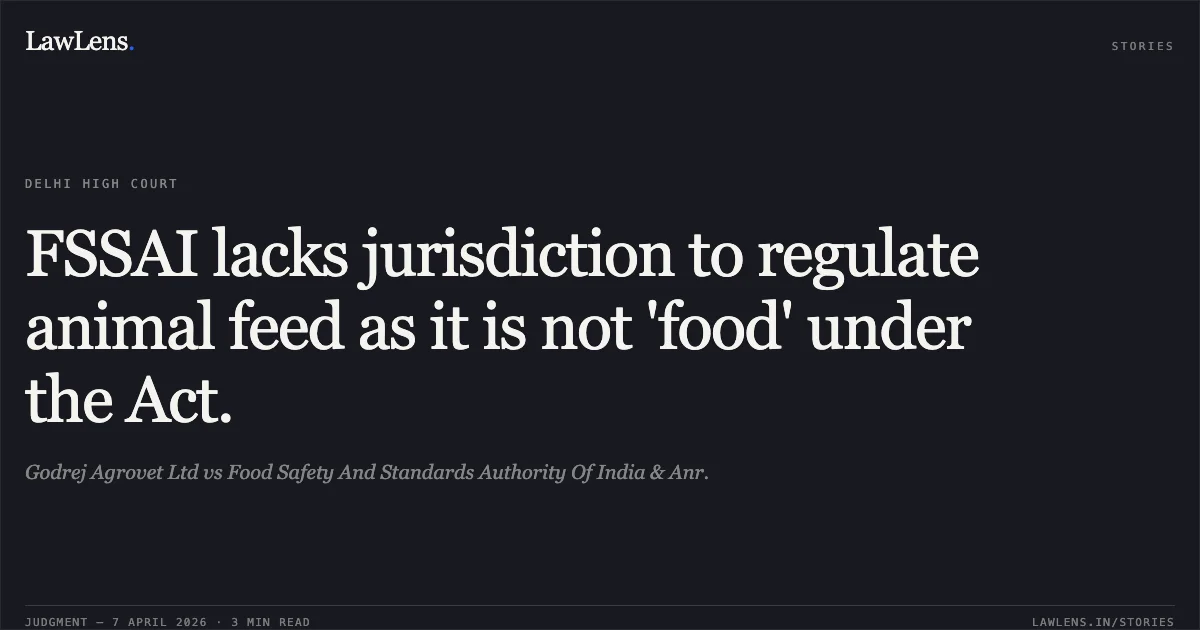
The Petitioner, a manufacturer of animal and cattle feed, challenged the validity of Note (c) appended to Regulation 2.5.2 of the Food Safety and Standards (Food Products Standards and Food Additives) Regulations, 2011, as amended in 2021.
Source reference: paras. 1-2The impugned Note (c) prohibited feeding meat or bone meal to milk and meat-producing animals and mandated that commercial feeds comply with Bureau of Indian Standards (BIS) standards and carry the BIS certification mark.
Source reference: para. 3Additionally, the Petitioner challenged three directions issued by the Food Safety and Standards Authority of India (FSSAI) under Section 16(5) of the Food Safety and Standards Act, 2006 (“Act, 2006”), which enforced mandatory BIS certification for cattle feed.
Source reference: paras. 6-7The Petitioner contended that the FSSAI lacks jurisdiction to regulate animal feed, as the Act, 2006 is limited to food for human consumption.
Source reference: para. 10Issues
1. Whether Note (c) of Regulation 2.5.2 and the subsequent FSSAI directions are ultra vires the FSS Act, 2006, by attempting to regulate animal feed.
Source reference: para. 372. Whether the Food Authority is competent to mandate BIS standards for cattle feed in the absence of a Central Government notification under Section 16 of the BIS Act, 2016.
Source reference: paras. 25-263. Whether the regulation of livestock feed falls within the exclusive legislative competence of the State under Entry 15 of List II of the Seventh Schedule.
Source reference: para. 29Law Applied
Section 3(1)(j) of the FSS Act, 2006, which defines “food” as substances intended for human consumption and explicitly excludes “animal feed”.
Source reference: para. 48Section 92, which limits the Food Authority’s regulation-making power to matters consistent with the Act.
Source reference: para. 54Principles from State of Tamil Nadu v. P. Krishnamurthy, establishing that subordinate legislation must conform to the parent statute.
Source reference: para. 38Naresh Chandra Agrawal v. ICAI, which clarifies the “generality versus enumeration” principle.
Source reference: para. 44Rule 24 of the BIS Rules, 2018, which stipulates that Indian Standards are voluntary unless made mandatory by a specific Government order or legislation.
Source reference: para. 51Reasoning
The Court reasoned that the FSS Act’s long title and statutory definitions, particularly Section 3(1)(j), limit the FSSAI’s jurisdiction to "food for human consumption".
Source reference: paras. 48-49Since the definition of "food" expressly excludes animal feed, any attempt by the FSSAI to regulate cattle feed through Note (c) travels beyond the scope of the parent Act.
Source reference: para. 56The Court rejected the FSSAI's reliance on Section 92(1) (general regulation-making power), noting that even general powers must be exercised to "carry out the provisions of the Act," which do not include animal feed.
Source reference: para. 63The Court found that the FSSAI bypassed the BIS Act, 2016; under the BIS framework, standards are voluntary unless the Central Government issues a notification under Section 16 of the BIS Act.
Source reference: paras. 50, 57The FSSAI could not use its own regulations to make voluntary BIS standards mandatory for a product it has no authority to regulate.
Source reference: para. 59The Court noted that the FSSAI itself had previously acknowledged the need for statutory amendments to regulate feed, yet proceeded without them.
Source reference: para. 67Holding
The Court allowed the writ petition, holding that the impugned Note (c) and the directions dated 10.12.2019, 27.01.2020, and 01.01.2021 are ultra vires the FSS Act, 2006.
The Court quashed Note (c) appended to Regulation 2.5.2 and all three impugned FSSAI directives.
Source reference: para. 71While the Court clarified that BIS standards can be made mandatory for commercial feeds, such recourse must be taken by the Central Government through the proper channels of the BIS Act, 2016, and not via the FSSAI.
Source reference: para. 69No orders were made as to costs.
Source reference: para. 73Acts & Sections Cited
32 provisions across 3 statutes referred to in this judgment. Each provision opens on LawLens.
Food Safety and Standards Act, 2006
Bureau of Indian Standards Act, 2016.6
General Clauses Act, 18971
Original Court PDF
Godrej Agrovet LtdvsFood Safety And Standards Authority Of India & Anr.
Click to open original judgment
Original judgment, available to read, download and summarize on LawLens.in