Facts
The Appellant-wife and Respondent-husband dissolved their marriage by mutual consent via a decree dated 29.08.2015 based on a Settlement Petition
Source reference: p. 2Clauses 8 and 10 of the settlement mandated a lump-sum payment of Rs. 2.20 Crores by the Respondent for the minor son’s maintenance, while Clause 9 required payment of 20% of the Respondent's annual income for the same purpose
Source reference: p. 3-4The Respondent paid the full lump-sum amount by 28.07.2017
Source reference: p. 4, para. 5In 2022, the Appellant filed an Execution Petition seeking enforcement of Clause 9 (20% annual income), which the Family Court dismissed, holding that Clause 9 became inoperative upon payment of the lump sum under Clause 10
Source reference: p. 4-5The High Court of Karnataka affirmed this dismissal, noting the Appellant’s five-year silence as conduct indicating Clause 9 was intended to be interim
Source reference: p. 6, para. 9Issues
1. Whether Clause 9 of the Settlement Petition constitutes an independent and continuing obligation surviving the lump-sum payments made under Clauses 8 and 10
Source reference: p. 17, para. 232. Whether the concurrent findings of the Family Court and High Court warrant interference under Article 136 of the Constitution of India
Source reference: p. 17, para. 23Law Applied
The Court applied the principle that an executing court cannot go behind the decree and must execute it as it stands
Source reference: p. 18, para. 24It utilized the "harmonious construction" canon, which mandates that an instrument be read as a whole to avoid rendering any clause redundant or surplusage
Source reference: p. 8, para. 13; p. 19, para. 26The court also applied Article 136 of the Constitution regarding the limited scope of interference in concurrent findings of fact unless they are perverse or manifestly erroneous
Source reference: p. 15, para. 20; p. 25, para. 33Article 142 pertaining to the Court's power to do complete justice, noting it cannot be used to supplant a concluded consensual arrangement
Source reference: p. 26-27, para. 34Reasoning
The Court found no repugnancy between Clauses 8, 9, and 10, viewing them as a "single interlocking arrangement"
Source reference: p. 19, para. 26Clause 8 established the total quantum, Clause 9 acted as an interim/transitional mechanism while the Respondent liquidated assets, and Clause 10 served as a discharge provision stating the Respondent "need not pay any further amount" once the first Rs. 1 Crore of the lump sum was paid
Source reference: p. 18-19To interpret Clause 9 as a perpetual obligation would render the discharge language in Clause 10 "entirely futile"
Source reference: p. 12, para. 17; p. 19, para. 26Furthermore, the conduct of the parties supported this: the Appellant raised no demand for 20% of the income for nearly five years after the final lump-sum installment, despite being meticulous in other financial demands
Source reference: p. 21, para. 28The Court held that the restructuring of the agreement from the 2013 joint application (periodic only) to the 2015 petition (capital settlement) showed a clear intent for finality
Source reference: p. 20, para. 27Holding
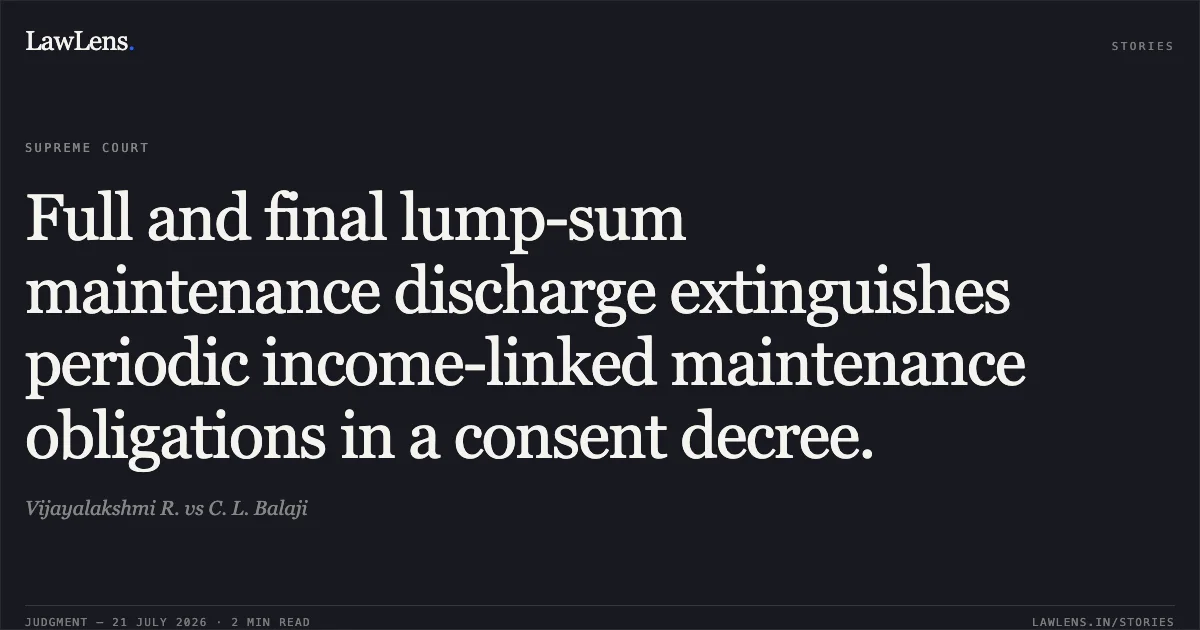
The Supreme Court dismissed the appeal, holding that Clause 9 was an interim obligation that ceased upon payment of the amounts under Clauses 8 and 10
The Court declined to exercise powers under Article 142 to create a new educational corpus. However, it recorded and accepted the Respondent's voluntary relinquishment of Rs. 1,00,00,000/- (transferred during proceedings) to be used exclusively for the son’s higher education, clarifying this was a voluntary act of paternal concern rather than a legal liability
Source reference: p. 26, para. 34; p. 27-30, para. 35, 40-41Acts & Sections Cited
4 provisions across 3 statutes referred to in this judgment. Each provision opens on LawLens.
Family Courts Act, 19841
Code of Civil Procedure, 19082
Limitation Act, 19631
Original Court PDF
Vijayalakshmi R.vsC. L. Balaji
Click to open original judgment
Original judgment, available to read, download and summarize on LawLens.in