Facts
The Tamil Nadu Slum Clearance Board (now the Tamil Nadu Urban Habitat Development Board) allotted Plot No. 150 in its approved “Chelliamman Nagar” layout to A.R. Farida under a lease-cum-sale agreement. Farida paid the full consideration, took possession, and built and occupied a house on the plot.
Source reference: p.3, para. 2.1After the State required the land for a Railway Over Bridge project, the District Collector offered her an alternative site, which she did not take possession of; Farida later died.
Source reference: p.4, para. 2.2Her legal heirs sought monetary compensation, but the Special Tahsildar rejected the request, citing the land’s classification as “Eri Ulvai” and the absence of a final sale deed.
Source reference: p.4, para. 2.3The Single Judge quashed that rejection and directed compensation. The State authorities appealed.
Source reference: pp. 3–4, paras. 1–2.3Issues
1. Whether Farida’s legal heirs were entitled to monetary compensation for Plot No. 150 despite the absence of a final sale deed and the State’s contention that the land was watercourse poramboke.
Source reference: pp. 4–7, paras. 2.3, 3–72. Whether the State could rely on documents and factual grounds first presented in the intra-court appeal to challenge the Single Judge’s decision.
Source reference: pp. 7–10, paras. 8–12Law Applied
Under Clause 15 of the Letters Patent, an intra-court appeal enables the appellate Bench to review and correct the Single Judge’s decision on the material presented to that court; it is not an opportunity to construct a new factual case.
Source reference: p.7, paras. 9–10In Baddula Lakshmaiah v. Sri Anjaneya Swami Temple, (1996) 3 SCC 52, the Supreme Court characterised a Letters Patent appeal as an intra-court appeal in which the Bench acts as a “Court of Correction”.
Source reference: p.7, para. 9Under Order XLI Rule 27 of the Code of Civil Procedure, additional evidence may be admitted only in exceptional circumstances and at the court’s discretion; it should not ordinarily be used to enable a party to raise a new point or remedy a failure to discharge its burden. The Court applied these principles from Union of India v. Ibrahim Uddin, (2012) 8 SCC 148.
Source reference: pp. 8–9, para. 11Reasoning
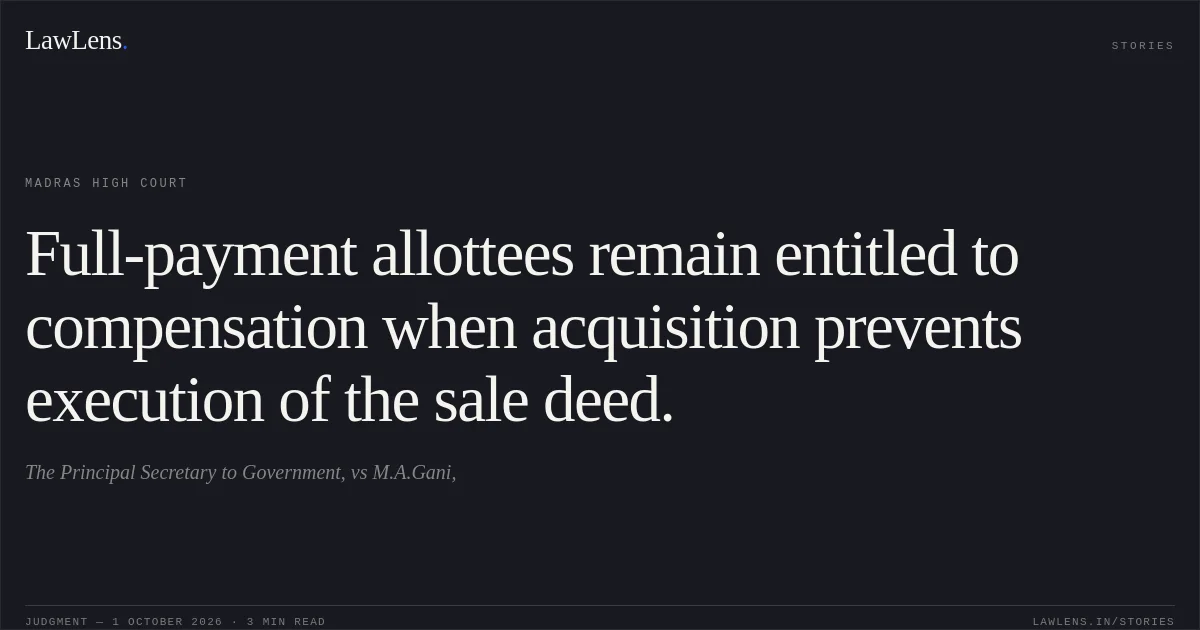
The Housing Board had acknowledged before the Single Judge that it received the full sale consideration and was to execute a sale deed, but the State’s acquisition of the land prevented execution.
Source reference: p.6, paras. 6–7The Court held that the State could not rely on its own administrative delay in completing the transfer to deny compensation to the allottee’s heirs, who had paid the full price to a statutory board.
Source reference: p.6, para. 7The State’s additional documents concerning the alternative site and patta had existed before the writ petition was decided but were not presented to the Single Judge; the appellate Bench therefore declined to allow them to form the basis of a new factual case.
Source reference: pp. 7–10, paras. 8–12The Court also noted that compensation had been paid for adjoining Plot No. 149 in the same layout and considered different treatment of Plot No. 150 unfair and discriminatory.
Source reference: p.10, para. 13Holding
The Court answered the compensation issue in favour of the legal heirs and rejected the State’s appeal. It affirmed the Single Judge’s order and directed the appellants to calculate and disburse compensation for Plot No. 150 to respondents 1 and 2 within eight weeks of receiving a copy of the judgment.
No costs were awarded.
Source reference: p.10, para. 14Original Court PDF
The Principal Secretary to Government,vsM.A.Gani,
Click to open original judgment
Original judgment, available to read, download and summarize on LawLens.in