Facts
The Appellant, a 38-year-old skilled carpenter, suffered a vehicular accident on November 9, 2004, when a Jeep driven rashly on the wrong side of the road collided with his motorcycle
Source reference: para. 3The injuries necessitated the amputation of his right leg above the knee
Source reference: para. 3.1He filed a claim seeking ₹18,50,000
Source reference: para. 3.1.1The Motor Accident Claims Tribunal (MACT) awarded ₹4,77,823 with 4% interest
Source reference: para. 3.1.1On appeal, the High Court of Uttarakhand enhanced the compensation to ₹11,51,423 with 6% interest, assessing his monthly income at ₹5,000 and disability at 70%
Source reference: para. 3.2The Appellant approached the Supreme Court seeking further enhancement, arguing his functional disability is 100% due to his vocation
Source reference: para. 4Issues
1. Whether the notional income of a skilled worker (carpenter) should be assessed higher than minimum wages for the purpose of compensation
Source reference: para. 5.32. Whether a 70% medical disability translates to 100% functional disability given the nature of the claimant’s occupation
Source reference: para. 5.7.43. Whether the claimant is entitled to separate pecuniary damages for the procurement and maintenance of a prosthetic limb
Source reference: para. 5.9.3Law Applied
The Court applied the principles of "just compensation" as outlined in Jagdish v. Mohan, which mandates covering pain, loss of future income, and medical expenses
Source reference: para. 5.1.1It relied on Raj Kumar v. Ajay Kumar to distinguish between physical impairment and loss of earning capacity
Source reference: para. 5.5.3Regarding skilled labor, the Court cited Karamjit Singh v. Amandeep Singh, classifying carpentry as a trade requiring manual dexterity and precision
Source reference: para. 5.2.3Future prospects were calculated as per the 40% addition rule in National Insurance Co. Ltd. v. Pranay Sethi
Source reference: para. 6The multiplier was determined using the table in Sarla Verma v. D.T.C.
Source reference: para. 5.4Reasoning
The Court reasoned that the High Court erred in assessing income at only ₹5,000, noting that as a skilled artisan, the Appellant’s unrefuted claim of higher earnings warranted a notional income of ₹9,000 per month
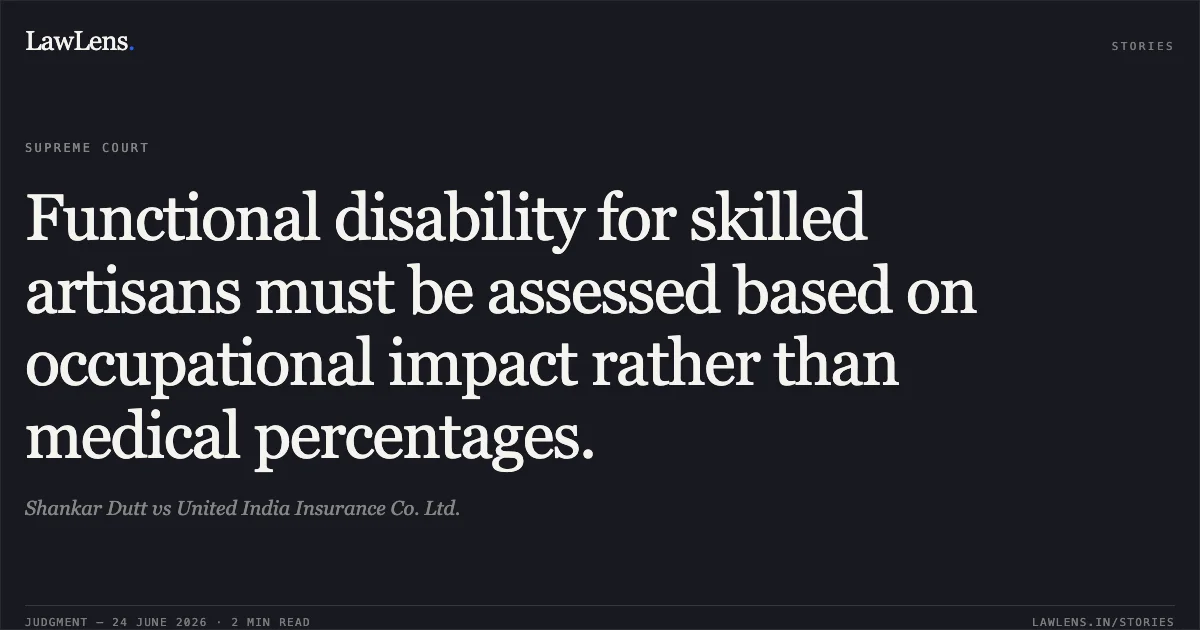
Source reference: para. 5.3.2On disability, the Court held that while the medical certificate stated 70%, the "functional disability" must be assessed relative to the claimant’s vocation
Source reference: para. 5.6.3Since a carpenter must sit cross-legged or stand with stability—actions now impossible for the Appellant—his earning capacity is effectively 100% destroyed
Source reference: para. 5.7.6Furthermore, the Court observed that a prosthetic limb is not a one-time expense; it requires periodic replacement (estimated 6 times over the claimant’s life) and bi-annual maintenance, necessitating a specific pecuniary award under "Future Medical Expenses"
Source reference: para. 5.9.2, 5.9.3Holding
The Court held that the Appellant's functional disability is 100% and his monthly income is ₹9,000
The Supreme Court allowed the appeal and enhanced the total compensation to ₹35,95,923, awarding ₹22,68,000 for loss of future earnings, ₹10,00,000 for the prosthetic leg and its maintenance, and various amounts for pain and suffering, loss of amenities, and attendant charges
Source reference: para. 7.1The Respondent Insurance Company was directed to deposit the balance amount with 6% per annum interest from the date of the claim petition within six weeks
Source reference: para. 8, 10Acts & Sections Cited
1 provisions across 1 statute referred to in this judgment. Each provision opens on LawLens.
Motor Vehicles Act, 19881
Original Court PDF
Shankar DuttvsUnited India Insurance Co. Ltd.
Click to open original judgment
Original judgment, available to read, download and summarize on LawLens.in