Facts
On February 27, 2001, the appellant, a truck driver, was changing a tyre on the roadside when a luxury bus driven by respondent no. 1 at excessive speed dashed into the truck from behind
Source reference: p. 1-2The bus rolled over the appellant’s leg, resulting in grievous injuries and the subsequent amputation of his right leg
Source reference: p. 2The Motor Accident Claims Tribunal (MACT), Vadodara, awarded Rs. 4,25,974/- in compensation, assuming a monthly income of Rs. 2,100/- and assessing functional disability at 80%, while also deducting 10% for self-negligence
Source reference: p. 1The appellant challenged the award seeking enhancement of the quantum
Source reference: p. 2Issues
1. Whether the learned Tribunal erred in assessing the appellant’s monthly income at Rs. 2,100/- in absence of cogent evidence, given his profession as a heavy vehicle driver.
Source reference: p. 5, para 132. Whether the functional disability should be assessed at 100% due to the amputation of a limb in a profession requiring physical operation of a vehicle.
Source reference: p. 6, para 14-153. Whether the appellant is entitled to compensation for the cost of an artificial limb and future medical maintenance despite not providing specific invoices.
Source reference: p. 9, para 21-22Law Applied
The court applied Section 166 of the Motor Vehicles Act regarding just compensation.
Source reference: p. 3, 5It relied on Minu Rout v. Satya Pradyumna Mohapatra (2013) to benchmark a driver’s monthly income at Rs. 6,000/-
Source reference: p. 3, 5It applied National Insurance Co. Ltd. v. Pranay Sethi (2017) and Sidram v. Divisional Manager, United India Insurance (2022) to grant 25% future prospects for a 47-year-old
Source reference: p. 3, 6Following Raj Kumar v. Ajay Kumar (2011), the court held that functional disability must reflect the loss of earning capacity specifically relative to the claimant's vocation
Source reference: p. 6Finally, it specialized in Mohd. Sabeer @ Shabir Hussain v. Regional Manager, UPSRTC (2023) to award damages for artificial limbs and pain and suffering
Source reference: p. 4, 8-9Reasoning
The Court found the Tribunal’s assessment of income (Rs. 2,100/-) too low, as the appellant held a valid heavy vehicle license; thus, following Minu Rout, it was reassessed to Rs. 6,000/-
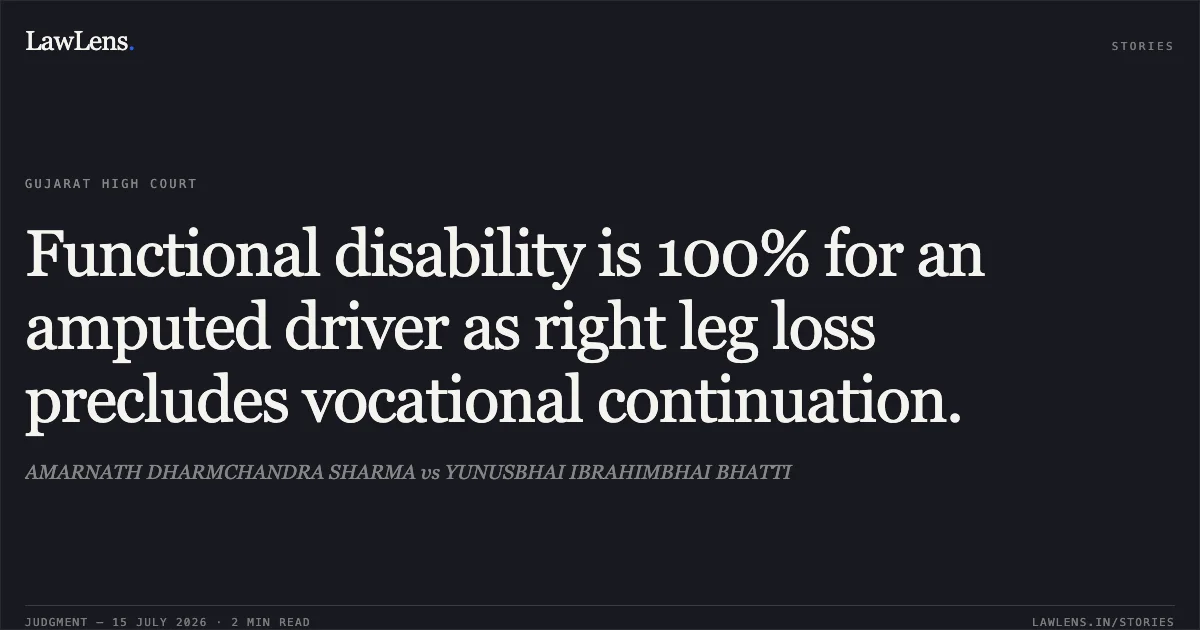
Source reference: p. 5Regarding disability, the Court determined that while physical disability was 80%, the functional disability for a driver with an amputated leg is 100% because he cannot drive a truck
Source reference: para 15The Court rejected the Insurance Company's argument that the lack of receipts for an artificial limb precluded compensation, ruling that "ground realities" dictate an amputee requires either a limb or a full-time attendant to lead a normal life
Source reference: p. 9-10Consequently, it enhanced the multiplier-based future loss and awarded substantial sums for pain, suffering, and loss of amenities based on the severity of the permanent impairment
Source reference: p. 8-9Holding
The Court held that the appellant’s net compensation, after a 10% deduction for negligence, totals Rs. 19,50,840/-
The Court partly allowed the appeal, significantly increasing the compensation, granting an additional amount of Rs. 15,24,866/- over the original award, carrying interest at 9% per annum from the date of the claim petition, and directed the Insurance Company to deposit the additional amount within six weeks
Source reference: p. 11Acts & Sections Cited
1 provisions across 1 statute referred to in this judgment. Each provision opens on LawLens.
Motor Vehicles Act, 19881
Original Court PDF
AMARNATH DHARMCHANDRA SHARMAvsYUNUSBHAI IBRAHIMBHAI BHATTI
Click to open original judgment
Original judgment, available to read, download and summarize on LawLens.in