Facts
On August 29, 2016, Petitioner No. 1 (rider) and Petitioner No. 2 (pillion) were on a motorcycle when they were hit by a rashly driven private bus.
Source reference: p. 4, para. 4Both sustained multiple fractures and underwent surgeries involving long-term hospitalization.
Source reference: p. 5, paras. 5.1-6.1Both were employed as masons/coolies.
Source reference: p. 5, paras. 6.1-6.2The Motor Accident Claims Tribunal (MACT) awarded compensation by calculating loss of future income by taking only 1/3rd of the whole-body disability assessed by the doctor.
Source reference: p. 8-11, paras. 11-12.2The Appellants/Claimants challenged the common judgment seeking enhancement of compensation, arguing the functional disability for manual laborers should be higher.
Source reference: p. 13, para. 14Issues
1. Whether the compensation awarded under the head of 'loss of future income due to disability' was calculated in accordance with law or requires interference based on the functional disability of the claimants.
Source reference: p. 14, para. 16Law Applied
Section 166 of the Motor Vehicles Act, 1988, regarding claim petitions for compensation.
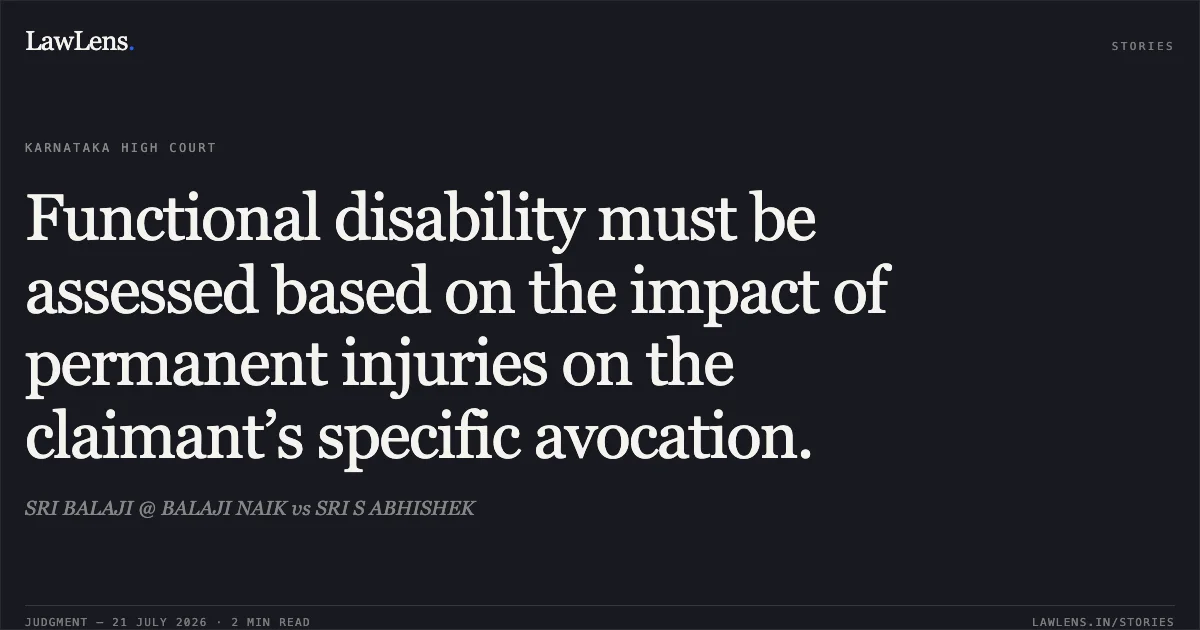
Source reference: p. 5, para. 6The Court relied extensively on the principles established in Raj Kumar v. Ajay Kumar and Another (2011) 1 SCC 343, which distinguishes between permanent physical disability and the resulting "loss of earning capacity" (functional disability), mandating that Tribunals assess how an injury specifically impacts a claimant’s ability to perform their particular avocation.
Source reference: p. 23-27, para. 20The Court also referenced Syed Sadiq v. Divisional Manager, United India Insurance Co. Ltd. regarding the use of notional income charts for manual laborers.
Source reference: p. 13, para. 14.1Reasoning
The Court observed that the Tribunal erred by mechanically reducing the medical disability to 1/3rd to arrive at the whole-body disability without considering the claimants' profession.
Source reference: p. 27, para. 21Applying Raj Kumar, the Court held that since both claimants were masons (manual laborers), injuries to their dominant right limbs significantly destroyed their earning capacity.
Source reference: p. 27-28, paras. 21-22For Petitioner No. 1, despite 41% whole-body medical disability, the Court assessed functional disability at 75% because his arm was "dangling," making manual labor impossible.
Source reference: p. 28, para. 22For Petitioner No. 2, the Court assessed functional disability at 50%, noting that while he couldn't perform construction work, he might perform other lesser physical tasks.
Source reference: p. 29, para. 24The Court also updated the notional monthly income to ₹9,500 in accordance with the 2016 Karnataka State Legal Services Authority chart.
Source reference: p. 28, para. 23Holding
The Court answered the issue in the affirmative, holding that the Tribunal failed to properly assess functional disability.
The High Court modified the award as follows: Petitioner No. 1’s compensation was enhanced from ₹7,03,931 to ₹16,55,031.
Source reference: p. 29, para. 23.2Petitioner No. 2’s compensation was enhanced from ₹4,32,250 to ₹11,79,310.
Source reference: p. 30, para. 24.1Both amounts carry interest at 9% per annum from the date of the petition.
Source reference: p. 30-31, para. 25-26The Respondent/Insurance Company was directed to deposit the enhanced amount within eight weeks.
Source reference: p. 31, para. 26(iv)Acts & Sections Cited
2 provisions across 1 statute referred to in this judgment. Each provision opens on LawLens.
Motor Vehicles Act, 19882
Original Court PDF
SRI BALAJI @ BALAJI NAIKvsSRI S ABHISHEK
Click to open original judgment
Original judgment, available to read, download and summarize on LawLens.in