Facts
The appellant, Manappa, was travelling as a pillion rider on motorcycle No. KA-33-L-6553 on 25 July 2019 when it was struck from behind by motorcycle No. KA-37-M-9758 near Tintani Bridge, allegedly due to rash and negligent riding.
Source reference: paras. 3–5He sustained cervical-spine and other injuries, underwent treatment, and claimed compensation of ₹33,50,000 under the Motor Vehicles Act.
Source reference: paras. 3–5The Tribunal held that the accident resulted from composite negligence, attributing 75% negligence to the rider of the offending vehicle and 25% to the rider of the motorcycle on which the appellant was travelling.
Source reference: para. 9It awarded ₹2,30,849 with 6% interest and directed the insurer of the offending vehicle to pay the amount with liberty to recover 25% from the owner/rider of the other motorcycle.
Source reference: paras. 17, 20–21The appellant challenged the apportionment of negligence and the Tribunal’s assessment of whole-body disability at 8%, seeking enhancement.
Source reference: para. 10Issues
1. Whether the appellant could urge before the High Court that the Tribunal wrongly apportioned negligence at 75% against the rider of the offending vehicle and 25% against the rider of the motorcycle carrying the appellant, despite the ground not being specifically pleaded in the memorandum of appeal.
Source reference: paras. 10–142. Whether the Tribunal was justified in attributing 25% contributory negligence to the rider of the motorcycle on which the appellant was travelling.
Source reference: paras. 15–173. Whether respondent No. 4, the insurer of the motorcycle carrying the appellant, was liable to satisfy the award despite the insurance policy having expired before the accident.
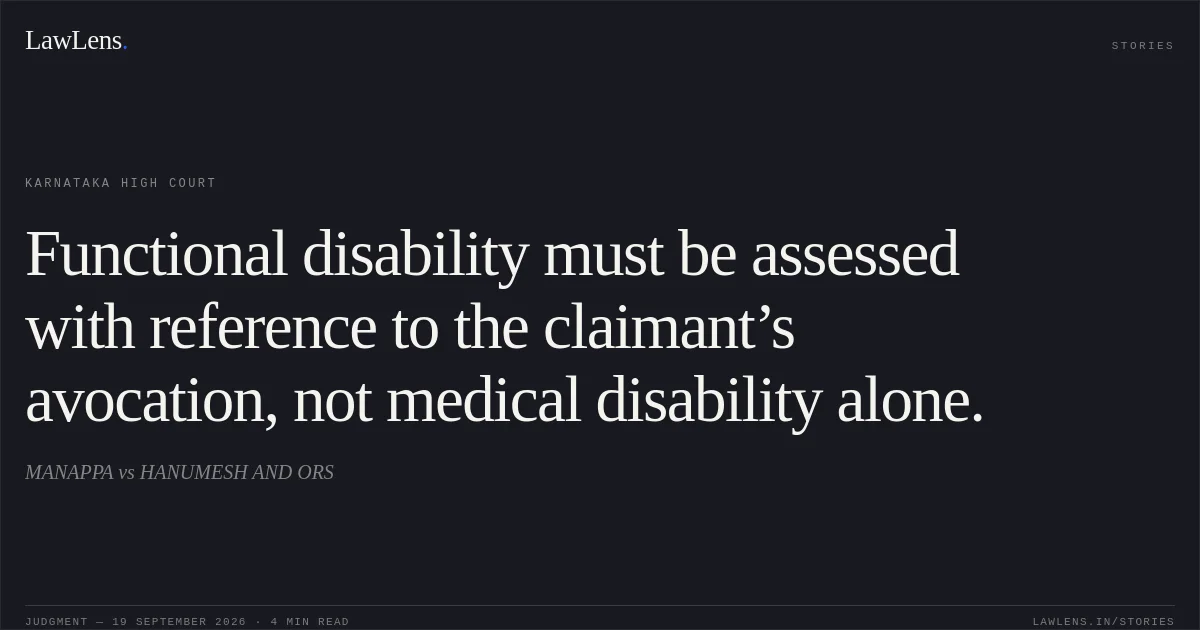
Source reference: paras. 18–194. Whether the Tribunal erred in reducing the doctor’s assessment of 18% whole-body disability to 8%, and what percentage of functional disability was appropriate having regard to the appellant’s avocation as an agriculturist.
Source reference: paras. 22–32, 89–955. Whether the compensation awarded under loss of future earnings and non-pecuniary heads required enhancement.
Source reference: paras. 96–99Law Applied
The Court exercised appellate jurisdiction under Section 173(1) of the Motor Vehicles Act.
Source reference: cause titleOrder XLI Rule 2 of the Code of Civil Procedure ordinarily requires an appellant to confine arguments to the grounds in the memorandum of appeal, but permits an additional ground with the Court’s permission.
Source reference: para. 14Relying on Raj Rani v. Oriental Insurance Co. Ltd., 2009 ACJ 2003, the Court held that proceedings under the Motor Vehicles Act should not be approached hyper-technically and that relevant grounds may be considered to determine liability and just compensation.
Source reference: para. 14Under the principle in Khenyei v. New India Assurance Co. Ltd., (2015) 9 SCC 273, in a case of composite negligence, the claimant may recover the entire compensation from any one of the joint tortfeasors or their insurer, leaving the paying party to recover the appropriate share from the other tortfeasor.
Source reference: paras. 20–21Disability must be assessed with reference to the applicable Central Government Guidelines on evaluation of locomotor and orthopaedic disability, including comparison with normal range of movement and conversion of impairment into whole-body disability.
Source reference: paras. 22–31Medical disability must further be translated into functional disability by considering the claimant’s occupation and its effect on earning capacity.
Source reference: paras. 92–95Reasoning
The Court permitted consideration of the appellant’s challenge to the apportionment of negligence because the issue directly affected liability and compensation, and the Motor Vehicles Act requires a liberal rather than hyper-technical approach.
Source reference: para. 14The police sketch, FIR and charge-sheet showed that both motorcycles were travelling in the same direction and that the offending vehicle struck the motorcycle from behind; however, the evidence also indicated that the motorcycle carrying the appellant abruptly moved towards the right side.
Source reference: paras. 15–17The Court therefore upheld the Tribunal’s allocation of 75% negligence to the offending vehicle and 25% to the other motorcycle.
Source reference: paras. 15–17Since respondent No. 4’s policy had expired on 14 April 2019, whereas the accident occurred on 25 July 2019, that insurer was not liable.
Source reference: paras. 18–19On disability, the Court found that the doctor had recorded substantial restriction of neck and wrist movements, reduced muscle power, loss of prehension and difficulty in lifting heavy objects.
Source reference: paras. 34–45, 47, 54–89Although the Court’s indicative calculation produced a higher percentage, it accepted the expert’s assessment of 18% whole-body disability rather than the Tribunal’s unexplained reduction to 8%.
Source reference: paras. 34–45, 47, 54–89Considering that the appellant was an agriculturist and that the combined impairments affected his capacity to perform agricultural and other physical work, the Court assessed functional disability at 16%.
Source reference: paras. 92–95Applying a monthly income of ₹13,250, multiplier 11 and 16% disability, loss of future earnings was recalculated at ₹2,79,840.
Source reference: para. 96The amounts under pain and suffering, nourishment/conveyance/attendant charges and loss of amenities were also enhanced.
Source reference: paras. 97–99Holding
The appeal was partly allowed.
The finding of composite negligence in the ratio of 75:25 was affirmed, and respondent No. 2, the insurer of the offending vehicle, remained liable to deposit the entire compensation with liberty to recover 25% from the owner/rider of the other motorcycle; respondent No. 4 was held not liable because its policy had expired before the accident.
Source reference: paras. 17–21The total compensation was enhanced from ₹2,30,849 to ₹4,15,769, resulting in an enhanced amount of ₹1,84,920.
Source reference: para. 99The enhanced compensation was directed to carry interest at 6% per annum from the date of the claim petition until realization, and the insurer was directed to deposit it within six weeks of receiving the certified copy of the judgment.
Source reference: para. 100Acts & Sections Cited
1 provisions across 1 statute referred to in this judgment. Each provision opens on LawLens.
Motor Vehicles Act, 19881
Original Court PDF
MANAPPAvsHANUMESH AND ORS
Click to open original judgment
Original judgment, available to read, download and summarize on LawLens.in