Facts
The appellant-claimant filed a claim petition under Section 166 of the Motor Vehicles Act, 1988, arising from a road accident dated 21 January 2012 in which he sustained fractures to the right forearm, injuries to the right brachial plexus, scapula and first rib, vascular injuries, and consequential paralysis of the right upper limb.
Source reference: pp. 9–13He underwent several procedures, including fracture fixation, plastic surgery, and brachial plexus-related surgery, followed by prolonged treatment and hospitalization.
Source reference: pp. 10–13The claimant, aged approximately 30 years, asserted that he earned his livelihood through agricultural labour and animal husbandry, including the sale of milk.
Source reference: no citationThe Motor Accident Claims Tribunal, Mehsana, awarded Rs.9,46,000 with interest at 9% per annum by judgment dated 3 September 2014, assessing monthly income at Rs.5,000 and functional disability at 45% of the body as a whole.
Source reference: pp. 1, 4Aggrieved by the alleged inadequacy of compensation, the claimant preferred the present appeal under Section 173 of the Act seeking enhancement.
Source reference: p. 1Issues
Whether the Tribunal assessed the claimant’s income and future loss of earning capacity on an unduly low basis?
Source reference: paras. 3, 5–6; pp. 4, 8–9Whether the claimant’s permanent and functional disability ought to have been assessed at a higher percentage than 45% of the body as a whole?
Source reference: paras. 3, 5–6; pp. 4, 12–14Whether the compensation awarded under the heads of future loss of income, actual loss of income, pain and suffering, medical expenses, special diet and transportation, attendant charges, and loss of amenities required enhancement?
Source reference: paras. 7–12; pp. 14–17Law Applied
The Court applied Sections 166 and 173 of the Motor Vehicles Act, 1988, governing claims for compensation and appeals against awards of the Motor Accident Claims Tribunal.
Source reference: no citationUnder the principles stated in Raj Kumar v. Ajay Kumar, 2011 ACJ 1, physical disability affecting a particular limb must be evaluated in terms of its impact on the claimant’s actual earning capacity and functional disability, particularly with reference to his avocation.
Source reference: paras. 3.1, 6; pp. 6, 12–13Relying on National Insurance Co. Ltd. v. Pranay Sethi, (2017) 16 SCC 680, the Court held that future prospects or prospective rise in income may be considered while assessing future loss of income.
Source reference: p. 9Prahlad v. Jagatpal & Ors., 2026 ACJ 751, was relied upon in assessing the income of a person engaged in agriculture and dairy work in the absence of documentary proof.
Source reference: pp. 6, 8–9The Court also relied on Kajal for the principles governing attendant charges.
Source reference: p. 16In assessing functional disability, it additionally referred to Part II of Schedule I to the Employees’ Compensation Act, 1923, under which loss of a hand corresponds to 60% loss of earning capacity, while treating the claimant’s permanently paralysed dominant hand and physical occupation as warranting a higher functional assessment.
Source reference: p. 13Reasoning
The Court found that the claimant’s oral evidence, supported by witnesses who purchased milk from him and by evidence regarding his agricultural labour, justified increasing his monthly income from Rs.5,000 to Rs.7,500 despite the absence of documentary proof.
Source reference: p. 9Since the claimant was 30 years old, the Court added 40% towards future prospects, resulting in a prospective monthly income of Rs.10,500.
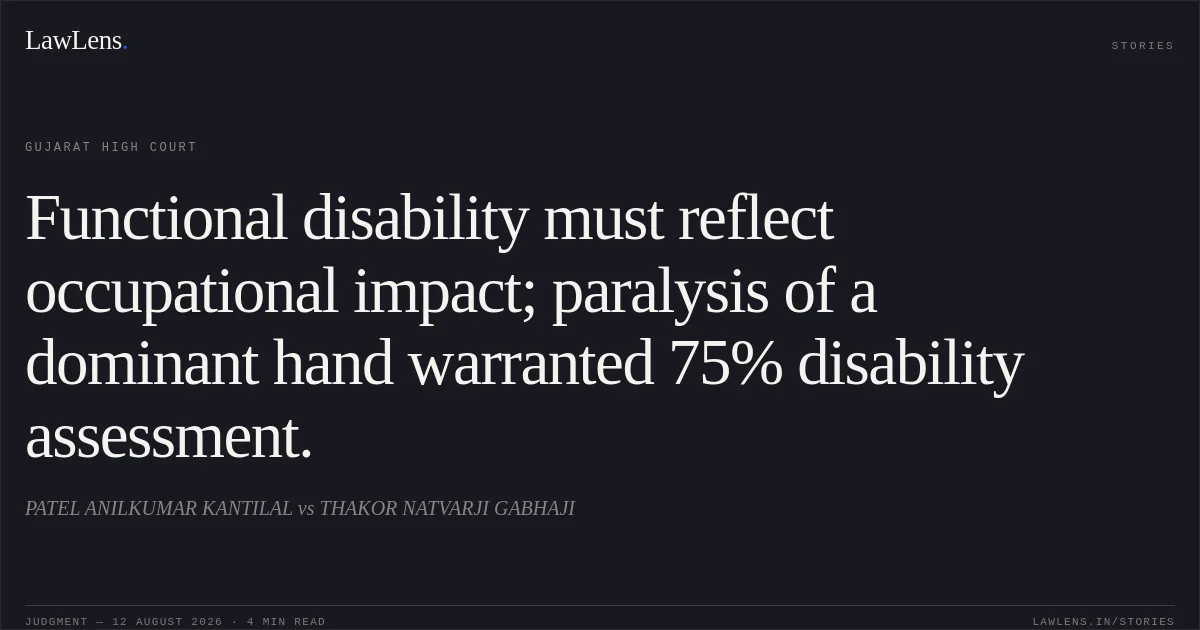
Source reference: p. 9The medical evidence established 90% disability of the right upper limb and permanent paralysis of the dominant hand.
Source reference: pp. 12–13Applying the functional-disability principles in Raj Kumar, the Court held that the injury substantially impaired the claimant’s ability to perform agricultural labour and animal-husbandry work, although it recognised that animal husbandry may involve the efforts of the entire family.
Source reference: p. 13It therefore assessed functional disability at 75% of the body as a whole, applied a multiplier of 16, and calculated future loss of income at Rs.15,12,000.
Source reference: p. 13The Court further enhanced compensation because of the claimant’s prolonged treatment, multiple surgeries, permanent paralysis, and loss of enjoyment of life.
Source reference: pp. 14–17It awarded Rs.90,000 for actual loss of income, Rs.3,00,000 for pain, shock and suffering, Rs.4,92,413 for medical expenses, Rs.50,000 for transportation and special diet, Rs.4,80,000 for attendant charges, and Rs.3,00,000 for loss of amenities.
Source reference: pp. 14–17Holding
The appeal was partly allowed.
The total compensation was enhanced from Rs.9,46,000 to Rs.32,24,413, resulting in an enhanced amount of Rs.22,78,413, with interest at 9% per annum from the date of filing of the claim petition until realization.
Source reference: paras. 12–13; pp. 17–18The respondents were directed to deposit the enhanced amount within eight weeks of receiving the judgment.
Source reference: para. 13; p. 18Upon deposit, the Tribunal was directed to release the amount to the claimant in accordance with the existing apportionment order, subject to verification and recovery of court fees, if applicable.
Source reference: para. 13; p. 18Acts & Sections Cited
2 provisions across 1 statute referred to in this judgment. Each provision opens on LawLens.
Motor Vehicles Act, 19882
Original Court PDF
PATEL ANILKUMAR KANTILALvsTHAKOR NATVARJI GABHAJI
Click to open original judgment
Original judgment, available to read, download and summarize on LawLens.in