01Facts
The Revenue appealed under Section 260A of the Income-tax Act, 1961, against the Income Tax Appellate Tribunal’s order for assessment year 2014–15
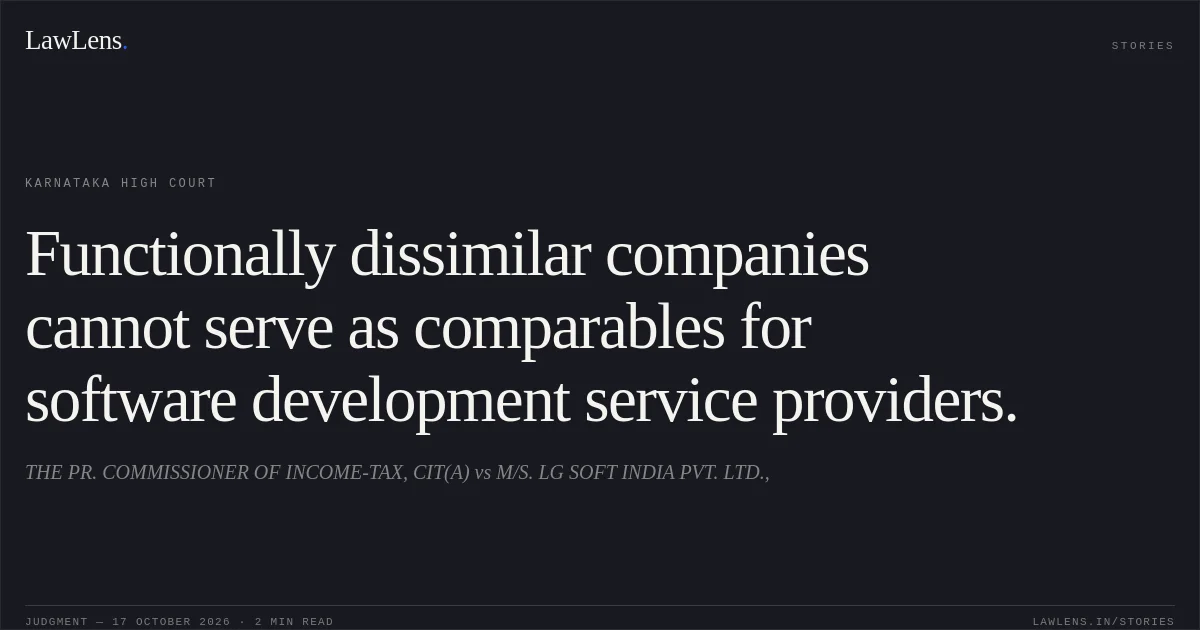
p. 2The Tribunal excluded Infosys Ltd., Persistent Systems Ltd. and Thirdware Solutions Ltd. as comparables, finding them functionally dissimilar to the assessee, a software development service provider; it restored the consideration of Cigniti Technologies Ltd. and SQS India BFSI Ltd. to the Transfer Pricing Officer (TPO)
pp. 6–8The High Court considered the appeal in light of its Coordinate Bench’s decision in SAP Labs India (P) Ltd.
pp. 3–602Issues
i.Whether, in applying the Transactional Net Margin Method (TNMM), the Tribunal was required to identify exactly comparable companies rather than companies with similar characteristics
pp. 2–3ii.Whether the Tribunal imposed a condition beyond the law by requiring exact comparability, when only differences likely to materially affect margins need be considered
p. 3iii.Whether the Tribunal failed to recognise that comparability analysis is not an exact science and that no two companies are identical
p. 303Law Applied
Section 260A of the Income-tax Act, 1961 provides for an appeal to the High Court on a substantial question of law.
p. 2Chapter X of the Act and Rule 10B of the Income-tax Rules govern the determination of the arm’s-length price and the comparability analysis; selection or exclusion of comparables is a factual, data-driven exercise that must conform to Rule 10B.
pp. 4–6Relying on SAP Labs India (P) Ltd. v. Income Tax Officer (ITA No. 10/2011 and connected appeals, judgment dated 28 August 2026), the Court stated that a TPO cannot reject a taxpayer’s comparables merely to substitute a standard departmental set, and that functional differences relevant to comparability must be assessed on the facts.
pp. 4–6Provisions in the judgment · 2
Income Tax Act, 1961 Section 260ASection 92C
04Reasoning
Applying SAP Labs, the Court treated the Tribunal’s comparability findings as factual and found no perversity warranting interference.
pp. 6–7Infosys had significant intangibles and substantial software-product revenue; Persistent Systems was engaged in product development and product-design services; and Thirdware Solutions was engaged in product development and earned revenue from licences and subscriptions. Those activities differed from the assessee’s software development services.
pp. 6–7The Court also noted that the three companies formed part of a standard departmental set of comparables, a practice disapproved in SAP Labs.
p. 7Because Cigniti Technologies and SQS India BFSI had been remitted to the TPO for fresh consideration, the Revenue was not aggrieved by that part of the Tribunal’s order.
p. 805Holding
The Court answered the admitted substantial questions of law in favour of the assessee and against the Revenue, applying its decision in SAP Labs.
p. 8It dismissed the Revenue’s appeal, leaving undisturbed the Tribunal’s exclusion of Infosys, Persistent Systems and Thirdware Solutions and its remittal of Cigniti Technologies and SQS India BFSI to the TPO.
pp. 7–8Original Court PDF
THE PR. COMMISSIONER OF INCOME-TAX, CIT(A)vsM/S. LG SOFT INDIA PVT. LTD.,
Click to open original judgment
Original judgment, available to read, download and summarize on LawLens.in