Facts
The petitioner, Shishir Kumar, challenged the initiation of Certificate Case No. 1 of 2016-17 pending before the District Certificate Officer, Vaishali.
Source reference: para. 1The recovery proceedings were initiated by the Zila Parishad, Vaishali, for the recovery of certain amounts advanced to the petitioner for executing schemes. The recovery was sought solely on the grounds that adjustment bills had not been submitted, without any formal finding of defalcation or misappropriation.
Source reference: para. 1(i)The petitioner filed an objection under Section 9 of the Bihar Public Demand Recovery Act, which was rejected by the District Certificate Officer on October 5, 2018.
Source reference: para. 1(ii)Issues
1. Whether an amount advanced for the execution of work, where an adjustment bill is pending, qualifies as "Public Demand" under Section 3(6) of the Bihar Public Demand Recovery Act.
Source reference: para. 1(i) and para. 42. Whether certificate proceedings can be initiated for the recovery of dues where the liability of the debtor is not predetermined or is in doubt.
Source reference: para. 7Law Applied
Section 3(6) of the Bihar Public Demand Recovery Act, which defines "Public Demand" as any money mentioned or referred to in Schedule I of the Act.
Source reference: para. 4Akhauri Bijoy Kumar Sinha v. State of Bihar (CWJC No. 4332 of 1995), which held that advances to employees for construction work do not constitute public demand unless specifically covered by Schedule I.
Source reference: para. 4Rabindra Nath Singh v. State of Bihar (2007 (1) PLJR 192), which clarified that Entry 8A of Schedule I (loans and advances) does not apply to funds given for official accounting purposes.
Source reference: para. 6Board's Instruction 10, asserting that certificate procedures are intended only for recovery of sums where the debtor's liability is beyond doubt.
Source reference: para. 7Reasoning
The court reasoned that for a recovery to be valid under the Act, the amount must strictly fall within one of the clauses of Schedule I; the respondents failed to demonstrate such coverage for work advances.
Source reference: para. 4Following the logic in Brij Mohan Prasad v. State of Bihar, the court noted that certificate proceedings are meant for recovering "ascertained dues" and not for determining liability like a Civil Court.
Source reference: para. 7The court observed that the petitioner was being held liable for an "assumed liability" regarding defalcation without a departmental proceeding to establish guilt or quantify the loss.
Source reference: para. 7Consequently, using the coercive machinery of the Public Demand Recovery Act (such as distress warrants) for unproven liabilities was deemed a violation of Articles 14, 21, and 300A of the Constitution.
Source reference: para. 6Holding
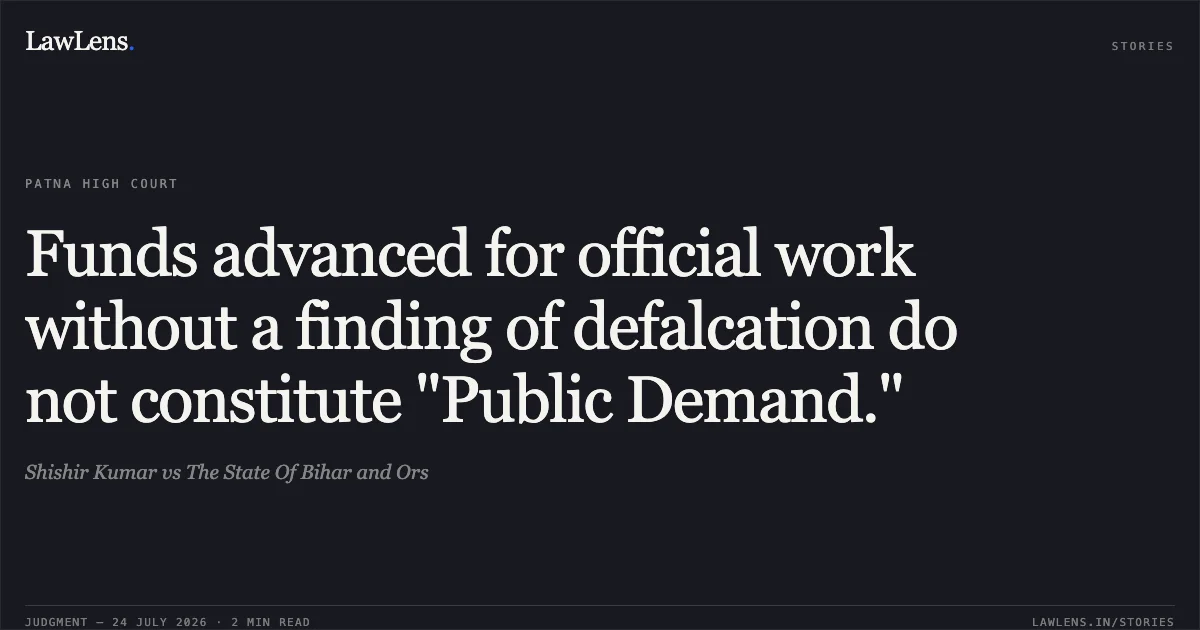
The court answered the issues in favor of the petitioner, holding that the amount sought was not a "public demand."
The Writ application was allowed, and the entire proceedings of Certificate Case No. 1 of 2016-17, including the requisition dated May 28, 2016, and the order dated October 5, 2018, were quashed; however, the quashing does not preclude the respondents from recovering any dues through other legal remedies available under the law.
Source reference: para. 8Acts & Sections Cited
5 provisions across 2 statutes referred to in this judgment. Linked provisions open on LawLens.
Bihar and Orissa Public Demands Recovery Act, 19144
City of Nagpur Corporation Act, 19481
Original Court PDF
Shishir KumarvsThe State Of Bihar and Ors
Click to open original judgment
Original judgment, available to read, download and summarize on LawLens.in


