Facts
The petitioner was arrested on 19.03.2026 by the Directorate General of GST Intelligence (DGGI) for allegedly operating a fake invoicing racket involving fraudulent Input Tax Credit (ITC) of approximately ₹14.01 crores through entities like M/s AAI Metalics and M/s Shakti International.
Source reference: p. 12-13The Additional Director General (ADG) recorded "reasons to believe" for the arrest via e-office notings (Note #111) and authorized an Intelligence Officer to effect the arrest.
Source reference: p. 27The petitioner was served with "grounds of arrest" and a copy of the "reasons to believe," which he acknowledged in writing.
Source reference: p. 14On 20.03.2026, the Chief Judicial Magistrate remanded the petitioner to judicial custody.
Source reference: p. 11The petitioner filed this Habeas Corpus writ challenging the arrest as illegal, primarily on the ground that he was not supplied with a verbatim, signed copy of the reasons recorded by the Commissioner/ADG.
Source reference: p. 11, 19Issues
1. Whether a writ of Habeas Corpus is maintainable to challenge a detention made pursuant to a judicial remand order when statutory mandates are allegedly violated.
Source reference: p. 15 / para. 28-292. Whether the failure to provide a verbatim, Commissioner-signed copy of the "reasons to believe" (as opposed to a summary or unsigned version) renders an arrest under Section 69 of the CGST Act illegal.
Source reference: p. 19 / para. 18-19Law Applied
Section 69 of the Central Goods and Services Tax Act, 2017, which mandates that the Commissioner must have "reasons to believe" a person committed specified offences before authorizing an arrest.
Source reference: p. 18V. Senthil Balaji v. State, holding that while judicial remand usually bars Habeas Corpus, an exception exists if mandatory statutory provisions are ignored.
Source reference: p. 15Principles from Arvind Kejriwal v. Directorate of Enforcement and Radhika Agarwal v. Union of India, which establish that "reasons to believe" must be furnished to the arrestee to enable a legal challenge to the arrest, as part of the safeguards for personal liberty under Article 21.
Source reference: p. 24, 20Reasoning
The court first affirmed that the petition was maintainable because it alleged a violation of a specific statutory mandate (Section 69), despite the existence of a remand order.
Source reference: p. 17-18On the merits, the court conducted an in camera review of the respondent’s e-office notings and found that the ADG (acting as Commissioner) had indeed recorded detailed "reasons to believe" at Note #111 based on investigative material.
Source reference: p. 27The court compared these internal notings with the document actually served on the petitioner at the time of arrest and concluded that the two were "in substance the same" and not at variance.
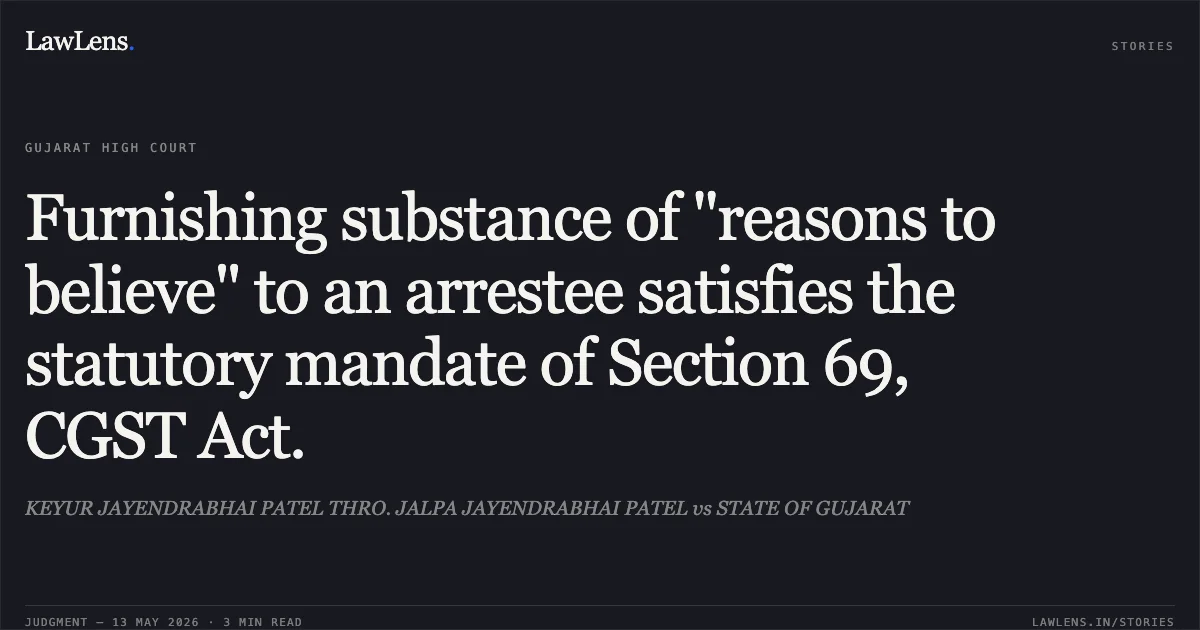
Source reference: p. 28The court reasoned that neither the CGST Act nor Supreme Court precedents prescribe a specific "form or manner" for the supply of reasons; the core requirement is that the arrestee receives the substance of the reasons to facilitate a judicial challenge.
Source reference: p. 28Consequently, the lack of a manual signature by the ADG on the specific physical copy given to the petitioner did not constitute a jurisdictional error.
Source reference: p. 28Holding
The court held that the requirements of Section 69(1) of the CGST Act were sufficiently complied with as the "reasons to believe" were duly recorded by the competent authority and furnished to the arrestee.
The court answered the issues by stating that while a Habeas Corpus petition is maintainable for statutory non-compliance, no such non-compliance occurred here; the petition was dismissed and the Rule was discharged.
Source reference: p. 28-29Acts & Sections Cited
11 provisions across 4 statutes referred to in this judgment. Each provision opens on LawLens.
Central Goods and Services Tax Act, 20173
Prevention of Money-Laundering Act, 20021
Customs Act,19625
Code of Criminal Procedure, 19732
Original Court PDF
KEYUR JAYENDRABHAI PATEL THRO. JALPA JAYENDRABHAI PATELvsSTATE OF GUJARAT
Click to open original judgment
Original judgment, available to read, download and summarize on LawLens.in