Facts
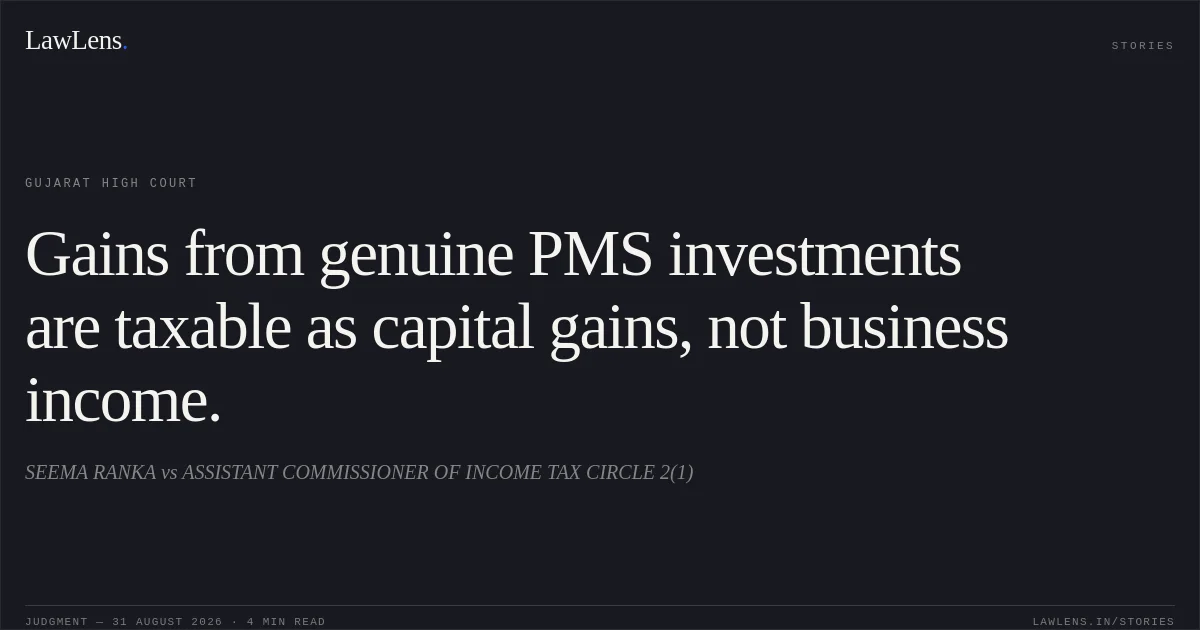
The assessees challenged common orders of the Income Tax Appellate Tribunal, Ahmedabad, concerning Assessment Years 2004–05 to 2007–08, involving the classification of profits from shares, securities, mutual funds and Portfolio Management Services (PMS).
Source reference: p.2, para. 2In the lead matter, the assessee had declared income under, inter alia, the head “Capital Gains.” The Assessing Officer treated short-term capital gains of ₹11,28,736 and long-term capital gains of ₹49,51,633 from listed securities as business income, principally because of the volume and frequency of transactions.
Source reference: pp.6–7, para. 7.2The Commissioner of Income Tax (Appeals) accepted the long-term gains and mutual-fund transactions as capital gains but treated profits from direct equity transactions and PMS transactions as business income.
Source reference: pp.8–20, para. 7.3The Tribunal affirmed that treatment, holding that the frequency and volume of PMS transactions—212 sales and 615 purchases—indicated trading activity.
Source reference: pp.24–30, para. 7.7The assessees contended that the PMS investment was a one-time investment of ₹1 crore, made from their own funds, which was subsequently withdrawn with the accretions.
Source reference: pp.31–36, paras. 8.1–8.6Issues
1. Whether the Tribunal was correct in law in treating profits from transactions in shares and securities as “Income from Business or Profession” instead of “Income from Capital Gains”.
Source reference: pp.2–5, paras. 3–52. Whether short-term capital gains arising from the sale of shares and from transactions executed through PMS were taxable as business income or as capital gains.
Source reference: pp.2–5, paras. 3–53. In Tax Appeal No. 366 of 2017, whether the Tribunal was correct in upholding the treatment of income from shares and securities trading as capital gains instead of business income.
Source reference: p.5, para. 5Law Applied
The Court applied Section 45 of the Income-tax Act, 1961, under which profits or gains arising from the transfer of a capital asset are taxable as capital gains.
Source reference: pp.32–33, para. 8.3The classification of securities depends on whether they were held as investments or as stock-in-trade, determined from the totality of circumstances rather than any single test.
Source reference: pp.25–30, paras. 7.7, 16–18Relying on CIT v. Associated Industrial Development Co. (P.) Ltd., (1971) 82 ITR 586 (SC), the Court held that the assessee’s treatment of the securities in its records is relevant to determining whether they were investments or trading assets.
Source reference: pp.24–26, para. 7.7Under CIT v. H. Holck Larsen, (1986) 160 ITR 67 (SC), the entire operation and all relevant circumstances must be considered in deciding whether the assessee was an investor or a dealer in shares.
Source reference: pp.25–26, para. 7.7CBDT Circular No. 4 of 2007 requires consideration of the substantial nature, manner of maintaining accounts, magnitude and ratio of purchases and sales, holding period, and investment objective, with no single factor being decisive.
Source reference: pp.53–55, para. 16The Court also relied on Kapur Investments (P.) Ltd., [2015] 61 taxmann.com 91 (Karnataka), and Radials International v. ACIT, [2014] 367 ITR 1 (Delhi), which held that professionally managed PMS investments do not, by themselves, constitute a share-trading business and that PMS is ordinarily an agency or investment arrangement.
Source reference: pp.46–57, paras. 11–16Reasoning
The Court held that the authorities below had focused excessively on the number and frequency of transactions executed by the PMS provider.
Source reference: pp.48–53, paras. 12–15Although the transactions legally belonged to the assessee, the PMS manager acted as an agent and the PMS agreement itself could not establish an intention to trade.
Source reference: pp.48–53, paras. 12–15The assessee’s intention had to be assessed holistically from the conduct and surrounding circumstances, including the source of funds, the manner in which the investments were treated, the holding period, and the overall nature of the portfolio.
Source reference: pp.54–59, paras. 16–22The funds used in the present case were the assessees’ own surplus funds and not borrowed money.
Source reference: p.58, para. 21The Court further treated the one-time placement of funds with the PMS provider, followed by withdrawal of the investment with its accretions, as consistent with investment rather than an independent business of share trading.
Source reference: pp.31–36, paras. 8.1–8.6Accordingly, the multiple purchases and sales undertaken by the PMS manager did not automatically convert the underlying investment into stock-in-trade.
Source reference: no citationThe Court also noted that professionally managed investment intended to maximise returns remains an investment unless the totality of facts establishes an adventure in the nature of trade.
Source reference: pp.46–50, paras. 11–13Holding
The Court answered the substantial questions of law in favour of the assessees and against the Revenue.
It held that the Tribunal erred in treating the relevant share and securities transactions, including the short-term gains arising from PMS, as business income rather than capital gains.
Source reference: pp.65–66, paras. 15–16The connected tax appeals were accordingly allowed, and the impugned orders to the extent they classified the disputed gains as business income were set aside.
Source reference: p.66, para. 16Acts & Sections Cited
6 provisions across 1 statute referred to in this judgment. Linked provisions open on LawLens.
Income Tax Act, 19616
Original Court PDF
SEEMA RANKAvsASSISTANT COMMISSIONER OF INCOME TAX CIRCLE 2(1)
Click to open original judgment
Original judgment, available to read, download and summarize on LawLens.in