01Facts
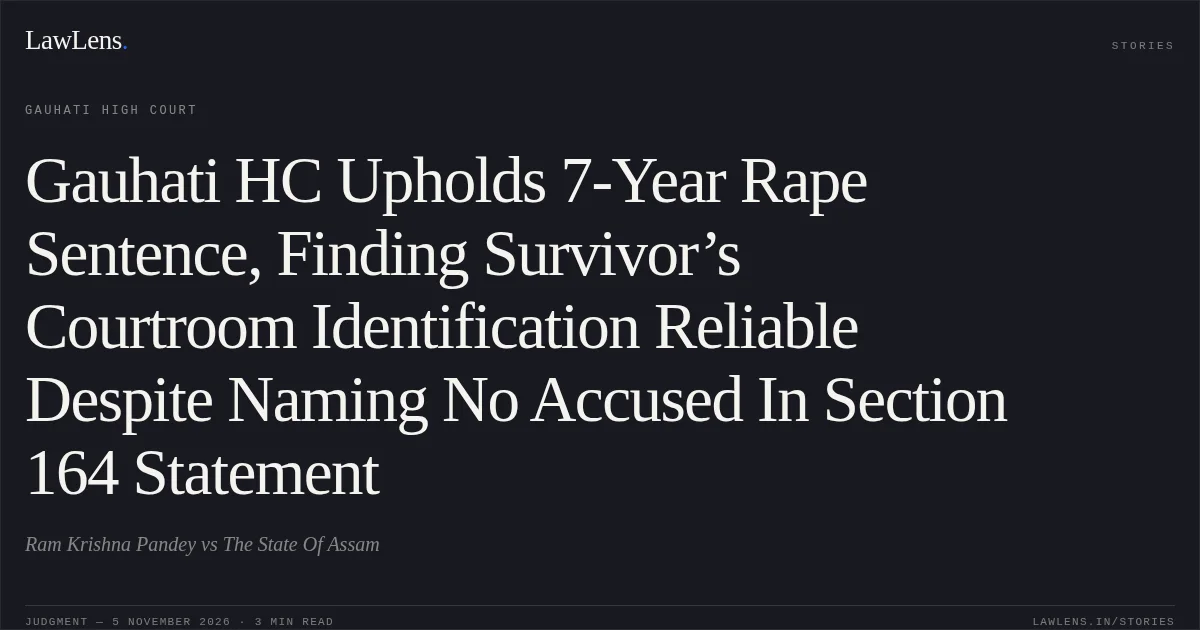
The petitioner was convicted by the Assistant Sessions Judge, Cachar, of rape under Section 376 IPC and house-trespass under Section 448 IPC, and sentenced to seven years’ rigorous imprisonment and six months’ rigorous imprisonment, respectively, with the sentences to run concurrently.
pp. 2–8The conviction arose from the allegation that, on 2 September 2007, he entered the informant’s home and raped her cousin, who was staying there as a maid.
pp. 2–8The Sessions Court dismissed the petitioner’s appeal.
pp. 2–8In revision under Section 401 CrPC, the petitioner challenged, among other matters, the victim’s identification and credibility, the two-day delay in reporting, the absence of injury or medical evidence of recent intercourse, and the non-examination of neighbouring witnesses.
pp. 2–802Issues
i.1. Whether the concurrent findings of guilt were liable to interference in revision because of alleged contradictions in the victim’s evidence, uncertainty in identification, or deficiencies in corroborative evidence
pp. 5–8, 10–11, 20–24ii.2. Whether the two-day delay in lodging the FIR, the absence of injury or signs of recent intercourse, and the non-examination of neighbours undermined the prosecution case
pp. 6–8, 23–28iii.3. Whether the Assistant Sessions Judge was competent to try the Section 376 IPC charge and convict the petitioner
pp. 28–3003Law Applied
Section 401 CrPC confers limited revisional jurisdiction, not an appellate jurisdiction; interference is warranted for patent legal or jurisdictional error, abuse of process, or a perverse finding, rather than merely because another view is possible (*Amit Kapoor v. Ramesh Chander*, (2012) 9 SCC 460).
pp. 10–11In a sexual-offence case, the victim’s credible testimony may by itself sustain a conviction; corroboration is not a rule of law (*State of Punjab v. Gurmit Singh*, 1996 Cri LJ 1728).
pp. 22–23In-court identification is substantive evidence of identity, including where the witness identifies the accused for the first time at trial (*Ronny v. State of Maharashtra*, (1998) 3 SCC 625; *Malkhansingh v. State of Madhya Pradesh*, (2003) 5 SCC 746; *P. Sasikumar v. State*, (2024) 8 SCC 600).
p. 22The court also relied on Section 114-A of the Evidence Act concerning the presumption of absence of consent in the circumstances addressed by that provision, and on the principle that absence of injuries or medical signs does not, by itself, displace credible testimony.
pp. 27–28Under Sections 9, 194 and 28(3) CrPC, an Assistant Sessions Judge may try a Sessions case made over to that judge, though sentencing powers are limited; that limitation does not itself invalidate the trial or conviction.
pp. 28–30Provisions in the judgment · 12 · Linked ones open on LawLens
Code of Criminal Procedure, 1973 9 provisions
Section 9Section 28Section 164Section 194Section 313Section 395Section 397Section 401Section 482Indian Penal Code, 1860 Section 376Section 448Section 506
04Reasoning
The High Court found no perversity or material legal error in the concurrent findings.
pp. 20–23The victim identified the petitioner in court and described him as the father of “Chukku and Borki”; the court considered this, together with the supporting evidence of the informant and her husband, sufficient despite the victim’s earlier failure to state the petitioner’s name.
pp. 20–23It treated the contradictions as minor and the absence of the helmet from the investigation as a defect that did not undermine the witnesses’ credibility.
pp. 20–21The two-day reporting delay was explained by the threats and the family’s initial approach to military police, and the court considered that explanation unchallenged.
pp. 24–27The lack of injury or medical signs did not outweigh the victim’s evidence, particularly given that her examination occurred about 48 hours after the alleged assault; the failure to call neighbours was also not fatal to an incident alleged to have occurred inside a room.
pp. 23–24, 27–28Although the petitioner did not raise a jurisdictional ground, the court held that the Assistant Sessions Judge was competent to try the case once it had been made over under Section 194 CrPC.
pp. 28–3005Holding
The High Court answered the revision issues against the petitioner, finding no ground to disturb the conviction or sentence and no jurisdictional defect in the trial.
pp. 27–30It dismissed the revision petition, left the parties to bear their own costs, and directed the Registry to return the relevant case file with a copy of the judgment.
p. 31Original Court PDF
Ram Krishna PandeyvsThe State Of Assam
Click to open original judgment
Original judgment, available to read, download and summarize on LawLens.in