Facts
The petitioner, a PHE Executive Engineer during the relevant period, was accused of involvement in irregular payments for individual household latrines under the Swachh Bharat Mission (Gramin). A departmental proceeding resulted in his dismissal, but the High Court set aside the dismissal because he had not been given an opportunity to explain his case; it permitted a fresh enquiry. The petitioner was later reinstated
Source reference: paras. 3.5–3.6; p. 4An FIR was registered on 2 May 2025 under Sections 120B, 420, 406, 409, 468 and 471 IPC and Sections 13(1)(a), 13(2) and 12 of the Prevention of Corruption Act, 1988. Following investigation, a charge-sheet was filed and the Special Judge took cognizance on 21 February 2026
Source reference: paras. 3.10–3.12, 3.17; pp. 5–7The petitioner sought quashing under Section 528 BNSS, arguing that the reports underlying the FIR had been interfered with in the earlier writ proceeding, that he had only processed bills for approval, and that the criminal case was abusive and mala fide
Source reference: paras. 5–22; pp. 8–14Issues
Whether the FIR, charge-sheet and cognizance order should be quashed under Section 528 BNSS because they were founded on reports associated with a departmental proceeding that had been set aside
Source reference: paras. 28–32; pp. 16–19Whether continuation of the criminal proceeding was an abuse of process, given the petitioner’s asserted limited role, the delay in registering the FIR, the pending departmental process and alleged mala fides
Source reference: paras. 29–35; pp. 17–20Law Applied
Section 528 BNSS preserves the High Court’s inherent power to prevent abuse of process and secure the ends of justice. Under State of Haryana v. Bhajan Lal, that power is exercised sparingly; threshold interference may be warranted where, among other recognized categories, the allegations taken at face value do not disclose an offence or the proceeding is manifestly mala fide
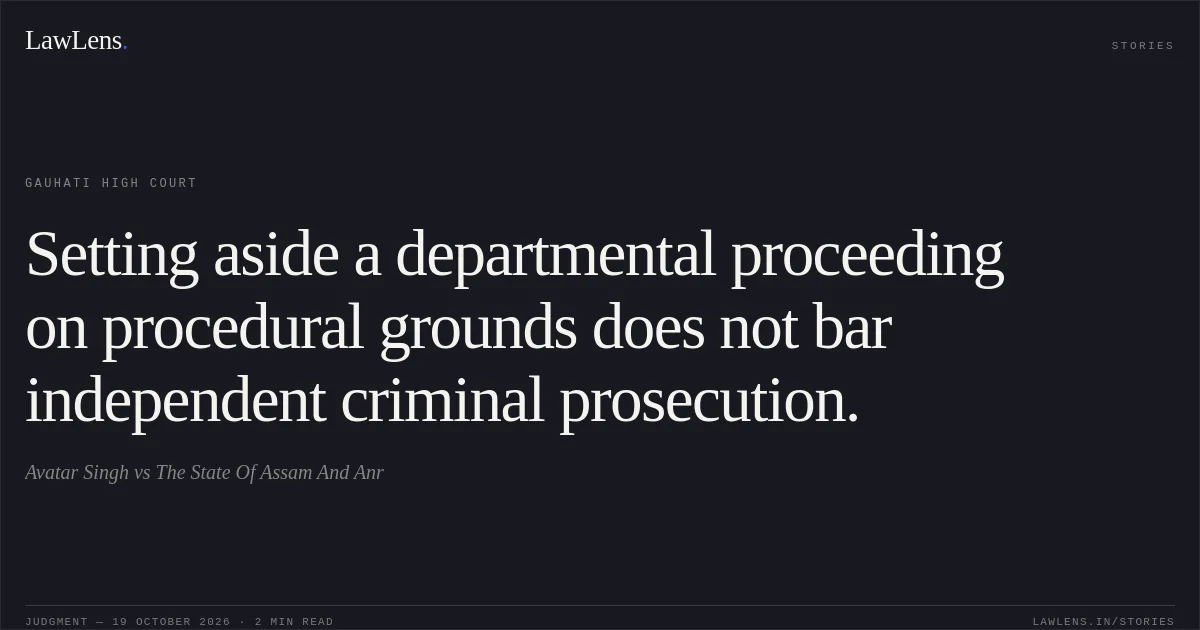
Source reference: para. 34; p. 20Departmental and criminal proceedings operate in distinct fields, and setting aside a departmental order does not, without more, determine criminal innocence. The Court distinguished P.S. Rajya v. State of Bihar, where the departmental proceeding had resulted in exoneration, and State of Punjab v. Davinder Pal Singh Bhullar and State of Bihar v. Ashok Kumar Singh on their facts
Source reference: paras. 30, 32–33; pp. 17–20Reasoning
The Court held that the petitioner’s account of merely processing bills, and his challenges to the verification and payment process, raised factual matters requiring investigation rather than resolution in an inherent-jurisdiction petition
Source reference: paras. 28–29; pp. 16–17The earlier departmental proceeding had been set aside for want of an opportunity to be heard, not on a determination that the underlying allegations were false; moreover, the initial enquiry report dated 4 April 2022 had not itself been set aside
Source reference: paras. 30, 32–33; pp. 17–20The pending fresh departmental process, delay, cooperation with investigators and alleged service-related motive did not independently establish a ground for quashing
Source reference: para. 31; p. 18On the face of the allegations, the Court could not find them inherently improbable or the proceeding manifestly mala fide
Source reference: paras. 34–35; p. 20Holding
The Court found no exceptional circumstance warranting exercise of its inherent jurisdiction under Section 528 BNSS.
It dismissed the petition seeking to quash Vigilance P.S. Case No. 11/2025, the consequential charge-sheet and the cognizance order dated 21 February 2026
Source reference: paras. 35–36; p. 20Acts & Sections Cited
8 provisions across 3 statutes referred to in this judgment. Each provision opens on LawLens.
Bharatiya Nagarik Suraksha Sanhita, 20231
Indian Penal Code, 18605
Prevention of Corruption Act, 19882
Original Court PDF
Avatar SinghvsThe State Of Assam And Anr
Click to open original judgment
Original judgment, available to read, download and summarize on LawLens.in