Facts
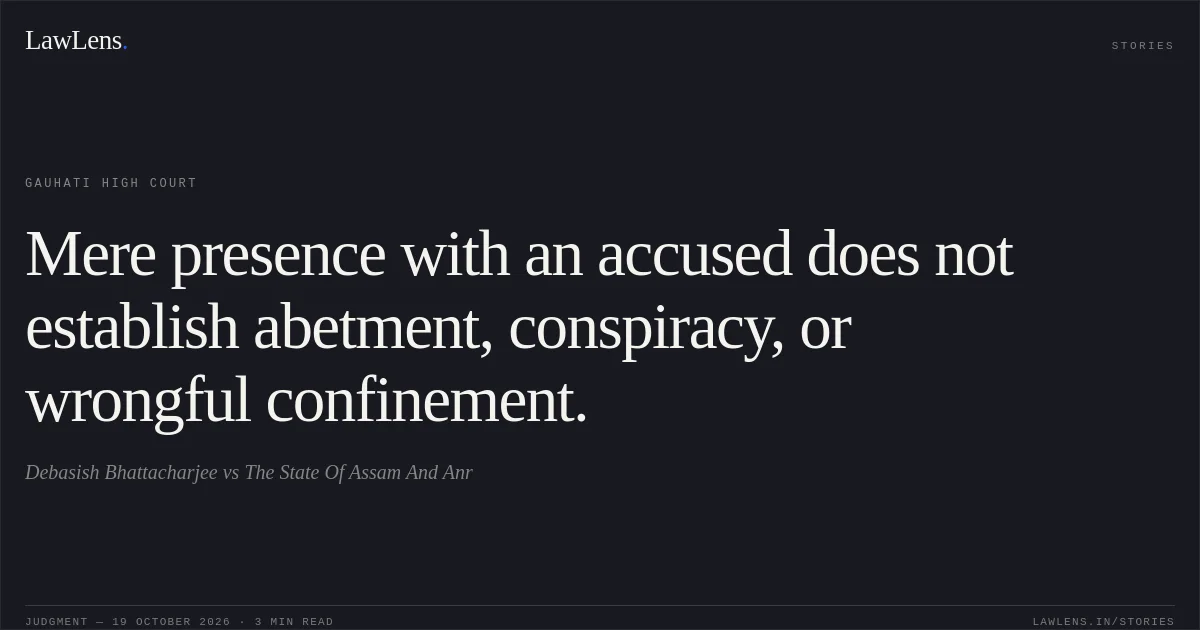
Respondent No. 2, the complainant, was the husband of Archana Bhattacharjee; the petitioner was her elder brother.
Source reference: para. 2–6Under a custody order dated 28 March 2024, Archana could visit the parties’ minor child on Sundays but was required to return him before sunset.
Source reference: para. 2–6The complaint alleged that on 6 October 2024 she took the child and failed to return him.
Source reference: para. 2–6The petitioner was named as accused No. 3, and the Magistrate took cognizance against him under Sections 49, 61(2), 127(4) and 127(6) of the Bharatiya Nyaya Sanhita, 2023 (BNS), noting that he was allegedly seen with Archana and the child in a car on the date they went missing.
Source reference: para. 2–6, 17The petitioner sought to quash the cognizance order insofar as it concerned him, arguing that no material disclosed the elements of the alleged offences.
Source reference: para. 2–6, 17Issues
1. Whether the allegations and materials disclosed a prima facie basis to proceed against the petitioner under Sections 49 and 61(2) of the BNS for abetment and criminal conspiracy?
Source reference: para. 15, 19–202. Whether those materials disclosed the petitioner’s participation in wrongful confinement sufficient to proceed under Sections 127(4) and 127(6) of the BNS?
Source reference: para. 15, 21Law Applied
Section 528 of the Bharatiya Nagarik Suraksha Sanhita, 2023 (BNSS), preserves the High Court’s inherent power to quash proceedings where allegations, accepted at face value, fail to disclose the essential ingredients of an offence; the Court must not conduct a mini-trial or decide the ultimate merits.
Source reference: para. 16Section 49 of the BNS concerns punishment for abetment where the act abetted is committed, while Section 61(2) punishes criminal conspiracy, which requires an agreement to commit an illegal act or an act made illegal by illegal means; conspiracy may be inferred from circumstances, but those circumstances must connect the accused to the agreement.
Source reference: para. 19–20Sections 127(4) and 127(6) address distinct aggravated forms of wrongful confinement—confinement for ten days or more, and confinement in circumstances intended to conceal the person or place of confinement, respectively—and require a prima facie basis for the accused’s participation.
Source reference: para. 21Mehmood Ul Rehman v. Khazir Mohammad Tunda, (2015) 12 SCC 420, requires judicial application of mind to the allegations and materials; CBI v. Aryan Singh, 2023 LiveLaw (SC) 292, and Abhishek Singh v. Ajay Kumar, 2025 LiveLaw (SC) 675, caution against a mini-trial at the quashing stage.
Source reference: para. 23Reasoning
The Court distinguished the allegation that Archana took and failed to return the child from the material against the petitioner.
Source reference: para. 18–24His relationship with Archana and his alleged presence with her and the child in a car were relevant circumstances, but the impugned order identified no further specific act connecting him to instigation, intentional aid, an agreement to commit an offence, or participation in wrongful confinement.
Source reference: para. 18–24The Court held that the car-sighting allegation, standing alone and without further connecting material, did not disclose the essential ingredients of the offences charged.
Source reference: para. 18–24This assessment addressed the legal sufficiency of the allegations, not their truth or evidentiary weight at trial.
Source reference: para. 18–24Holding
The Court held that the materials disclosed no sufficient prima facie basis to continue proceedings against the petitioner under Sections 49, 61(2), 127(4) and 127(6) of the BNS.
It allowed the petition and quashed the cognizance order dated 22 September 2025, together with consequential proceedings, insofar as they related to the petitioner.
Source reference: para. 26–28Proceedings against the other accused were left unaffected.
Source reference: para. 26–28Acts & Sections Cited
6 provisions across 2 statutes referred to in this judgment. Each provision opens on LawLens.
Bharatiya Nagarik Suraksha Sanhita, 20233
Bharatiya Nyaya Sanhita, 20233
Original Court PDF
Debasish BhattacharjeevsThe State Of Assam And Anr
Click to open original judgment
Original judgment, available to read, download and summarize on LawLens.in