Facts
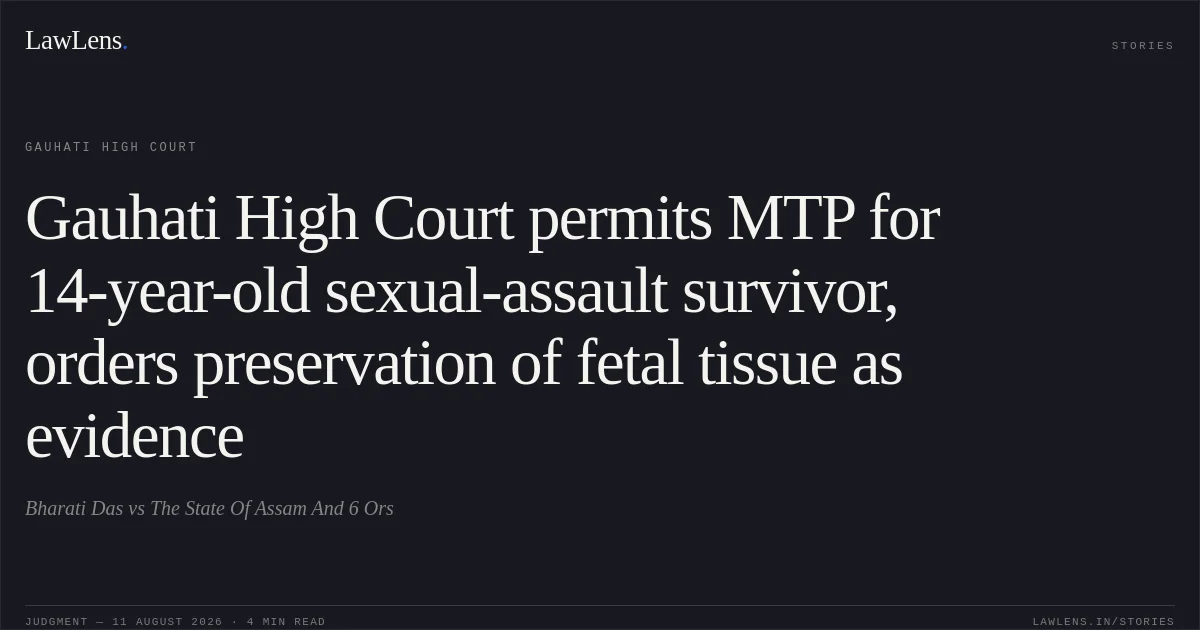
The petitioner, mother and natural guardian of a 14-year-old minor, approached the Gauhati High Court under Article 226 seeking constitution of a Medical Board and permission for medical termination of the minor’s pregnancy arising from alleged successive penetrative sexual assaults.
Source reference: no citationThe minor’s date of birth was recorded as 14 May 2012, and she was studying in Class IX.
Source reference: p.3In connection with the alleged assaults, Bongaigaon P.S. Case No. 127/2026 was registered under Section 65(1) of the Bharatiya Nyaya Sanhita, 2023 read with Section 6 of the POCSO Act, 2012; investigation was pending.
Source reference: p.4An obstetric report dated 20 June 2026 recorded a live intrauterine pregnancy of approximately 18 weeks and 4 days.
Source reference: p.4On 2 July 2026, the Court directed examination of the minor by a Medical Board at Barpeta Medical College & Hospital.
Source reference: p.4The five-member Medical Board subsequently found the minor medically fit for MTP, recorded that continuation of the pregnancy was likely to cause grave mental and physical injury, and noted that the minor and her mother were unwilling to continue the pregnancy.
Source reference: pp.5–6The hospital confirmed that the procedure could be performed there and that the product of conception could be preserved and forwarded for forensic examination.
Source reference: p.6Issues
1. Whether, in view of the minor’s age, alleged sexual assault, gestational age, medical condition, and unwillingness to continue the pregnancy, she should be permitted to undergo Medical Termination of Pregnancy under the Medical Termination of Pregnancy Act, 1971, as amended.
Source reference: pp.6–102. Whether directions should be issued for the minor’s informed consent and medical care, and for the collection, preservation, sealing, documentation, and forensic examination of the terminal foetus and other biological material relevant to the pending criminal investigation.
Source reference: pp.10–123. Whether the State should bear the medical, transportation, and post-operative expenses and provide necessary support for the minor’s safety and welfare.
Source reference: pp.11–13Law Applied
The Court applied Sections 3, 3(2), 3(2B), 3(2D), 3(3), 4(a), and 5(1) of the Medical Termination of Pregnancy Act, 1971, as amended.
Source reference: pp.6–8Section 3 permits termination where continuation of pregnancy risks grave physical or mental injury, and Explanation 2 presumes the anguish caused by a pregnancy alleged to have resulted from rape to constitute grave injury to the pregnant woman’s mental health.
Source reference: pp.6–8Section 4(a) requires the written consent of the guardian for termination of a minor’s pregnancy, while the minor’s own wishes remain an important consideration in decisions concerning reproductive autonomy.
Source reference: no citationThe Court relied on Suchita Srivastava v. State (UT of Chandigarh), (2009) 9 SCC 1, for the principle that reproductive choice is part of personal liberty under Article 21 and that the pregnant person’s consent is paramount.
Source reference: p.9It further relied on A (Mother of X) v. State of Maharashtra, 2024 INSC 371, for the principle that the safety and welfare of the minor are the controlling considerations and that her wishes must be considered alongside those of her guardian.
Source reference: pp.8–10XYZ v. State of Gujarat, 2023 SCC OnLine SC 1573, recognising that pregnancy resulting from sexual assault may cause compounded physical and psychological trauma.
Source reference: p.10Murugan Nayakkar v. Union of India, (2020) 19 SCC 806, permitting termination of a minor survivor’s pregnancy in accordance with the Medical Board’s opinion.
Source reference: p.10Reasoning
The Court found that the material circumstances justified termination: the minor was allegedly a victim of penetrative sexual assault, the Medical Board unanimously certified her medical fitness for the procedure, continuation of the pregnancy was likely to aggravate her mental and physical injury, and both the minor and her mother expressed unwillingness to continue it.
Source reference: p.10Applying the MTP Act and the Supreme Court’s emphasis on reproductive autonomy, the minor’s welfare, and the psychological consequences of rape-related pregnancy, the Court held that permitting MTP was in her best interest.
Source reference: no citationSince the pending criminal investigation could require biological evidence, the Court balanced the minor’s medical and privacy interests with evidentiary requirements by directing collection and preservation of the terminal foetus and other biological materials in accordance with medical protocol and chain-of-custody safeguards.
Source reference: pp.10–12Holding
The writ petition was allowed.
The Court permitted termination of the minor’s pregnancy at Barpeta Medical College & Hospital, preferably on 17 July 2026 or on the nearest medically feasible date, by an expert medical team.
Source reference: p.11The minor and her mother were to be informed of the relevant medical risks and obtain requisite informed consent; appropriate specialists, medical facilities, and post-operative care were to be provided.
Source reference: pp.11–12The police were directed to facilitate safe transportation of the minor and her parents, receive the terminal foetus and biological materials under proper seal and documentation, and forward them to the Forensic Science Laboratory, Guwahati while maintaining the chain of custody.
Source reference: p.12The State was directed to bear all procedure-related and medical expenses and to provide further medical care required for the minor’s safety and welfare.
Source reference: pp.12–13Acts & Sections Cited
10 provisions across 5 statutes referred to in this judgment. Each provision opens on LawLens.
Bharatiya Nyaya Sanhita, 20232
Registration of Births and Deaths Act, 19692
Protection of Children from Sexual Offences Act, 20121
Bharatiya Nagarik Suraksha Sanhita, 20231
Original Court PDF
Bharati DasvsThe State Of Assam And 6 Ors
Click to open original judgment
Original judgment, available to read, download and summarize on LawLens.in