Facts
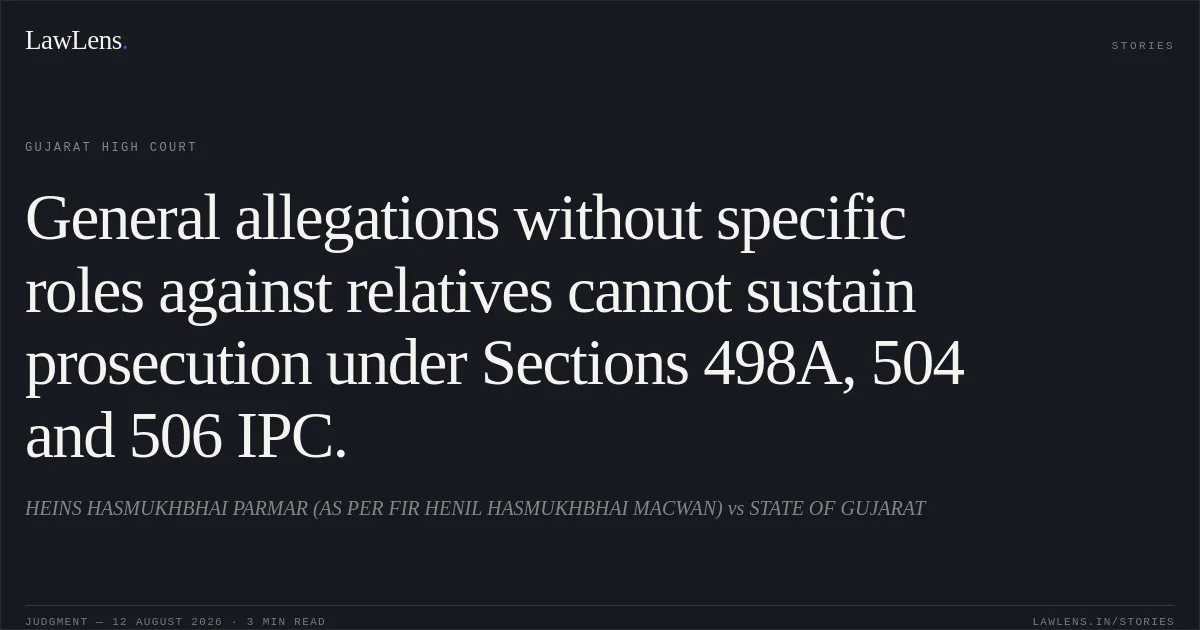
The petitioners invoked Section 482 of the Code of Criminal Procedure, 1973 (“CrPC”) seeking quashing of FIR C.R. No. 11215018210040 of 2021, registered at Mahila Police Station, Anand, for offences under Sections 498A, 323, 504, 506(2) and 114 of the Indian Penal Code, 1860 (“IPC”).
Source reference: para. 1; p. 1Petitioner No. 1 was the nephew and Petitioner No. 2 the sister-in-law of the complainant.
Source reference: para. 2; p. 2The FIR alleged that the petitioners had aided and supported the complainant’s husband in mentally and physically harassing her and had participated in an incident on 26 November 2021 involving threats of dire consequences.
Source reference: para. 2; p. 2The petitioners contended that they were falsely implicated, that Petitioner No. 2 lived separately, and that the allegations were general, vague and unsupported by any specific role or overt act.
Source reference: paras. 3–3.1; pp. 2–3The State and the complainant opposed quashing, asserting that a prima facie case of mental and physical harassment and criminal intimidation was disclosed.
Source reference: paras. 4–6; pp. 3–4The Court also noted that proceedings against certain other accused had previously been quashed and that the complainant’s husband had subsequently been acquitted in the connected criminal case.
Source reference: para. 13; p. 9Issues
Whether the allegations in the FIR, even if accepted at face value, disclosed the ingredients of an offence under Section 498A IPC against the petitioners, in the absence of specific allegations or distinct roles attributed to them?
Source reference: para. 9; p. 5Whether the allegations satisfied the statutory requirements of Sections 504 and 506(2) IPC, particularly intentional insult likely to provoke breach of peace and an intention to cause alarm?
Source reference: paras. 10–11; pp. 5–7Whether the High Court should exercise its inherent jurisdiction under Section 482 CrPC to prevent abuse of process and secure the ends of justice?
Source reference: para. 12; pp. 7–9Law Applied
The Court applied Section 482 CrPC, which empowers the High Court to quash criminal proceedings to prevent abuse of process or secure the ends of justice.
Source reference: para. 12; pp. 7–8It considered the ingredients of Section 498A IPC and the principle that vague and omnibus allegations against relatives, without attribution of a specific role, may constitute over-implication, particularly where the relatives live separately; this principle was drawn from Abhishek v. State of Madhya Pradesh, Preeti Gupta v. State of Jharkhand, and Achin Gupta v. State of Haryana.
Source reference: para. 8; pp. 4–5In relation to Section 504 IPC, the Court relied on Mohammad Wajid v. State of Uttar Pradesh, holding that the prosecution must disclose intentional insult, provocation likely to cause breach of peace, and the accused’s intention or knowledge in that regard; the abusive words or conduct must ordinarily be identifiable.
Source reference: paras. 10–11; pp. 5–7For Section 506(2) IPC, the prosecution must establish an intention to cause alarm; a mere threat without such intention is insufficient.
Source reference: paras. 10–11; p. 7The Court further applied the illustrative categories in State of Haryana v. Bhajan Lal, permitting quashing where the allegations do not prima facie constitute an offence, are inherently improbable, or the proceedings are manifestly attended with mala fides or an ulterior motive.
Source reference: para. 12; pp. 7–9Reasoning
The Court found that the allegations under Section 498A IPC were general and did not identify any specific or distinct role played by either petitioner in the alleged cruelty.
Source reference: para. 9; p. 5The allegation that the petitioners had merely supported or instigated the husband was insufficient to establish their individual participation in the offence, particularly in light of the petitioners’ separate residence and the absence of specific overt acts.
Source reference: paras. 3, 8–9; pp. 2, 4–5The allegations under Sections 504 and 506(2) IPC also failed to disclose the essential statutory elements: no specific insulting words or conduct demonstrating intentional provocation were identified, and there was no material showing an intention to cause alarm through the alleged threats.
Source reference: paras. 10–11; pp. 5–7Applying the Bhajan Lal principles, the Court concluded that continuing the prosecution against the petitioners would amount to abuse of the process of law, particularly where the proceedings appeared to involve over-implication of relatives in a matrimonial dispute.
Source reference: paras. 8, 12–13; pp. 4–9Holding
The High Court allowed the application and held that the FIR did not disclose the necessary ingredients of the alleged offences against the petitioners.
FIR C.R. No. 11215018210040 of 2021, registered with Mahila Police Station, Anand, and all consequential proceedings were quashed and set aside qua the petitioners.
Source reference: para. 14; p. 10Rule was made absolute to that extent, with direct service permitted.
Source reference: para. 15; p. 10Acts & Sections Cited
9 provisions across 2 statutes referred to in this judgment. Each provision opens on LawLens.
Code of Criminal Procedure, 19733
Indian Penal Code, 18606
Original Court PDF
HEINS HASMUKHBHAI PARMAR (AS PER FIR HENIL HASMUKHBHAI MACWAN)vsSTATE OF GUJARAT
Click to open original judgment
Original judgment, available to read, download and summarize on LawLens.in