Facts
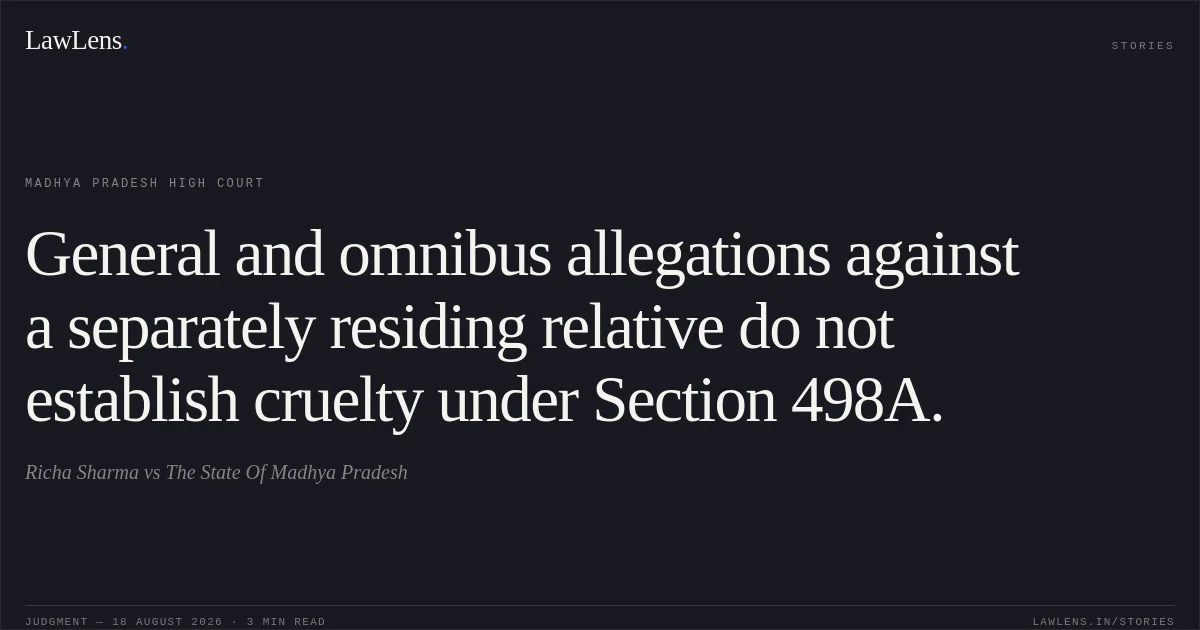
The petitioner, Richa Sharma, sister-in-law of respondent No. 2/complainant, invoked Section 482 Cr.P.C. seeking quashing of the criminal proceedings in RCT No. 2952/2024 pending before the JMFC, Bhopal.
Source reference: p.1She contended that she was employed in a private company at Mumbai, lived separately from the complainant, and had been implicated through vague and omnibus allegations, whereas the principal allegations were against the complainant’s husband.
Source reference: p.1The complainant’s marriage with the petitioner’s brother was stated to have been solemnized on 21 January 2022, with the reception held at Bhopal on 25 January 2023.
Source reference: p.2The prosecution alleged that when the complainant visited Bhopal in June 2023, she complained to her in-laws about her husband’s misconduct; the petitioner’s parents allegedly supported the husband and told the complainant to obey him.
Source reference: p.2It was also alleged that the complainant’s ornaments were retained by the in-laws.
Source reference: p.2The complainant reiterated these allegations in her statement under Section 161 Cr.P.C.
Source reference: p.2The State and the complainant opposed quashing, arguing that the High Court could not conduct a mini-trial while exercising jurisdiction under Section 482 Cr.P.C.
Source reference: pp.2–3Issues
1. Whether the FIR and consequential criminal proceedings disclosed specific and legally sufficient allegations of cruelty or dowry-related harassment against the petitioner under Section 498-A IPC?
Source reference: pp.9–10, 122. Whether the High Court should exercise its inherent jurisdiction under Section 482 Cr.P.C. to quash the proceedings against the petitioner on the ground that the allegations were general, omnibus, and did not attribute any specific role to her?
Source reference: pp.3–5, 11–15Law Applied
The Court applied Section 482 Cr.P.C., which preserves the High Court’s inherent power to prevent abuse of the process of any court and secure the ends of justice.
Source reference: no citationUnder State of Haryana v. Ch. Bhajan Lal, the Court may quash proceedings where, even if the allegations are accepted at face value, they do not prima facie constitute an offence, or where the allegations are inherently improbable or legally insufficient.
Source reference: pp.3–4Neeharika Infrastructure v. State of Maharashtra establishes that the Court must exercise caution at the quashing stage and ordinarily should not assess the merits or conduct a mini-trial; the principal test is whether the allegations disclose a cognizable offence.
Source reference: pp.4–5Rajiv Thapar v. Madan Lal Kapoor permits quashing where unimpeachable and sterling-quality material conclusively displaces the prosecution’s allegations and continuation of the proceedings would amount to abuse of process.
Source reference: pp.5–6The Court also relied on Preeti Gupta v. State of Jharkhand, concerning careful scrutiny of generalized matrimonial allegations, particularly against relatives living separately; Neelu Chopra v. Bharti, which requires specific particulars and the role of each accused; and Geeta Mehrotra v. State of U.P., concerning omnibus allegations against relatives in matrimonial prosecutions.
Source reference: pp.1, 6–7The Court distinguished the complainant’s reliance on Rupali Devi v. State of U.P. and Muskan v. Ishan Khan, where the allegations were considered materially different.
Source reference: pp.2–3, 4Reasoning
The Court found that the dispute was primarily matrimonial in nature between the complainant and her husband, while the petitioner was employed in Mumbai and living separately from the complainant, who herself worked in Pune.
Source reference: p.7Applying the principles in Bhajan Lal, Preeti Gupta, and Neelu Chopra, the Court held that the FIR and the complainant’s Section 161 statement contained only general and omnibus allegations of harassment and dowry demand against the petitioner.
Source reference: p.7They did not identify any specific incident, conduct, or individual role of Richa Sharma amounting to “cruelty” under Section 498-A IPC.
Source reference: p.7The Court therefore concluded that merely asserting harassment without particulars was insufficient to establish a prima facie offence against the petitioner.
Source reference: no citationAlthough the Court acknowledged the general limitation against conducting a mini-trial under Section 482 Cr.P.C., it found that continuation of the prosecution on such generalized allegations would constitute abuse of the process of the court and would not serve the ends of justice.
Source reference: pp.4–5, 7–8Holding
The Court answered the issues in favour of the petitioner.
It held that the FIR and consequential proceedings did not disclose specific allegations sufficient to constitute cruelty under Section 498-A IPC against Richa Sharma.
Source reference: p.7Exercising its inherent jurisdiction under Section 482 Cr.P.C., the Court quashed the entire criminal proceedings in RCT No. 2952/2024 pending before the JMFC, Bhopal, so far as they related to the petitioner.
Source reference: p.8The petition was accordingly allowed.
Source reference: p.8Acts & Sections Cited
4 provisions across 1 statute referred to in this judgment. Each provision opens on LawLens.
Code of Criminal Procedure, 19734
Original Court PDF
Richa SharmavsThe State Of Madhya Pradesh
Click to open original judgment
Original judgment, available to read, download and summarize on LawLens.in