Facts
The petitioners (parents-in-law) sought quashing of a 2019 cognizance order for an offense under Section 498A of the IPC.
Source reference: para. 1-2The Complainant (O.P. No. 2) alleged that following her marriage in 2018, the petitioners and her husband demanded a Fortuner car and subjected her to cruelty due to non-fulfillment.
Source reference: para. 3She further alleged her husband and mother-in-law consumed alcohol and that she had been living at her paternal home since November 2018.
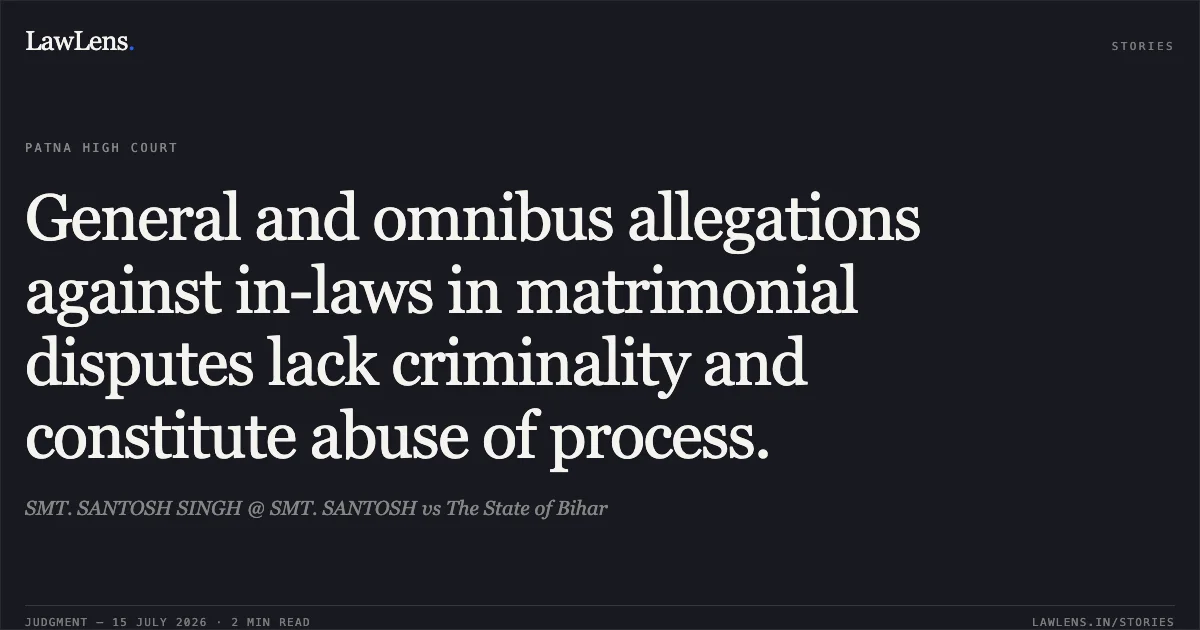
Source reference: para. 3The petitioners contended that the allegations were general and omnibus, arising solely from matrimonial discord between the husband and wife, leading the petitioners to eventually disown their son via press publication.
Source reference: para. 4-5Issues
1. Whether the allegations in the complaint against the parents-in-law meet the threshold of specific criminal acts or are merely general and omnibus in nature.
Source reference: para. 92. Whether the continuance of criminal proceedings against the family members of the husband in the absence of concrete allegations constitutes an abuse of the process of law.
Source reference: para. 10-12Law Applied
The court primarily applied Section 498A of the IPC regarding matrimonial cruelty.
Source reference: para. 2It relied on the Supreme Court precedent in Kahkashan Kausar @ Sonam & Ors. v. State of Bihar (2022), which established that family members should not undergo the rigors of prosecution based on generalized allegations.
Source reference: para. 11It further cited Dara Lakshmi Narayana & Ors. v. State of Telangana (2025) and Geddam Jhansi & Anr. v. The State of Telangana (2025), holding that roping in relatives during matrimonial disputes without specific acts is an abuse of process.
Source reference: para. 12Additionally, the court applied the principle from Salib @ Shalu v. State of Uttar Pradesh (2023), which mandates looking beyond the drafting of a complaint to the attending circumstances to identify "wreaking vengeance".
Source reference: para. 13Reasoning
The Court observed that upon reviewing the complaint and the statements of enquiry witnesses, the allegations against the petitioners were "general and sweeping".
Source reference: para. 9The Court noted a "growing tendency" of roping in all family members when matrimonial relations turn bitter, often involving "exaggerated" or "frivolous" claims.
Source reference: para. 12The Court found that while the complaint was well-drafted, it lacked concrete and precise allegations linking the petitioners to specific criminal acts.
Source reference: para. 9Since the mediation had failed and the husband had filed for divorce, the Court deduced that the dispute was primarily between the husband and wife, and the petitioners were being unnecessarily harassed due to matrimonial discord.
Source reference: para. 5, 8-9Applying the Kahkashan Kausar doctrine, the Court reasoned that allowing a trial to proceed on such "omnibus" allegations would cause irreparable harm and constitute a miscarriage of justice.
Source reference: para. 11-14Holding
The Court answered the issues in the affirmative, holding that the allegations against the petitioners were too vague to sustain a criminal prosecution.
The Court concluded that the proceedings were vexatious and an abuse of the process of law. Consequently, the High Court allowed the application and quashed the order dated 30.09.2019 passed by the Judicial Magistrate-1st Class, Gaya, in Complaint Case No. 1486 of 2019, specifically as it pertained to the two petitioners.
Source reference: para. 14-15Acts & Sections Cited
1 provisions across 1 statute referred to in this judgment. Linked provisions open on LawLens.
Indian Penal Code, 18601
Original Court PDF
SMT. SANTOSH SINGH @ SMT. SANTOSHvsThe State of Bihar
Click to open original judgment
Original judgment, available to read, download and summarize on LawLens.in