Facts
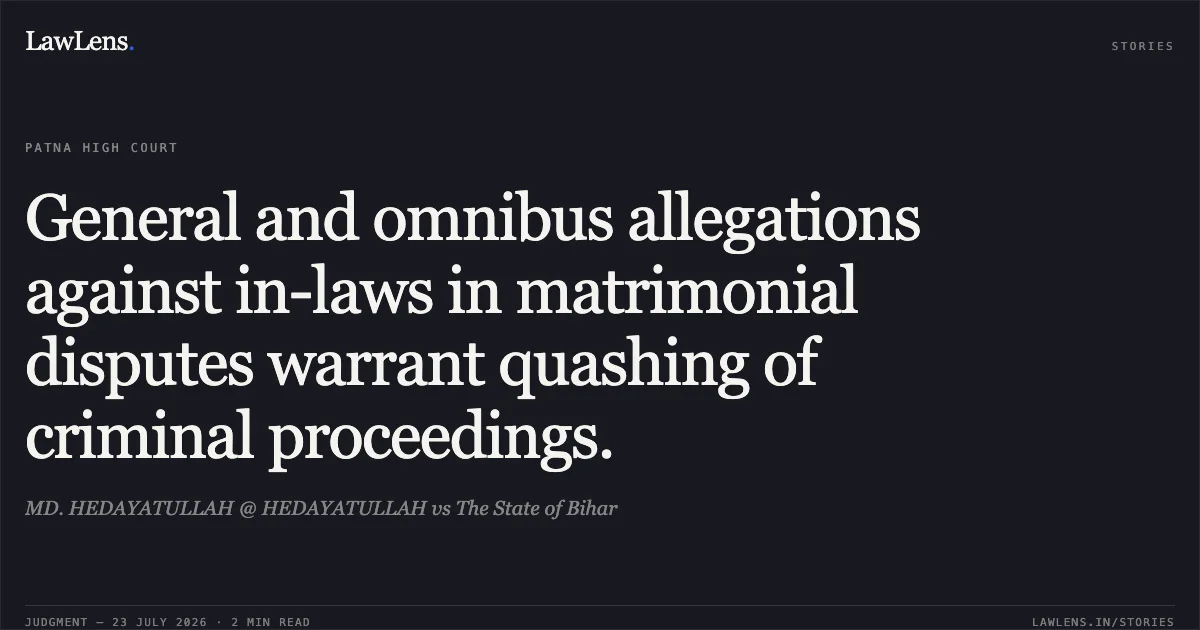
The informant (Opposite Party No. 2) filed an FIR alleging that following her marriage in March 2016, the petitioners (her husband's relatives, including his brother, nephews, sister, and mother) demanded additional dowry and subjected her to cruelty that caused a miscarriage.
Source reference: p. 2Specifically, she alleged an assault on February 2, 2019, leading to her being abandoned near a railway station.
Source reference: p. 2The petitioners moved the High Court under Section 482 of the Cr.P.C. to quash the cognizance order dated June 12, 2019, for offences under Sections 341, 323, 379, 498(A), and 34 of the IPC and Section 3/4 of the Dowry Prohibition Act.
Source reference: p. 1-2They contended that they reside separately and were implicated based on vague, omnibus allegations intended to pressure the husband.
Source reference: p. 2-3Issues
1. Whether the allegations in the FIR against the in-laws and distant relatives were specific enough to sustain criminal proceedings or were "general and omnibus" in nature
Source reference: p. 3 / para. 62. Whether the continuation of the criminal proceedings against the petitioners constitutes an abuse of the process of law
Source reference: p. 3 / para. 4, 7Law Applied
The court primarily applied the principles governing the quashing of criminal proceedings under Section 482 of the Cr.P.C. as articulated in Abhishek v. State of Madhya Pradesh (2023), which warns against the "increased tendency to implicate relatives of the husband in matrimonial disputes" through general allegations.
Source reference: p. 3-4 / para. 6It further relied on Kahkashan Kausar @ Sonam v. State of Bihar (2022) regarding the necessity of clear, specific allegations to prevent misuse of Section 498A IPC.
Source reference: para. 13Preeti Gupta v. State of Jharkhand (2010), which mandates that courts exercise circumspection when distant relatives living separately are named in matrimonial complaints.
Source reference: para. 14Reasoning
The Court observed that the FIR lacked specific overt acts, dates, or incidents attributable to any of the five petitioners individually; instead, the allegations were collective and undifferentiated.
Source reference: p. 3, 6 / para. 6, 7The Court noted that Petitioner No. 1 is the Bhaisur (brother-in-law), Nos. 2 and 5 are nephews, No. 3 is the Nanad (sister-in-law), and No. 4 is the Saas (mother-in-law), all of whom lived separately and had no independent concern with the couple's matrimonial affairs.
Source reference: p. 2, 6 / para. 4, 7Applying the Abhishek precedent, the Court reasoned that allowing a criminal trial to proceed on such "vague and omnibus" statements would result in a grave injustice and inflict "severe scars" on the accused despite the likelihood of eventual acquittal.
Source reference: p. 4 / para. 13; p. 6 / para. 7Holding
The Court answered the issues in the affirmative, holding that the allegations were indeed general and omnibus, and the prosecution was an abuse of process.
The petition was allowed, and the order of cognizance dated June 12, 2019, passed by the SDJM, Madhubani in Mahila P.S. Case No. 15 of 2019, was quashed specifically regarding the five petitioners.
Source reference: p. 6-7 / para. 8, 9Acts & Sections Cited
7 provisions across 3 statutes referred to in this judgment. Each provision opens on LawLens.
Indian Penal Code, 18604
Code of Criminal Procedure, 19731
Original Court PDF
MD. HEDAYATULLAH @ HEDAYATULLAHvsThe State of Bihar
Click to open original judgment
Original judgment, available to read, download and summarize on LawLens.in