Facts
The complainant alleged that she married co-accused Birendra Singh in December 2011 and that substantial dowry, including cash, gold ornaments and household articles, was given at the time of marriage. She alleged that, approximately six months after marriage, her husband and in-laws subjected her to cruelty, demanded money for purchasing a car, and subsequently demanded ₹3 crores for purchasing a flat
Source reference: p. 2, paras. 3–3.1She further alleged that petitioner nos. 1 and 2, her father-in-law and mother-in-law, and petitioner no. 3, her married sister-in-law, were involved in the alleged forced abortion, confinement and assault at Bilaspur, Chhattisgarh
Source reference: pp. 2–3, para. 3.1The complainant allegedly approached the local police at Bilaspur on 5 June 2017 regarding the matrimonial cruelty but requested that no action be taken. She thereafter returned to her parental home at Patna on 6 June 2017 and instituted the complaint case at Patna on 28 June 2017
Source reference: pp. 3–4, paras. 3.1–4After recording her solemn affirmation and the evidence of enquiry witnesses, the learned Magistrate took cognizance under Section 498A IPC and Section 4 of the Dowry Prohibition Act against the petitioners and the co-accused on 22 November 2017
Source reference: p. 2, para. 2; p. 3, para. 3.2The petitioners sought quashing of the cognizance order under the High Court’s inherent jurisdiction.
Source reference: no citationIssues
Whether the allegations against the father-in-law, mother-in-law and married sister-in-law, being general and omnibus in nature, disclosed a prima facie offence under Section 498A IPC and Section 4 of the Dowry Prohibition Act?
Source reference: pp. 4–7, paras. 4–4.2, 7Whether the Patna court could exercise jurisdiction when the alleged acts of cruelty and dowry harassment substantially occurred at Bilaspur, Chhattisgarh, and the complainant instituted proceedings after returning to her parental home at Patna?
Source reference: pp. 7–8, paras. 4.3–4.4; p. 9, para. 7Whether continuation of the criminal proceedings against the petitioners amounted to an abuse of the process of law warranting quashing under the principles stated in State of Haryana v. Bhajan Lal?
Source reference: p. 9, para. 7Law Applied
The Court considered Section 498A IPC, which criminalises cruelty by the husband or his relatives, and Section 4 of the Dowry Prohibition Act, which penalises demanding dowry
Source reference: p. 2, para. 2It also considered the territorial-jurisdiction principles under Sections 177 and 179 CrPC, including the rule that an offence is ordinarily tried where it was committed, subject to jurisdiction where the consequence of the act ensues
Source reference: pp. 7–8, para. 4.3Applying the inherent jurisdiction to prevent abuse of process, the Court relied on State of Haryana v. Bhajan Lal, 1992 Supp (1) SCC 335, particularly the category concerning proceedings instituted with malicious or improper motives and cases where the allegations do not disclose a prima facie offence
Source reference: p. 9, para. 7It further relied on Maram Nirmala v. State of Telangana, 2025 SCC OnLine SC 2913, and the principles reiterated in Dara Lakshmi Narayana, that merely naming family members in a matrimonial complaint, without specific allegations of active involvement, cannot justify criminal prosecution
Source reference: pp. 5–7, para. 4.2The Court also noted the caution expressed in Preeti Gupta v. State of Jharkhand, (2010) 7 SCC 667, and K. Subba Rao v. State of Telangana, (2018) 14 SCC 452, against proceeding on vague and generalised allegations against the husband’s relatives
Source reference: p. 8, para. 4.4Reasoning
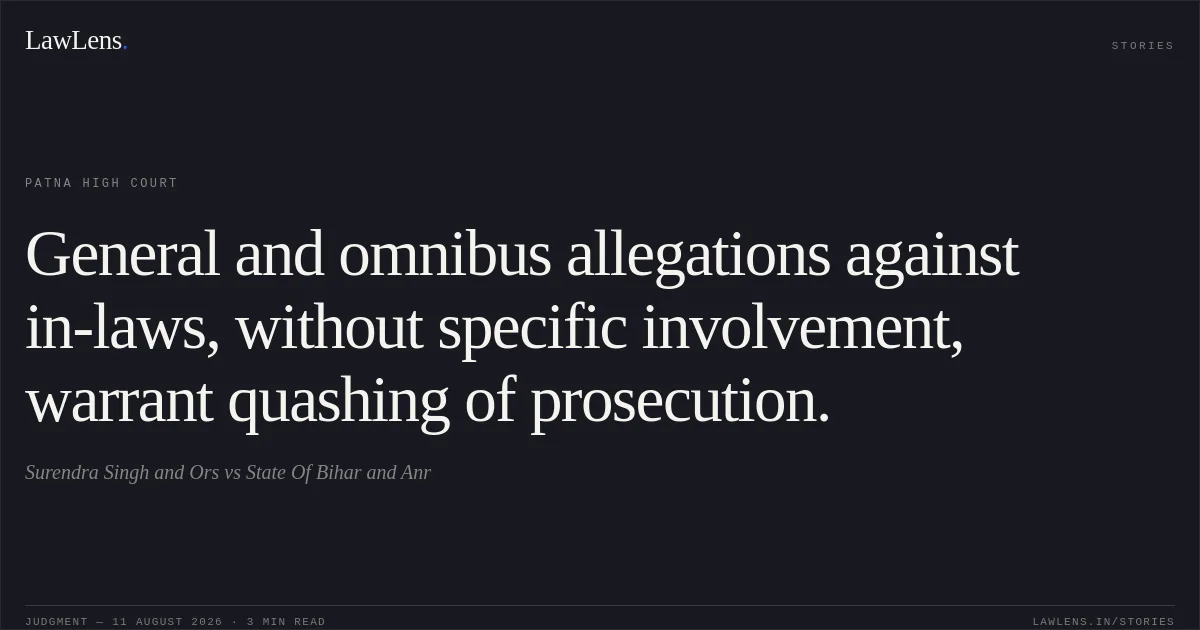
The Court found that the petitioners were the complainant’s parents-in-law and married sister-in-law and that the allegations against them were general and omnibus rather than specific or particularised
Source reference: p. 9, para. 7Although the complaint referred to alleged cruelty, dowry demands and other incidents, the Court considered that the material allegations concerned events occurring at Bilaspur, where the complainant had lived for nearly six years.
Source reference: pp. 7–9, paras. 4.3, 7The complainant had also reported the alleged conduct to the Bilaspur police before returning to Patna, and no distinct act of cruelty at Patna was identified
Source reference: pp. 7–9, paras. 4.3, 7In light of the absence of specific allegations demonstrating the petitioners’ active participation, the Court applied the Bhajan Lal and Maram Nirmala principles and held that continuing the prosecution against these relatives would constitute misuse of the criminal process
Source reference: p. 9, para. 7Holding
The Court held that the proceedings against petitioner nos. 1 to 3 were based on general and omnibus allegations, that the alleged incidents primarily occurred in Chhattisgarh, and that continuation of the prosecution against them would amount to an abuse of the process of law
It accordingly quashed the order taking cognizance dated 22 November 2017 in Complaint Case No. 603 of 2017 insofar as it concerned the three petitioners.
Source reference: p. 10, paras. 7–8The prosecution against the co-accused husband was not quashed by this order.
Source reference: no citationThe application was allowed
Source reference: p. 10, paras. 7–8Acts & Sections Cited
6 provisions across 2 statutes referred to in this judgment. Each provision opens on LawLens.
Code of Criminal Procedure, 19734
Original Court PDF
Surendra Singh and OrsvsState Of Bihar and Anr
Click to open original judgment
Original judgment, available to read, download and summarize on LawLens.in