Facts
The informant’s marriage with co-accused Shahab Alam was solemnised on 1 April 2013 according to Muslim rites. She alleged that her parents gave ₹10 lakhs in cash, gold ornaments and household articles, but that the husband and his relatives subsequently demanded a Maruti Swift car and ₹5 lakhs as dowry. She further alleged physical and mental cruelty, deprivation of food and medical care, abuse during her pregnancy, continued dowry demands, and payment of ₹2 lakhs to the petitioner-sister-in-law and her husband on 21 March 2014. After the birth of a female child, further threats and dowry demands were allegedly made, leading to registration of Bihta P.S. Case No. 378 of 2014 under Section 498-A IPC and Sections 3/4 of the Dowry Prohibition Act
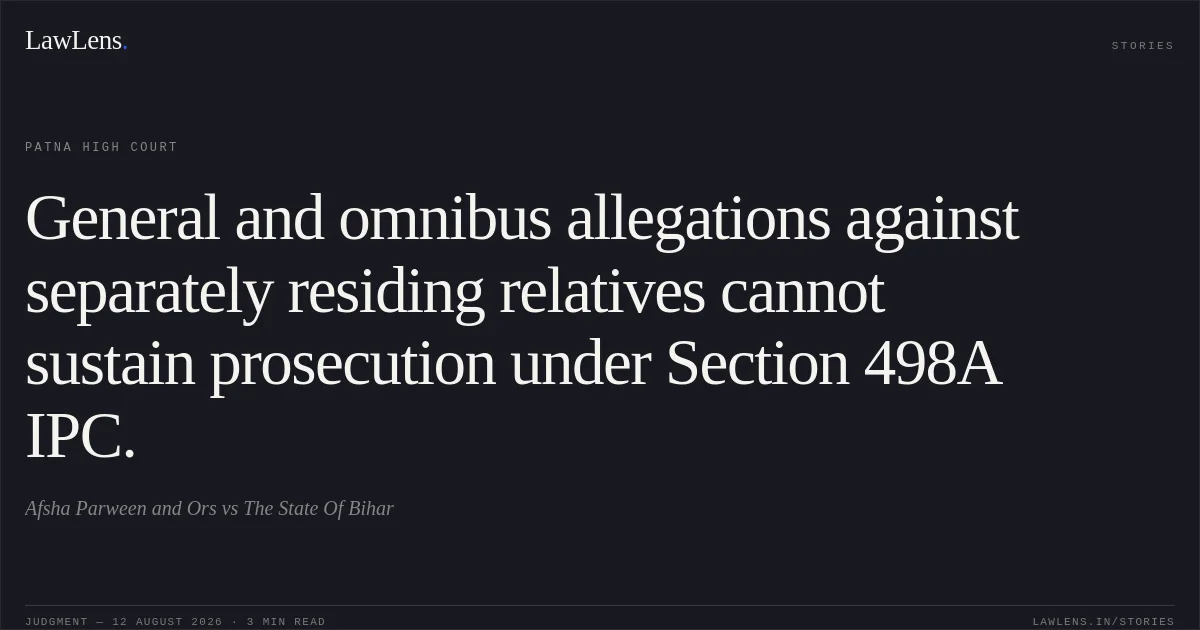
Source reference: pp. 2–4, paras. 5–6Afsha Parween, her husband Aslim Umar, and Md. Jawed @ Md. Jawed Akhtar sought quashing of the order dated 15 June 2016 by which the Sub-Divisional Judicial Magistrate, Danapur, took cognizance against them. The petitioners were respectively the married sister-in-law, her husband, and the maternal uncle of the informant’s husband. They contended that they lived separately in different districts and had been implicated through general and omnibus allegations
Source reference: p. 4, paras. 7–7.1The husband, Shahab Alam, filed the connected Criminal Miscellaneous No. 50458 of 2016, which was withdrawn and dismissed as withdrawn
Source reference: p. 2, paras. 1–3Issues
Whether the order taking cognizance under Section 498-A IPC and Sections 3/4 of the Dowry Prohibition Act should be quashed against relatives of the husband who lived separately and against whom only general and omnibus allegations were made.
Source reference: pp. 8–9, para. 10Whether the connected petition filed by the husband, Shahab Alam, should be adjudicated on merits after his counsel sought permission to withdraw it.
Source reference: p. 2, paras. 1–3Law Applied
The Court exercised its inherent jurisdiction under Section 482 of the Code of Criminal Procedure, 1973 to prevent abuse of the process of court. The prosecution invoked Section 498-A IPC, concerning cruelty by the husband or his relatives, and Sections 3/4 of the Dowry Prohibition Act, concerning giving, taking and demanding dowry
Source reference: p. 2, para. 5Applying the principles in State of Haryana v. Bhajan Lal, 1992 Supp (1) SCC 335, particularly the categories concerning proceedings that are manifestly attended with mala fides or instituted for an ulterior purpose, the Court considered whether continuation of the prosecution would constitute abuse of process
Source reference: pp. 5–6, paras. 7.5–7.6It also relied on Preeti Gupta v. State of Jharkhand, (2010) 7 SCC 667, Geeta Mehrotra v. State of U.P., (2012) 10 SCC 741, and Kahkashan Kausar v. State of Bihar, (2022) 6 SCC 599, which caution against prosecuting married sisters-in-law, brothers-in-law and distant relatives on the basis of vague, general or omnibus allegations without specific attribution of overt acts
Source reference: pp. 6–7, paras. 7.6–7.8Reasoning
The Court found that the petitioners were not members of the husband’s household: petitioner no. 1 was the married sister-in-law, petitioner no. 2 was her husband, and petitioner no. 3 was the husband’s maternal uncle; all resided separately at different places
Source reference: p. 8, para. 10Although the prosecution alleged that the petitioners had participated in dowry demands and harassment, the allegations were not supported by specific acts individually attributable to them. Applying the Supreme Court’s caution against mechanically implicating every relative in matrimonial prosecutions, the Court held that continuation of the proceedings against these separately residing relatives would amount to abuse of the process of court
Source reference: pp. 7–9, paras. 7.8, 10The Court distinguished the case of the parents-in-law, whose challenge to the cognizance order had earlier failed, on the ground that the present petitioners neither resided with the husband nor were involved in the day-to-day matrimonial affairs
Source reference: p. 8, para. 10Holding
The Court allowed Criminal Miscellaneous No. 46602 of 2016 and quashed the order dated 15 June 2016 taking cognizance in Bihta P.S. Case No. 378 of 2014 insofar as it concerned Afsha Parween, Aslim Umar and Md. Jawed @ Md. Jawed Akhtar
The connected Criminal Miscellaneous No. 50458 of 2016 filed by Shahab Alam was dismissed as withdrawn; consequently, proceedings against him were directed to continue
Source reference: p. 2, paras. 1–3; p. 9, para. 10Acts & Sections Cited
3 provisions across 2 statutes referred to in this judgment. Each provision opens on LawLens.
Code of Criminal Procedure, 19731
Original Court PDF
Afsha Parween and OrsvsThe State Of Bihar
Click to open original judgment
Original judgment, available to read, download and summarize on LawLens.in