Facts
The petitioners, who are the nanad (sister-in-law) and nandoi (husband of sister-in-law) of the informant (Opposite Party No. 2), sought quashing of a cognizance order dated 14.09.2020 involving Sections 341, 323, 379, 498A/34 of the IPC and Sections 3 and 4 of the Dowry Prohibition Act
Source reference: para. 2The informant filed the written report on 01.05.2020, four days after the death of her husband, alleging cruelty and dowry harassment since her marriage in 2007
Source reference: para. 4The petitioners established that they have resided in Patna City—approximately 17 kilometres away from the matrimonial home—and have maintained a separate household without visiting the matrimonial home since 1998
Source reference: para. 3The allegations against the petitioners were that they engaged in "womanising" and aided a general atmosphere of harassment
Source reference: para. 4Issues
1. Whether the general and omnibus allegations leveled against the petitioners, who reside separately from the matrimonial home, are sufficient to sustain a criminal prosecution under Section 498A of the IPC
Source reference: para. 52. Whether the continuation of the proceedings constitutes an abuse of the process of the court when the allegations lack specificity regarding time, date, and individual culpability
Source reference: para. 5Law Applied
Section 498A of the Indian Penal Code regarding cruelty by relatives of the husband and Sections 3 and 4 of the Dowry Prohibition Act
Source reference: para. 2Section 528 of the Bharatiya Nagarik Suraksha Sanhita, 2023 (BNSS) (the successor to Section 482 of the CrPC) for the quashing of proceedings
Source reference: para. 2The Supreme Court in Abhishek vs. State of Madhya Pradesh [(2023) INSC 779], which established that general and omnibus allegations without specific individual culpability cannot justify a criminal trial for distant relatives
Source reference: para. 5Reasoning
The court observed that the allegations against the petitioners were "entirely general and omnibus in character," lacking any specific mention of date, time, or circumstance
Source reference: para. 5It noted the absurdity of the "morally coloured assertions" regarding the petitioners' character, which do not satisfy the legal ingredients of the charged offences
Source reference: para. 5Significant weight was given to the fact that the petitioners resided 17 kilometres away and had not visited the matrimonial home for over two decades—a fact conceded by the prosecution's own records
Source reference: para. 3, 5The court highlighted the 13-year delay in filing the FIR, which was lodged only after the husband's death, without explanation for the prior silence
Source reference: para. 5Following the principle of parity, the court noted that high court orders in related petitions (Cr. Misc. No. 16948/2023) had already quashed proceedings for other co-accused on similar grounds
Source reference: para. 5Holding
The court answered the issues in the negative, holding that allowing the prosecution to continue would amount to an abuse of the process of the court
The application was allowed, and the cognizance order dated 14.09.2020 passed by the Sub-Divisional Judicial Magistrate, Munger, along with all subsequent proceedings in Kasim Bazar P.S. Case No. 160 of 2020, were quashed insofar as they concerned the two petitioners
Source reference: para. 6-7Acts & Sections Cited
7 provisions across 3 statutes referred to in this judgment. Each provision opens on LawLens.
Bharatiya Nagarik Suraksha Sanhita, 20231
Indian Penal Code, 18604
Original Court PDF
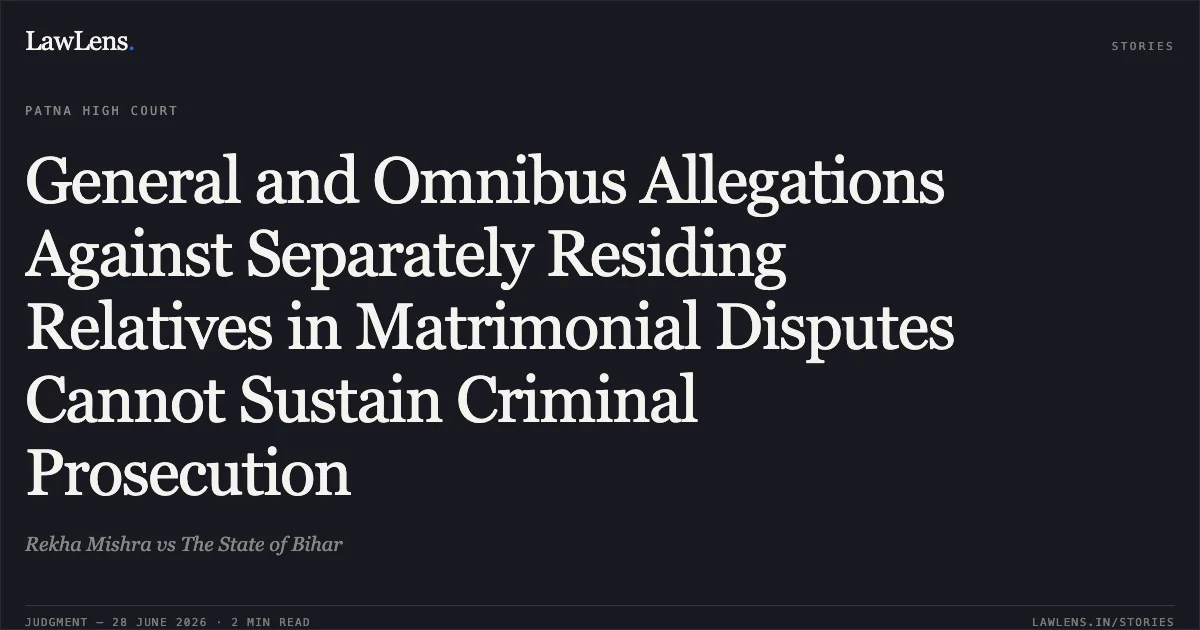
Rekha MishravsThe State of Bihar
Click to open original judgment
Original judgment, available to read, download and summarize on LawLens.in