Facts
The informant alleged that she married Rajesh Verma in June 2014 and that her father provided cash, jewellery, clothes, utensils and other articles at the time of marriage.
Source reference: p.2, para. 3She alleged that, after accompanying her husband to Surat, the accused persons assaulted her, demanded ₹5 lakhs as dowry, took away her belongings and expelled her from the matrimonial house when the demand was not fulfilled.
Source reference: p.2, para. 3On the basis of her written report dated 10 January 2016, Mahila P.S. Case No. 3 of 2016 was registered for offences under Sections 498-A, 379, 323 and 34 of the Indian Penal Code.
Source reference: p.2, para. 2Following investigation and submission of a charge-sheet, the learned S.D.J.M., Biharsharif, took cognizance of the offences against the petitioners by order dated 27 October 2016.
Source reference: p.3, para. 4The petitioners contended that petitioner nos. 1 and 3 were married sisters-in-law and petitioner no. 2 was the husband of petitioner no. 1; all were living separately and had no involvement in the informant’s day-to-day matrimonial affairs.
Source reference: p.3, para. 5They argued that the allegations against them were general and omnibus and that their prosecution was motivated by an intention to harass the husband’s relatives.
Source reference: p.3, para. 5Issues
Whether the order taking cognizance under Sections 498-A, 379, 323 and 34 IPC against the petitioners should be quashed where the allegations against married, separately residing relatives were general and omnibus in nature?
Source reference: pp.3–7, paras. 5–7Whether continuation of the criminal proceedings against the petitioners would amount to an abuse of the process of court warranting exercise of the High Court’s inherent jurisdiction under Section 482 CrPC?
Source reference: pp.5–7, paras. 16–17Law Applied
The Court exercised its inherent jurisdiction under Section 482 of the Code of Criminal Procedure to prevent abuse of process and secure the ends of justice.
Source reference: no citationIt applied the principle that criminal proceedings may be quashed where the allegations, even if accepted at face value, do not disclose an offence; where the uncontroverted allegations and collected evidence do not make out a case; where the allegations are inherently improbable; or where the proceedings are manifestly attended with mala fides or instituted to wreak vengeance, as identified in State of Haryana v. Bhajan Lal.
Source reference: pp.6–7, para. 17Relying on Abhishek v. State of Madhya Pradesh, 2023 SCC OnLine SC 1083, and the authorities discussed therein, including Kahkashan Kausar v. State of Bihar, (2022) 6 SCC 599, Preeti Gupta v. State of Jharkhand, (2010) 7 SCC 667, and Neelu Chopra v. Bharti, (2009) 10 SCC 184, the Court reiterated that vague and omnibus allegations against the husband’s relatives, particularly relatives living separately, cannot justify prosecution without specific allegations describing each accused’s role.
Source reference: pp.4–6, paras. 13–16The Court also noted that the allegations in a matrimonial complaint must contain particulars of the offence and the role played by each accused, rather than merely reproducing statutory language.
Source reference: p.5, para. 15Reasoning
The Court found that the petitioners were married relatives of the husband who were residing separately and were not connected with the informant’s daily domestic affairs.
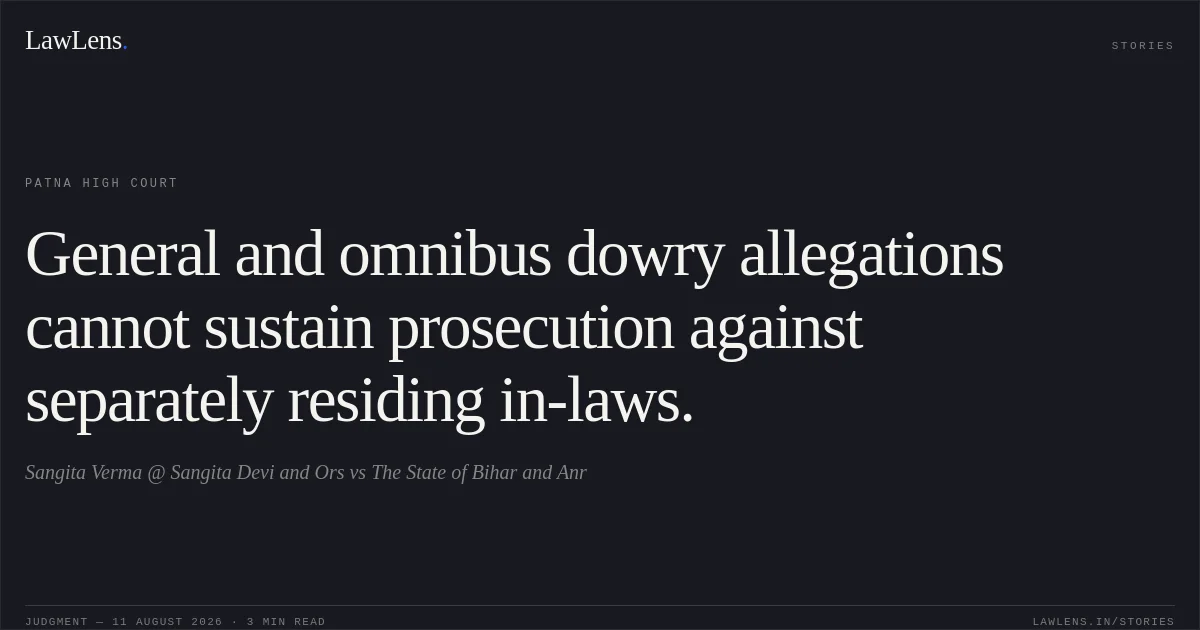
Source reference: p.7, para. 7The allegations of dowry demand and cruelty were general and omnibus and did not attribute any specific overt act or distinct role to any petitioner.
Source reference: no citationApplying the principles against prosecuting relatives solely on the basis of vague allegations in matrimonial disputes, the Court held that the materials did not justify continuation of the criminal case against these petitioners.
Source reference: no citationTheir prosecution consequently fell within the categories recognised in Bhajan Lal as cases involving abuse of the process of court and requiring intervention under Section 482 CrPC.
Source reference: pp.6–7, paras. 16–17Holding
The Patna High Court allowed the petition and quashed the order dated 27 October 2016 taking cognizance of offences under Sections 498-A, 379, 323 and 34 IPC against all the petitioners in Mahila P.S. Case No. 3 of 2016.
The criminal proceedings against the petitioners were accordingly terminated, and the order was directed to be transmitted to the trial court along with the trial court record, if any.
Source reference: p.8, paras. 8–9Acts & Sections Cited
6 provisions across 2 statutes referred to in this judgment. Each provision opens on LawLens.
Indian Penal Code, 18603
Code of Criminal Procedure, 19733
Original Court PDF
Sangita Verma @ Sangita Devi and OrsvsThe State of Bihar and Anr
Click to open original judgment
Original judgment, available to read, download and summarize on LawLens.in