Facts
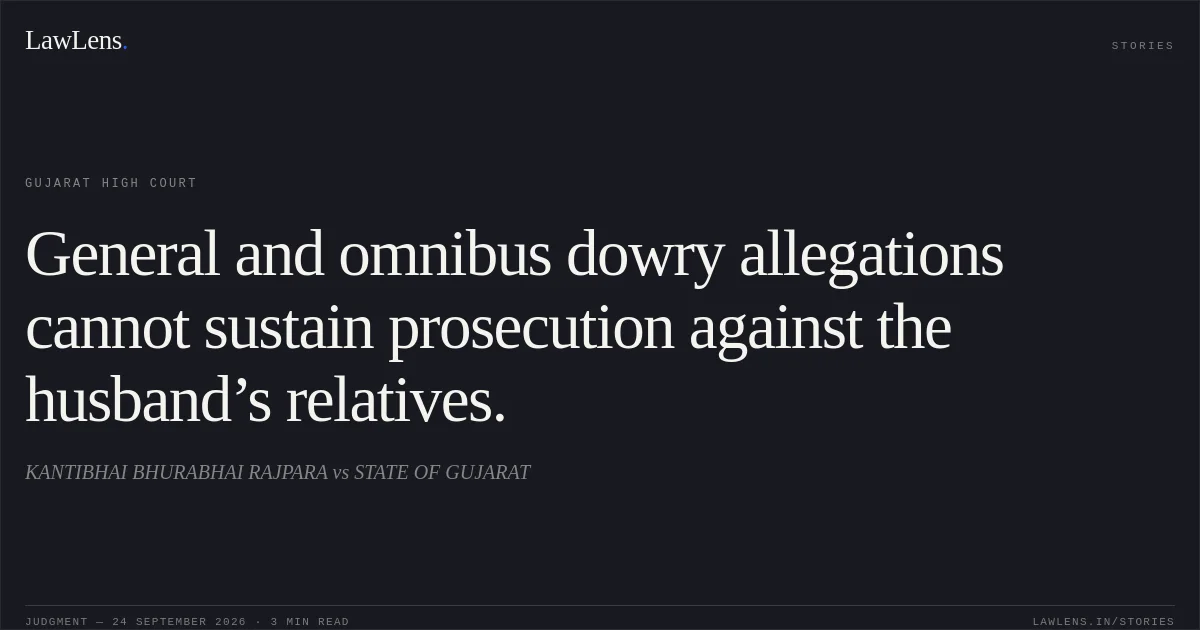
The petitioners invoked Section 482 of the Code of Criminal Procedure, 1973 (“CrPC”) seeking quashing of FIR C.R. No. I-172 of 2019 registered at Puna Police Station, Surat, for offences under Sections 498-A, 323, 406, 504 and 506(2) of the IPC and Sections 3 and 5 of the Dowry Prohibition Act.
Source reference: p.1, para.1The complainant alleged that his daughter, Chandni, married accused Pranavbhai Kantibhai Rajpara on 13 November 2014 and was thereafter subjected by her husband and in-laws to dowry demands, including gold, diamond ornaments, cash and ₹10 lakh, as well as physical and mental cruelty.
Source reference: p.2, para.2It was further alleged that, after the couple moved to Canada in February 2016, the husband assaulted and harassed Chandni, demanded money for purchasing a house, failed to provide basic necessities, and attempted to strangulate her; the in-laws allegedly instigated him telephonically from India.
Source reference: pp.2, 9–11, paras.2.1, 4.3The petitioners contended that the 2014 marriage was merely a “paper marriage,” that the couple had stayed with the in-laws only briefly before moving to Canada, and that the FIR was filed to harass them and exert pressure in relation to an alleged financial dispute.
Source reference: pp.3–5, paras.3.1–3.7The complainant disputed these assertions and maintained that Chandni had stayed with the in-laws and that her stridhan remained in their custody.
Source reference: pp.7–13, paras.4–4.7Issues
Whether the High Court should exercise its inherent jurisdiction under Section 482 CrPC to quash the FIR and consequential proceedings where the allegations against the petitioners are alleged to be vague, general and omnibus.
Source reference: pp.15–16, paras.5.3–5.5Whether the allegations against the petitioners other than the husband disclosed specific and distinct acts of dowry-related cruelty, retention of stridhan or instigation sufficient to justify continuation of the criminal prosecution.
Source reference: pp.16–18, para.5.5Whether the FIR and consequential proceedings should be quashed qua the petitioners in the circumstances of the case.
Source reference: p.18, para.5.6Law Applied
The Court applied Section 482 CrPC, which preserves the High Court’s inherent power to prevent abuse of the process of law and secure the ends of justice.
Source reference: p.15, para.5.3It relied on State of Haryana v. Bhajan Lal, AIR 1992 SC 604, which recognises that criminal proceedings may be quashed where the allegations, even if taken at face value, do not prima facie constitute an offence.
Source reference: p.15, para.5.3The Court also relied on Preeti Gupta v. State of Jharkhand, (2010) 7 SCC 667, cautioning that allegations against relatives living separately must be scrutinised carefully, particularly where matrimonial complaints contain broad or exaggerated assertions.
Source reference: pp.5–6, para.3.8; p.15, para.5.3Further, under Kahkashan Kausar @ Sonam v. State of Bihar, (2022) 6 SCC 599, relatives cannot be subjected to criminal trial on the basis of general and omnibus allegations without specific and distinct roles being attributed to them.
Source reference: p.15, para.5.3The Court considered the offences alleged under Sections 498-A, 323, 406, 504 and 506(2) IPC and Sections 3 and 5 of the Dowry Prohibition Act.
Source reference: p.1, para.1Reasoning
The Court separated the allegations against the husband from those against the in-laws.
Source reference: p.16, para.5.4It found that the principal incidents of alleged assault, extreme cruelty and desertion occurred in Canada, whereas the in-laws resided in Surat.
Source reference: p.16, para.5.5The allegations that the in-laws were dissatisfied with the dowry, retained the stridhan, behaved rudely and instigated the husband by telephone were held to be general and omnibus, without particulars identifying the specific petitioner involved, the date of any demand, the exact demand made, or any distinct act of cruelty.
Source reference: pp.16–17, para.5.5The Court held that the allegation of telephonic instigation, without supporting particulars, did not establish active participation in the alleged Canadian incidents.
Source reference: p.17, para.5.5Similarly, broad assertions that dowry demands commenced from the engagement or the first day of marriage were treated as routine, unparticularised allegations insufficient to sustain prosecution against the in-laws.
Source reference: p.17, para.5.5Applying Preeti Gupta and Kahkashan Kausar, the Court concluded that continuation of the proceedings on such allegations would constitute an abuse of the process of law.
Source reference: pp.16–18, paras.5.5–5.6Holding
The Court allowed the petition and quashed FIR C.R. No. I-172 of 2019 registered with Puna Police Station, Surat, together with all consequential proceedings, qua the petitioners.
The Rule was made absolute, with the clarification that the observations were confined to the Section 482 proceedings and would not influence the trial against any other accused.
Source reference: p.18, para.5.6The connected application for vacating interim relief was rendered infructuous and was disposed of accordingly.
Source reference: p.19, para.5.6Acts & Sections Cited
7 provisions across 3 statutes referred to in this judgment. Each provision opens on LawLens.
Code of Criminal Procedure, 19731
Indian Penal Code, 18604
Original Court PDF
KANTIBHAI BHURABHAI RAJPARAvsSTATE OF GUJARAT
Click to open original judgment
Original judgment, available to read, download and summarize on LawLens.in