Facts
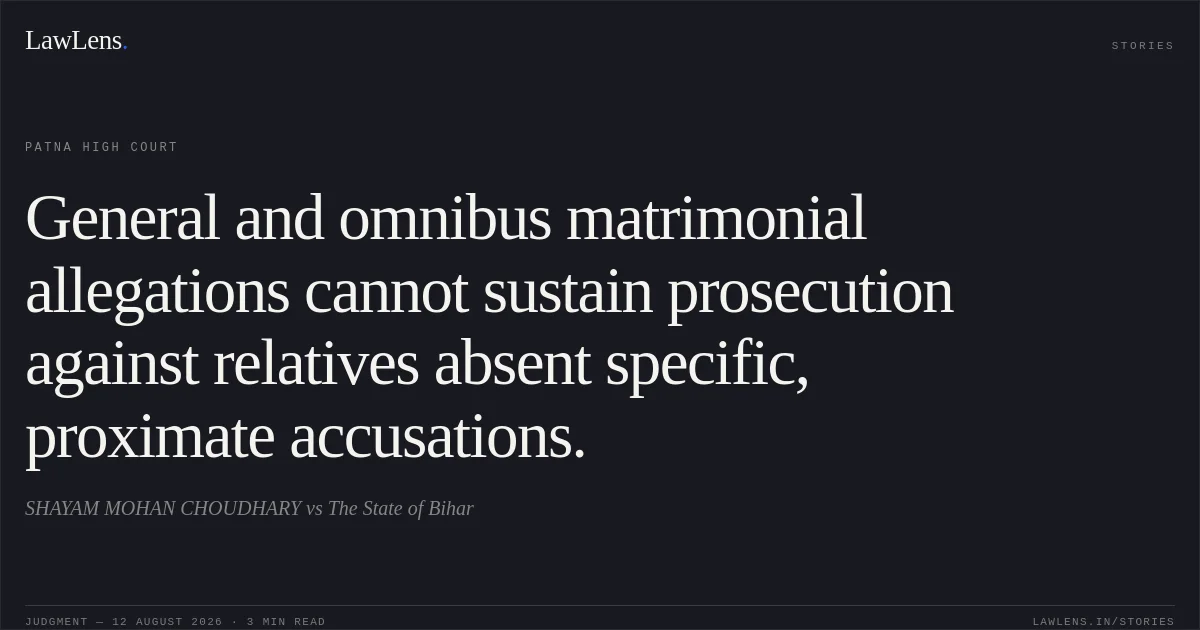
The petitioners—comprising the father-in-law, mother-in-law, brothers-in-law and cousin father-in-law of Opposite Party No. 2—were accused in Bahadurpur P.S. Case No. 666 of 2022 arising from matrimonial allegations of mental and physical cruelty, dowry demand and assault.
Source reference: pp. 2–4, paras. 2, 5–6The marriage between Opposite Party No. 2 and the son of Petitioner No. 1 took place on 2 May 2022, and she allegedly stayed at the matrimonial home for approximately nine days.
Source reference: pp. 2–4, paras. 2, 5–6The Sub-Divisional Judicial Magistrate, Darbhanga, took cognizance on 1 June 2023 under Sections 341, 323, 504 and 498-A read with Section 34 of the IPC and Sections 3 and 4 of the Dowry Prohibition Act.
Source reference: p. 2, para. 2Subsequently, charges were framed on 20 September 2024 under Sections 498-A, 323, 341 and 504 read with Section 34 of the IPC against all petitioners, and under Sections 3 and 4 of the Dowry Prohibition Act against Petitioners Nos. 2 and 4.
Source reference: p. 2, para. 2Issues
Whether the criminal proceedings against the petitioners should be quashed where the FIR and accompanying materials contained only general, sweeping and omnibus allegations, without specific acts of cruelty, assault or dowry demand being attributed to them?
Source reference: pp. 5–7, paras. 10–11Whether the High Court could interfere with the order framing charges when the allegations and materials did not disclose a prima facie case against the petitioners?
Source reference: pp. 10–11, paras. 15–16Whether the allegations relating to dowry demand and payment were sufficient to sustain the charges under Sections 3 and 4 of the Dowry Prohibition Act against the concerned petitioners?
Source reference: pp. 4–5, paras. 7–9Law Applied
The Court considered the offences alleged under Sections 341, 323, 504 and 498-A read with Section 34 of the IPC and Sections 3 and 4 of the Dowry Prohibition Act.
Source reference: p. 2, para. 2It applied the principle that relatives of a spouse should not be subjected to criminal prosecution in matrimonial disputes merely on the basis of general and omnibus allegations; specific acts, proximate allegations and supporting material must disclose the ingredients of a criminal offence.
Source reference: pp. 6–10, paras. 11–14Relying on Kahkashan Kausar v. State of Bihar, (2022) 6 SCC 599, the Court held that generalized allegations without a specific role attributed to the accused should not compel relatives to undergo the rigours of trial.
Source reference: pp. 7–8, para. 12It further relied on Dara Laxmi Narayana v. State of Telangana, (2025) 3 SCC 735, concerning the impermissible roping-in of relatives in matrimonial disputes, and Geddam Jhansi v. State of Telangana, 2025 SCC OnLine SC 263, which emphasized that criminal proceedings in domestic disputes require specific allegations and credible supporting material.
Source reference: pp. 8–10, paras. 13–14The Court also relied on Onkar Nath Mishra v. State (NCT of Delhi), (2008) 2 SCC 561, for the proposition that an order framing charges may be interfered with in an appropriate case where the charges are not prima facie sustainable.
Source reference: p. 10, para. 15Reasoning
The Court found that the allegations against the petitioners were vague, general and sweeping, principally concerning an alleged demand for Rs. 10 lakhs and casual assertions of cruelty, without identifying specific incidents or individual overt acts.
Source reference: pp. 5–7, paras. 10–11It also noted that the principal matrimonial dispute appeared to be between Opposite Party No. 2 and her husband, while the petitioners had stayed with her only for a short period and, in some cases, subsequently lived or worked separately.
Source reference: p. 6, para. 10The alleged dowry payments and demands were not supported by sufficiently particularized allegations connecting each petitioner with the statutory offences, and the framing of charges itself did not cure the absence of prima facie material.
Source reference: pp. 4–5, 7, paras. 7–10Applying the safeguards against over-implication recognized in the cited Supreme Court decisions, the Court held that continuation of the prosecution against these family members would serve no legitimate purpose and would amount to an abuse of the process of law.
Source reference: pp. 10–11, paras. 15–16Holding
The High Court held that the prosecution against the petitioners was based on general and omnibus allegations, lacked specific and proximate material establishing their individual criminal liability, and constituted an abuse of the process of law.
Accordingly, the orders dated 1 June 2023 taking cognizance and 20 September 2024 framing charges in Bahadurpur P.S. Case No. 666 of 2022 were quashed and set aside insofar as they related to the petitioners.
Source reference: p. 11, paras. 16–17The criminal miscellaneous application was allowed.
Source reference: p. 11, paras. 16–17Acts & Sections Cited
6 provisions across 2 statutes referred to in this judgment. Each provision opens on LawLens.
Indian Penal Code, 18604
Original Court PDF
SHAYAM MOHAN CHOUDHARYvsThe State of Bihar
Click to open original judgment
Original judgment, available to read, download and summarize on LawLens.in