Facts
Kumari Pallavi alleged that she married Abhishek Kumar on 4 July 2010 and that her father gave cash, jewellery and other articles at the time of marriage. She further alleged that, after marriage, the accused demanded an additional dowry of ₹5,00,000, received ₹2,00,000 from her father, and subsequently subjected her to cruelty for non-fulfilment of dowry demands. She alleged that she was ultimately driven out of her matrimonial home on 8 March 2017
Source reference: pp. 2–3, paras. 3–4After examining the complainant on solemn affirmation and the enquiry witnesses, the Sub-Divisional Judicial Magistrate, East Muzaffarpur, took cognizance on 28 March 2018 against the petitioners and others for offences under Section 498-A of the Indian Penal Code and Sections 3 and 4 of the Dowry Prohibition Act
Source reference: p. 3, para. 5During the pendency of the petition, petitioner no. 1, Kaushal Kumar Verma, died; accordingly, the petition became infructuous as against him and survived only against petitioner no. 2, Indu Verma, the complainant’s mother-in-law
Source reference: p. 1, paras. 1–2Issues
Whether the allegations in the complaint disclosed a prima facie case under Section 498-A IPC and Sections 3 and 4 of the Dowry Prohibition Act against Indu Verma, the complainant’s mother-in-law?
Source reference: pp. 3–4, paras. 5–6; p. 8, para. 9Whether continuation of the criminal proceedings against Indu Verma, in the presence of general and omnibus allegations and her alleged separate residence from the complainant’s matrimonial household, amounted to an abuse of the process of court warranting exercise of inherent jurisdiction?
Source reference: pp. 4–8, paras. 6–10Whether the proceedings had become infructuous against petitioner no. 1 on account of his death during the pendency of the petition?
Source reference: p. 1, paras. 1–2Law Applied
The Court considered Section 498-A IPC, which penalises cruelty by the husband or his relatives, and Sections 3 and 4 of the Dowry Prohibition Act, concerning giving or taking dowry and demanding dowry
Source reference: p. 3, paras. 3–5It applied the High Court’s inherent power under Section 482 CrPC to prevent abuse of process and secure the ends of justice.
Source reference: no citationRelying principally on Abhishek v. State of Madhya Pradesh, 2023 SCC OnLine SC 1083, and the authorities discussed therein, including Kahkashan Kausar v. State of Bihar, (2022) 6 SCC 599, Preeti Gupta v. State of Jharkhand, (2010) 7 SCC 667, and Neelu Chopra v. Bharti, (2009) 10 SCC 184, the Court held that general and omnibus allegations against the husband’s relatives, without specific particulars of their individual roles, may justify quashing where continuation of prosecution would constitute abuse of process
Source reference: pp. 4–6, paras. 7–8The Court also relied on the illustrative categories in State of Haryana v. Bhajan Lal, 1992 Supp (1) SCC 335, particularly cases where the allegations, even if accepted at face value, do not make out an offence, are inherently improbable, or show that the proceeding is maliciously instituted
Source reference: pp. 6–7, para. 8Reasoning
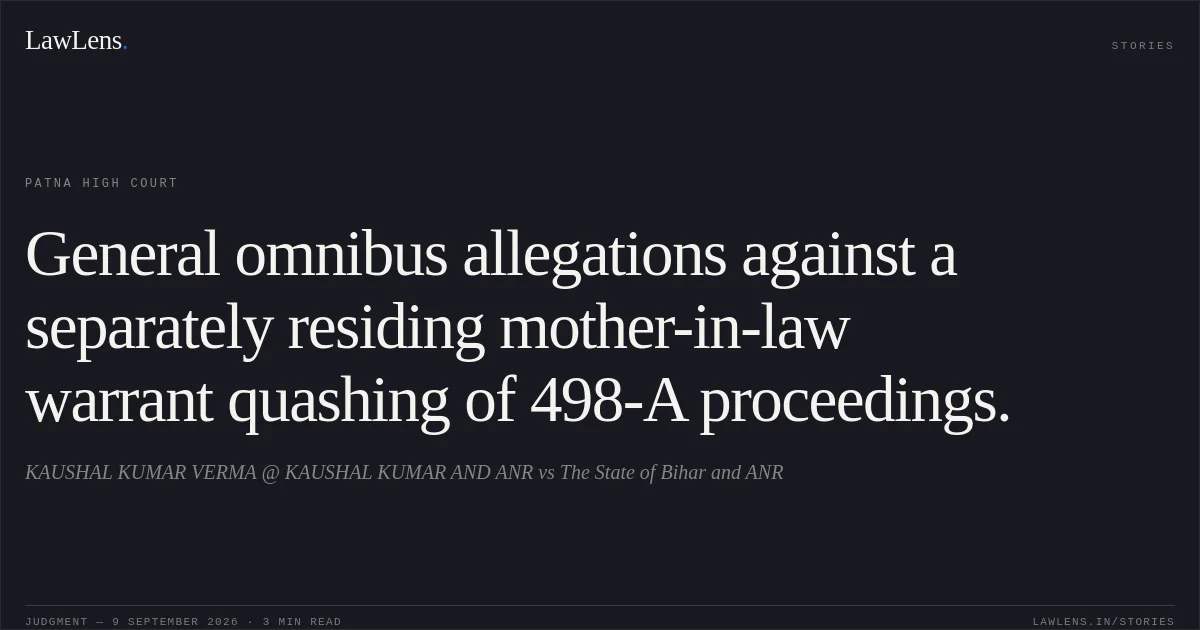
The Court found that Indu Verma was the complainant’s mother-in-law and was stated to be living separately, without involvement in the complainant’s day-to-day domestic affairs
Source reference: p. 8, para. 9The allegations against her were considered general and omnibus, lacking specific particulars of the acts allegedly constituting cruelty, dowry demand, or participation in the alleged offences
Source reference: pp. 4–5, paras. 6–8Applying the principles in Abhishek, Kahkashan Kausar, Preeti Gupta, and Neelu Chopra, the Court held that merely naming a relative of the husband, without attributing a specific role, was insufficient to sustain criminal proceedings.
Source reference: pp. 6–8, paras. 8–10In those circumstances, permitting the prosecution to continue would amount to an abuse of the process of court within the principles stated in Bhajan Lal
Source reference: pp. 6–8, paras. 8–10As petitioner no. 1 had died, the challenge on his behalf no longer required adjudication
Source reference: p. 1, paras. 1–2Holding
The Court held that the proceedings against petitioner no. 1, Kaushal Kumar Verma, had become infructuous due to his death
As regards petitioner no. 2, Indu Verma, the Court held that the general and omnibus allegations, coupled with her separate residence and lack of demonstrated involvement in the complainant’s daily matrimonial affairs, did not justify continuation of the prosecution
Source reference: p. 8, paras. 9–10Accordingly, the cognizance order dated 28 March 2018 in Trial No. 2671 of 2018 arising out of Complaint Case No. 1518 of 2017, together with all consequential proceedings against Indu Verma, was quashed and set aside.
Source reference: p. 8, paras. 10–12The application was allowed, and a copy of the judgment was directed to be communicated to the trial court
Source reference: p. 8, paras. 10–12Acts & Sections Cited
5 provisions across 2 statutes referred to in this judgment. Each provision opens on LawLens.
Code of Criminal Procedure, 19733
Original Court PDF
KAUSHAL KUMAR VERMA @ KAUSHAL KUMAR AND ANRvsThe State of Bihar and ANR
Click to open original judgment
Original judgment, available to read, download and summarize on LawLens.in