Facts
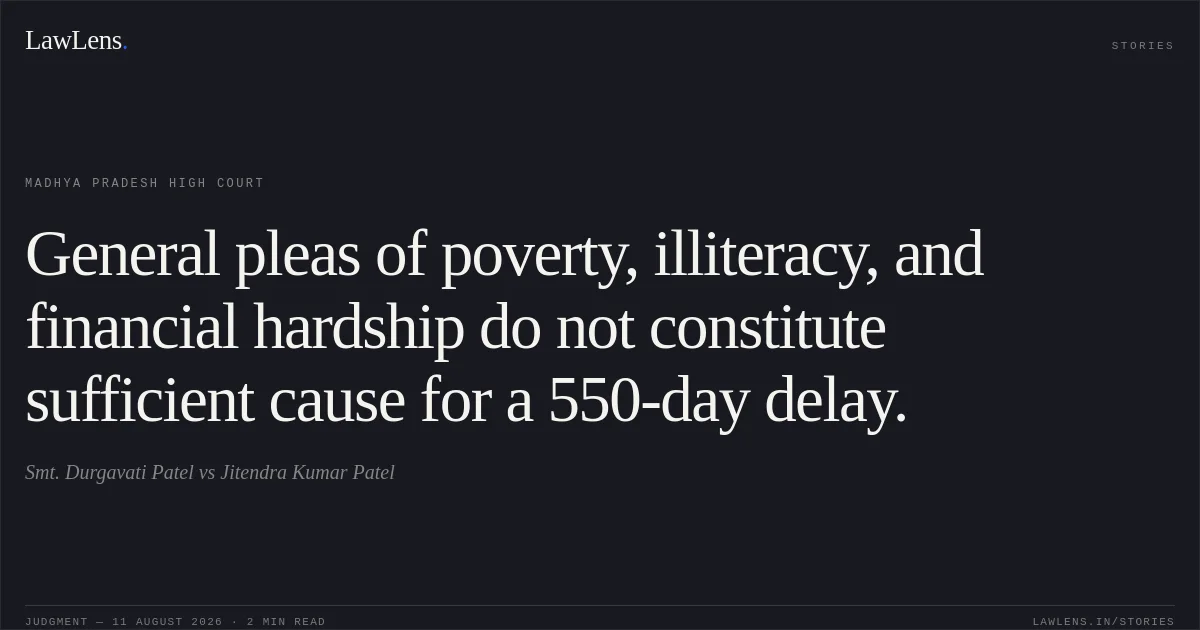
The appellants filed a miscellaneous appeal with a delay of approximately 550 days and moved I.A. No. 16462/2026 seeking condonation of delay.
Source reference: para. 1They submitted that they were poor, less educated, unaware of legal procedures, and unable to arrange the requisite court fees until they received the compensation amount. They contended that the delay was neither intentional nor deliberate and resulted from genuine financial difficulties.
Source reference: para. 2The High Court heard the application and examined the record.
Source reference: para. 3Issues
Whether the appellants had shown sufficient cause for condoning the delay of approximately 550 days in filing the miscellaneous appeal?
Source reference: paras. 1–4Whether poverty, lack of education, lack of legal knowledge, and difficulty in arranging court fees constituted adequate grounds for condonation of the entire delay?
Source reference: para. 4Law Applied
The Court applied the principle governing condonation of delay under the law of limitation, namely that an applicant must establish a legally sufficient and satisfactory explanation for the entire period of delay.
Source reference: paras. 1, 4, 7It relied on Pundlik Jalam Patil v. Executive Engineer, Jalgaon Medium Project, (2008) 17 SCC 448, for the principles that courts cannot revive belated and stale claims merely on equitable grounds, that “delay defeats equity,” and that the law assists vigilant litigants rather than those who sleep over their rights.
Source reference: para. 5The Court also relied on Majji Sannemma @ Sanyasirao v. Reddy Sridevi, AIR 2022 SC 332, which followed the same approach.
Source reference: para. 5Further, relying on Shivamma (Dead) by LRs v. Karnataka Housing Board and Others, Civil Appeal No. 11794 of 2025, the Court reiterated that delay should not be condoned on frivolous or superficial grounds and that litigants cannot be permitted to act lethargically or apathetically.
Source reference: para. 6Reasoning
The Court found that the appellants’ reasons—poverty, limited education, lack of legal knowledge, and inability to arrange court fees—were general assertions and did not satisfactorily account for the entire period of 550 days.
Source reference: para. 4Applying the requirement of “sufficient cause” and the Supreme Court’s caution against condoning unexplained and inordinate delay, the Court held that the explanation was inadequate and that the delay could not be excused merely on equitable or sympathetic considerations.
Source reference: paras. 4–7The appellants therefore failed to establish a proper basis for condonation under the applicable limitation principles.
Source reference: para. 7Holding
The High Court held that no sufficient cause had been shown for condoning the delay of approximately 550 days.
Accordingly, I.A. No. 16462/2026 was dismissed, and, as a consequence, the miscellaneous appeal itself was also dismissed.
Source reference: paras. 7–8Acts & Sections Cited
1 provisions across 1 statute referred to in this judgment. Each provision opens on LawLens.
Code of Civil Procedure, 19081
Original Court PDF
Smt. Durgavati PatelvsJitendra Kumar Patel
Click to open original judgment
Original judgment, available to read, download and summarize on LawLens.in