Facts
The appellant was convicted by the Special Judge, West Tripura, under Section 6 of the Protection of Children from Sexual Offences Act, 2012 (POCSO Act), and Sections 449 and 342 of the Indian Penal Code, 1860 (IPC), arising from an alleged sexual assault on a seven-year-old child.
Source reference: p. 1, 5–6The prosecution case was that the appellant entered the child’s home while she was alone and touched her private parts; the incident was disclosed to her mother three days later, and the FIR was lodged on 11 May 2021.
Source reference: p. 1, 5–6The child testified at trial, and her statement recorded by a Magistrate during investigation was also proved.
Source reference: p. 2–3The appellant challenged the conviction, arguing, among other things, that the evidence was unreliable, the FIR was delayed, and there was no medical evidence.
Source reference: p. 2–3Issues
Whether the child’s testimony and the other evidence were sufficient to sustain a finding of sexual assault despite the appellant’s challenges concerning the testimony, delay in lodging the FIR, and absence of medical evidence.
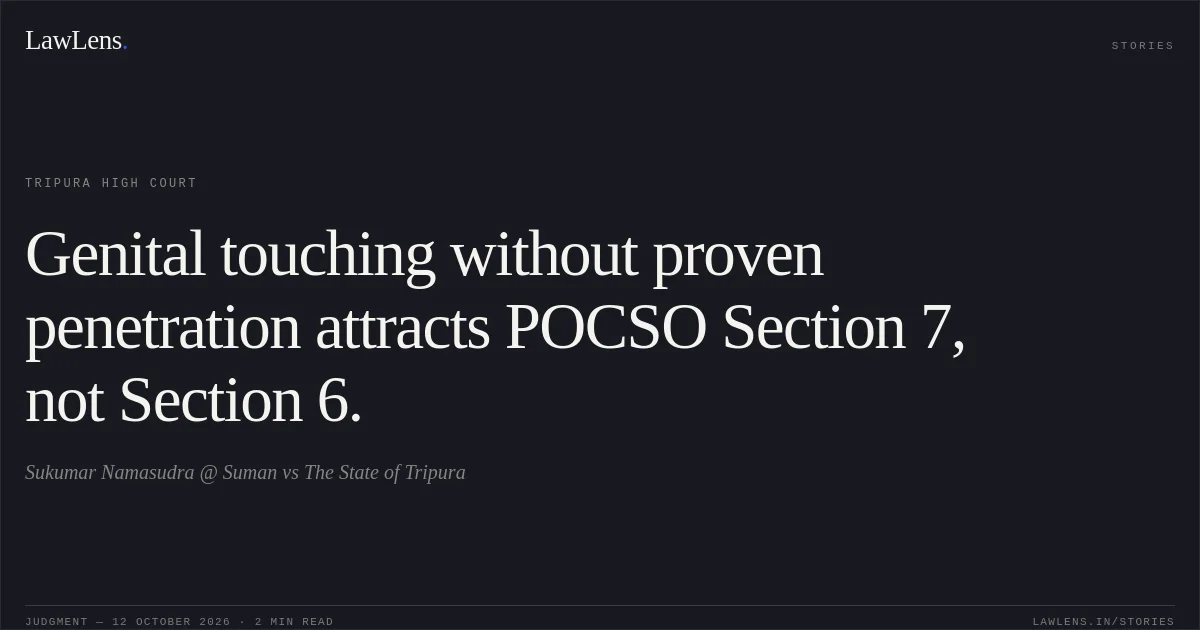
Source reference: p. 2–4, 9–10Whether the proved conduct amounted to a penetrative sexual offence punishable under Section 6 of the POCSO Act, or instead to sexual assault under Section 7, punishable under Section 8.
Source reference: p. 10–11Law Applied
Section 7 of the POCSO Act defines sexual assault as sexual-intent physical contact with a child involving specified body parts, or another act involving physical contact, where there is no penetration; Section 8 prescribes the punishment for that offence.
Source reference: p. 11The Court distinguished that offence from the penetrative sexual offence charged under Section 6, concluding that the evidence did not establish penetration.
Source reference: p. 10–11It also directed that the appellant receive set-off for detention already undergone under Section 428 of the Code of Criminal Procedure, 1973, corresponding to Section 468 of the Bharatiya Nagarik Suraksha Sanhita, 2023.
Source reference: p. 11Reasoning
The Court accepted the child’s evidence that the appellant removed clothing and touched his private part to hers, and noted that her account was also recorded before a Magistrate during the investigation.
Source reference: p. 6–10The alleged contradiction put to the child in cross-examination was not confirmed by the investigating officer; the Court therefore found no basis to extend the appellant the benefit of that alleged discrepancy.
Source reference: p. 6–10The Court nevertheless assessed the nature of the proved conduct separately from the child’s identification of the appellant: it held that the prosecution had not established penetration, so Section 6 was not made out.
Source reference: p. 10–11The described physical contact, however, fell within Section 7.
Source reference: p. 10–11Holding
The appeal was allowed in part.
The Court modified the conviction, finding the appellant guilty of sexual assault under Section 7 of the POCSO Act and sentencing him under Section 8 to five years’ rigorous imprisonment and a fine of ₹10,000, with four months’ rigorous imprisonment in default.
Source reference: p. 11It set off the period of detention already undergone and directed that any fine realised be deposited with the trial court for payment to the victim’s father for the victim’s welfare.
Source reference: p. 11–12The convictions and sentences for the other offences were interfered with and modified.
Source reference: p. 11–12Acts & Sections Cited
12 provisions across 4 statutes referred to in this judgment. Each provision opens on LawLens.
Code of Criminal Procedure, 19733
Indian Penal Code, 18604
Bharatiya Nagarik Suraksha Sanhita, 20231
Original Court PDF
Sukumar Namasudra @ SumanvsThe State of Tripura
Click to open original judgment
Original judgment, available to read, download and summarize on LawLens.in