Facts
The Petitioner, a 90-year-old retired IPS officer and life beneficiary of the Central Government Health Services (CGHS), sought full reimbursement for his late wife’s cancer treatment
Source reference: para. 2His wife suffered from advanced oral cancer that escalated into an emergency involving airway obstruction
Source reference: para. 3On the advice of specialists, she underwent Dendritic Cell Immunotherapy (DCT) at a private clinic and laser surgery at a non-empanelled hospital because these treatments were unavailable at CGHS empanelled facilities
Source reference: para. 3The Petitioner filed two claims: MRC-1 (Rs. 5,27,508/-) and MRC-2 (Rs. 5,04,362/-). The Department partially reimbursed these, leaving a balance of Rs. 3,14,348/-
Source reference: para. 7The High-Powered Committee (HPC) rejected the remainder, classifying DCT as an "unapproved/experimental" therapy despite the Ministry of Defence (ECHS) having sanctioned it for other patients
Source reference: para. 4, 9, 13Issues
1. Whether the Respondents are justified in denying full medical reimbursement on the grounds that the treatment was "experimental/unapproved" or obtained at a non-empanelled facility during a medical emergency
Source reference: para. 1, 152. Whether the technical opinion of a committee can override the clinical judgment of treating physicians in life-threatening situations
Source reference: para. 21, 22Law Applied
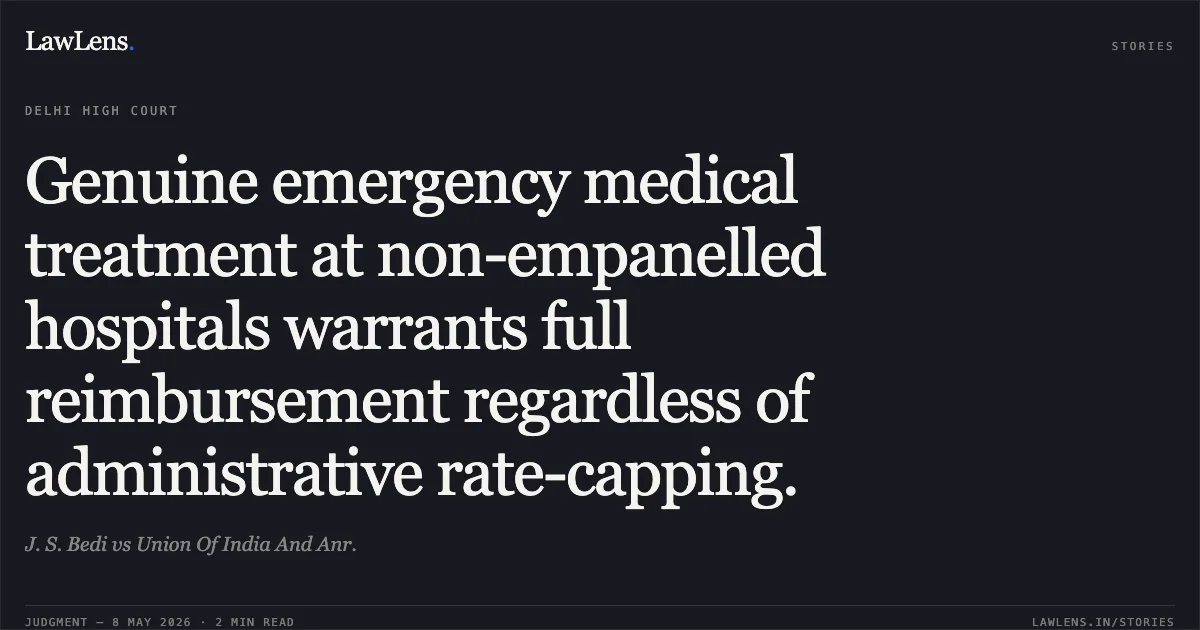
The Court primarily relied on the Supreme Court’s decision in Shiva Kant Jha v. Union of India, which established that the right to medical claim cannot be denied on technical grounds or because a hospital is not empanelled, provided the treatment is genuine
Source reference: para. 15It applied the principle that the ultimate decision on treatment vests with the doctor, not administrative committees
Source reference: para. 15, 21The Court also cited the Office Memorandum dated 20.02.2009 (Ministry of Health and Family Welfare), which allows reimbursement in excess of approved rates for emergencies involving advanced malignancy
Source reference: para. 19Further precedents included Basant Dabas v. Govt of India and Jagir Kaur v. Union of India, affirming that genuine emergency treatment at private facilities merits full reimbursement
Source reference: para. 16, 17, 18Reasoning
The Court reasoned that the Petitioner’s wife faced an "imminent risk of asphyxiation," making the treatment choice a specialized medical decision rather than an elective one
Source reference: para. 21It rejected the Respondents' argument that DCT was "experimental," noting that the Government's own circular (OM dated 20.02.2009) specifically provides for reimbursement in cases of advanced malignancy
Source reference: para. 19, 20The Court observed an "institutional tendency" of committees to place procedural barriers before bonafide medical decisions, citing a previous instance where the Petitioner had to seek the Secretary's intervention to override a similar rejection of approved drugs
Source reference: para. 6Crucially, the Court clarified that the restrictive phraseology in Shiva Kant Jha (limiting the decision to the facts of that case) does not efface the legal ratio that health schemes must be responsive and humane under a welfare state
Source reference: para. 24Holding
The Court held that the Petitioner is entitled to the full outstanding balance of Rs. 3,14,348/-
It quashed the decisions of the High-Powered Committee dated 11.01.2019 and 11.02.2019
Source reference: para. 1, 9The Court directed the appropriate Committee to consider the claims in light of this judgment and ensure reimbursement within three months
Source reference: para. 26The petition was disposed of with the finding that technical and administrative objections cannot penalize a beneficiary for seeking life-saving treatment recommended by qualified doctors
Source reference: para. 21, 27Original Court PDF
J. S. BedivsUnion Of India And Anr.
Click to open original judgment
Original judgment, available to read, download and summarize on LawLens.in