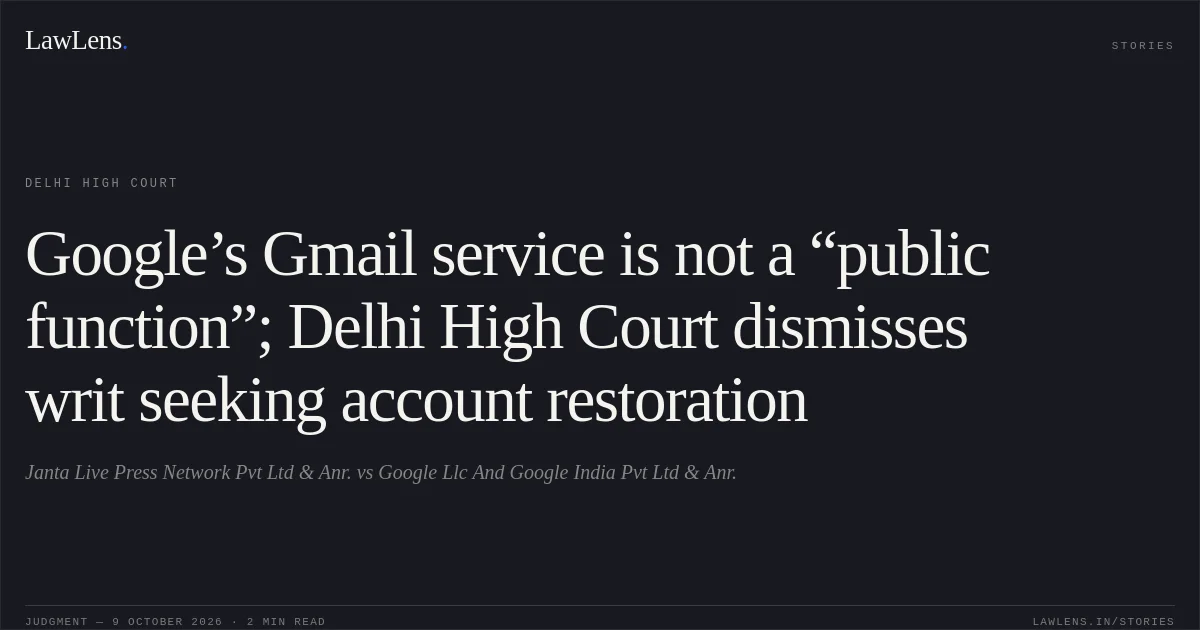
Facts
Petitioner No. 1, a media company operating the ‘Janta Live News’ business and YouTube channel, used the Gmail account at issue; Petitioner No. 2 was its director.
Source reference: para. 2–3The petitioners alleged that third parties accessed the account without authorisation on 20 July 2026, after which Google disabled it for “unusual activity.”
Source reference: para. 2–3Petitioner No. 2 contacted Google Support, but received no response, and the petitioners also lodged a complaint with the Cyber Police Station.
Source reference: para. 2–3They sought a writ directing Google to verify their recovery credentials and restore full access to the account, relying on the public-function doctrine and the Information Technology Act, 2000 and the 2021 Rules.
Source reference: para. 1, 4Issues
1. Whether Google’s provision of email services, and its suspension of the petitioners’ account, constituted a public function or public duty sufficient to make the writ petition maintainable under Article 226.
Source reference: para. 5–7, 102. Whether the decision in XYZ v. Union of India & Ors., 2026:DHC:8440, or obligations under the Information Technology Act, 2000 and the Information Technology (Intermediary Guidelines and Digital Media Ethics Code) Rules, 2021, made the petition maintainable.
Source reference: para. 8–9Law Applied
Under Article 226 of the Constitution, a writ may lie against a private body where it performs a public function; the relevant inquiry concerns the nature of the function, including whether it is similar or closely related to a function performable by the State in its sovereign capacity (G. Bassi Reddy v. International Crops Research Institute, (2003) 4 SCC 225).
Source reference: para. 6The provision of commercial email services, or the suspension of an account on security grounds, does not, without more, amount to a public function or public duty.
Source reference: para. 7Statutory obligations concerning grievance redressal and intermediary compliance under the Information Technology Act, 2000 and the 2021 Rules do not automatically convert account-restriction disputes into matters amenable to writ jurisdiction.
Source reference: para. 9Reasoning
The Court treated the account-access dispute as arising from Google’s provision of a commercial service, rather than the discharge of a State function.
Source reference: para. 7The account’s importance to the petitioners’ media business, and the widespread use of Google’s services, did not change the nature of that function; email services were also available from independent providers and were not monopolised by Google.
Source reference: para. 7The Court distinguished XYZ, which concerned informational privacy and the continued online availability and searchability of judicial records, from this petition, which sought restoration of an email account.
Source reference: para. 8The statutory obligations relied upon by the petitioners likewise did not, by themselves, establish a public function.
Source reference: para. 9Holding
The Court held that the petitioners had not demonstrated a public function in the strict legal sense required to invoke Article 226.
It found the writ petition not maintainable and dismissed it, while leaving the petitioners at liberty to pursue appropriate legal remedies in accordance with law.
Source reference: para. 11–12Original Court PDF
Janta Live Press Network Pvt Ltd & Anr.vsGoogle Llc And Google India Pvt Ltd & Anr.
Click to open original judgment
Original judgment, available to read, download and summarize on LawLens.in