Facts
The West Bengal College Service Commission ("Commission") recommended the writ petitioner (Tamal Dasgupta) for the post of Assistant Professor in English at the appellant College.
Source reference: para. 5The College’s Governing Body refused to issue an appointment letter, citing the petitioner’s social media posts which contained "obscene, scurrilous, demeaning and insulting remarks" against religion, the Ramkrishna Mission, and its monks.
Source reference: para. 6The College contended these views were anti-ethical to its philosophy and would vitiate the academic atmosphere.
Source reference: para. 7, 29The writ petitioner challenged this refusal. A Single Judge directed the College to appoint the petitioner.
Source reference: para. 3The College appealed, and the petitioner filed a cross-objection regarding certain recordings in the judgment.
Source reference: para. 1, 54Issues
1. Whether a government-aided college is under an absolute obligation to accept a recommendation for the appointment of teaching staff made by the Commission without any right of refusal.
Source reference: para. 302. Whether, in the specific facts of the case, the appellants were justified in refusing to grant appointment to the writ petitioner based on his conduct/views.
Source reference: para. 30, 48Law Applied
Interpretation of Sections 7, 8, and 10 of the West Bengal College Service Commission Act, 2012, noting that while appointment must be made on the Commission's recommendation, the Act allows for "re-recommendation" in certain cases, implying recommendations are not always absolute.
Source reference: para. 35-37The precedent The Governing Body of Bankim Sardar College & Anr. v. State of West Bengal, which held that the final decision to appoint remains with the college, provided the refusal is bona fide, non-arbitrary, and in the institution's best interest.
Source reference: para. 31-32, 43Principles from the Indian Contract Act, 1872 regarding the voluntary nature of employment contracts and the Specific Relief Act, 1963, which generally prohibits the specific performance of a contract of personal service.
Source reference: para. 39-40Reasoning
The Court reasoned that the Act of 2012 ensures minimum teaching standards but does not override the fundamental legal requirement that a contract (including employment) must be entered into by free will.
Source reference: para. 39, 42The power to recommend does not equate to a power to force an unwilling employer into a contract of service unless the refusal is mala fide.
Source reference: para. 41, 45The Court found that the petitioner’s Facebook posts—which targeted the very institution he sought to join and its religious foundations—provided a "plausible" ground for the Governing Body to deem him unsuitable.
Source reference: para. 49-51The Court emphasized that while the petitioner has a right to free speech and religion, the College’s refusal to hire him does not infringe upon those rights; it merely reflects a decision that his expressed views are "inimical to the concerned educational institution".
Source reference: para. 52-53Because the decision was plausible and aimed at protecting the college atmosphere, it was neither arbitrary nor mala fide.
Source reference: para. 51Holding
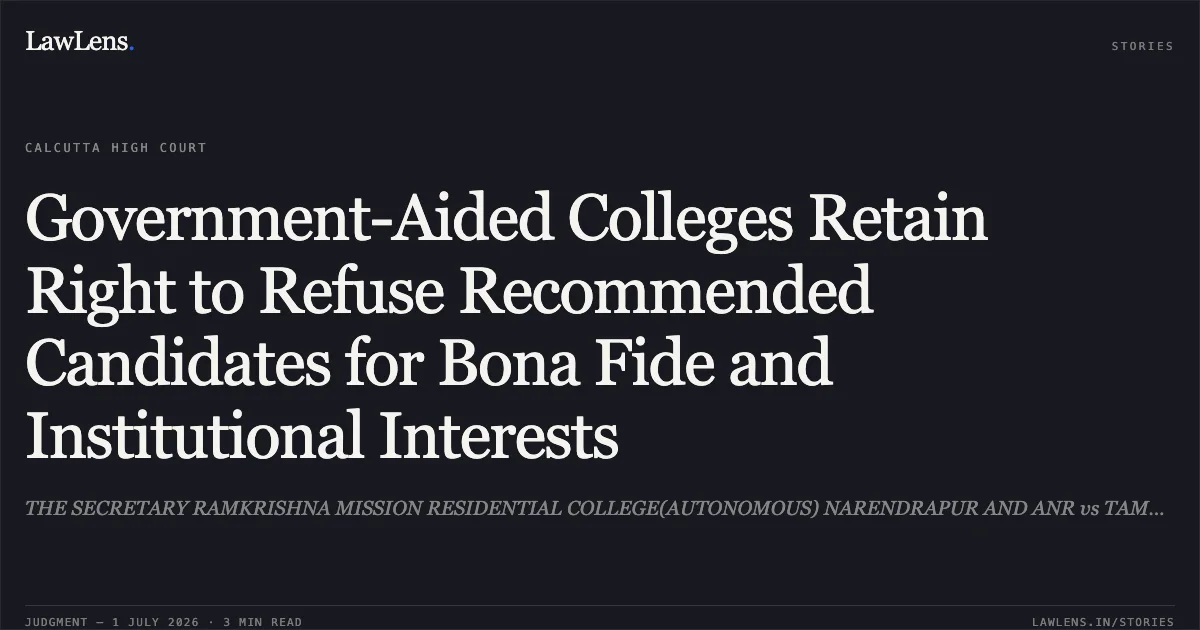
The Court held that a college governed by the Act of 2012 possesses a right of refusal over Commission recommendations if the decision is bona fide and in the institution's best interest.
The Court found the appellant College’s refusal justified due to the petitioner’s derogatory public remarks against the Mission's monks and ideology.
Source reference: para. 51The Court set aside the Single Judge’s order, allowed the appeal (MAT 1604 of 2025), and dismissed the writ petitioner's cross-objection; the College is not required to appoint the petitioner.
Source reference: para. 56Acts & Sections Cited
9 provisions across 3 statutes referred to in this judgment. Each provision opens on LawLens.
West Bengal College Service Commission Act, 20125
West Bengal College Teachers ( Security Of Service ) Act, 19751
Original Court PDF
THE SECRETARY RAMKRISHNA MISSION RESIDENTIAL COLLEGE(AUTONOMOUS) NARENDRAPUR AND ANRvsTAMAL DASGUPTA AND ORS
Click to open original judgment
Original judgment, available to read, download and summarize on LawLens.in