Facts
The Petitioners claimed title to land bearing Old Survey No. 66, New Survey No. 15, corresponding to CTS No. 31, admeasuring 8,697.60 sq. metres at Village Paspoli, Mumbai. Their claim was based on historical conveyances and assignments culminating in a 1938 indenture in favour of the predecessor holders of Petitioner Nos. 1 to 4.
Source reference: paras. 2–4A 1963 consent decree in Suit No. 316 of 1953 recognised that certain properties, including the subject property, had been appropriated and continued to vest in the original landholders rather than the Government.
Source reference: para. 5Despite this, a City Survey Inquiry conducted in 1967 resulted in the name of Bombay Municipal Water Works/MCGM being entered in the relevant property records. The Petitioners challenged the entry before the revenue authorities, but the proceedings ultimately resulted in the MCGM’s claim being maintained.
Source reference: paras. 6.1–6.3The Petitioners thereafter filed a civil suit seeking declaration of title, which remained pending, and subsequently instituted the present writ petition seeking correction of the revenue records and demarcation of the property.
Source reference: para. 6.4MCGM contended that the land had been acquired in the nineteenth century for Vehar Water Works, that it had remained in continuous possession, and that the writ petition involved disputed questions of title and was barred by delay and suppression of facts.
Source reference: paras. 7–7.8Issues
Whether the City Survey and revenue authorities could record MCGM’s name in respect of the subject property while disregarding the 1963 consent decree recognising the Petitioners’ proprietary rights.
Source reference: paras. 11–15Whether MCGM established a legally valid acquisition, vesting, or other basis for claiming ownership of the subject property.
Source reference: paras. 10–12Whether the existence of disputed questions of title and the pendency of a civil suit barred the exercise of writ jurisdiction under Article 226.
Source reference: paras. 11, 20–21Whether the Petition was liable to be dismissed on the grounds of delay, suppression of material facts, or lack of locus of Petitioner No. 5.
Source reference: paras. 17–19Law Applied
The Court exercised its jurisdiction under Article 226 of the Constitution to correct an erroneous revenue entry where the authorities had disregarded an existing and unchallenged court decree.
Source reference: para. 1It applied the principle that a decree declaring title cannot be nullified or ignored by an administrative or revenue authority and must be implemented unless set aside by a superior court.
Source reference: paras. 14, 24The Court further held that the State, acting through its departments and statutory authorities, must speak with one voice, relying on Vadilal Chemicals Ltd. v. State of A.P. , (2005) 6 SCC 292.
Source reference: para. 15It relied on Meena A. Rizvi v. State of Maharashtra , 2026 BHC-OS:3317, for the proposition that a consent decree continues to operate in law and must be reflected in revenue records until appropriately set aside.
Source reference: para. 14On suppression, the Court applied Arunima Baruah v. Union of India , (2007) 6 SCC 120, holding that suppression justifies denial of discretionary relief only where the suppressed fact is material to determination of the dispute.
Source reference: para. 19The Court also held that mere correspondence, possession, or use of land for a public purpose does not, without sufficient proof of acquisition, establish ownership by acquisition.
Source reference: para. 12Reasoning
The Court rejected MCGM’s inconsistent case that the lands had both vested in it under a perpetual lease from 1863 and were subsequently acquired in 1885.
Source reference: para. 10The acquisition correspondence relied upon by MCGM itself indicated that the lands were treated as privately owned at the relevant time and therefore did not establish prior vesting in the Government or MCGM.
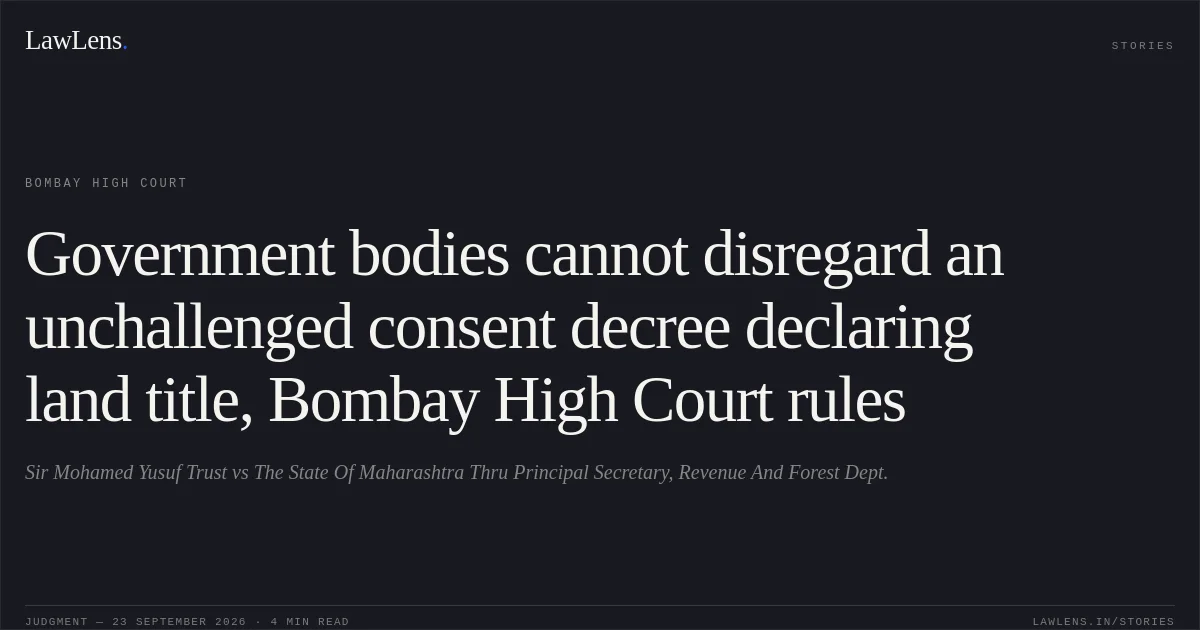
Source reference: para. 10More importantly, the 1963 consent decree had recognised that the subject lands vested in the original landholders, and that decree remained unchallenged. The City Survey Officer’s entry in favour of Bombay Municipal Water Works was therefore held to be erroneous because it had failed to consider the decree.
Source reference: para. 11The Court further held that the fact that MCGM was not a party to the decree did not permit it, as a statutory authority under the State’s umbrella, to disregard the State’s position or a binding judicial declaration concerning the property.
Source reference: paras. 14–16The historical letters and alleged possession did not conclusively prove acquisition, particularly in the absence of a clear acquisition order or other legally sufficient proof connecting the acquisition to the subject CTS property.
Source reference: para. 12The pendency of the civil suit did not prevent writ relief because, in the Court’s view, the decree itself conclusively established the Petitioners’ entitlement for the limited purpose of correcting the revenue records.
Source reference: paras. 20–21The objections concerning Petitioner No. 5’s locus and alleged suppression were found immaterial and non-prejudicial, especially since the relief sought was to record the names of Petitioner Nos. 1 to 4.
Source reference: paras. 17–19Holding
The Court held that the City Survey and revenue authorities could not disregard the 1963 consent decree or maintain MCGM’s name in the property records on the basis of unproven acquisition or possession.
The writ petition was allowed in terms of prayer clauses (i), (ii), and (iii), directing the authorities to record the names of Petitioner Nos. 1 to 4 in the relevant revenue records and property card as holders of the subject property.
Source reference: para. 25Respondent Nos. 4 to 7 were additionally directed to demarcate the property by metes and bounds within six weeks from uploading of the judgment.
Source reference: para. 25The petition was allowed without costs, and MCGM’s request for stay pending an appeal to the Supreme Court was rejected.
Source reference: paras. 26–29Acts & Sections Cited
2 provisions across 2 statutes referred to in this judgment. Each provision opens on LawLens.
Specific Relief Act, 19631
Manipur Municipalities Act, 19941
Original Court PDF
Sir Mohamed Yusuf TrustvsThe State Of Maharashtra Thru Principal Secretary, Revenue And Forest Dept.
Click to open original judgment
Original judgment, available to read, download and summarize on LawLens.in