Facts
The applicants (Special Land Acquisition Officer and Executive Engineer) sought to condone a delay of 1248 days in filing a First Appeal against the judgment and award dated 24.12.2021 passed by the Additional Senior Civil Judge, Kalol in LAR No. 140 of 2012
Source reference: para. 2The judgment was delivered on 24.12.2021, and the certified copy was obtained on 06.05.2022
Source reference: para. 3The applicants contended that the delay was not intentional but due to bureaucratic procedures, including obtaining legal opinions, seeking administrative sanctions from the Narmada Water Resources, Water Supply and Kalpasar Department, and rectifying factual errors in the initial award
Source reference: para. 3-5, 14The application for condonation was filed under Section 5 of the Limitation Act, 1963
Source reference: para. 2Issues
1. Whether the administrative and procedural delays inherent in government machinery constitute "sufficient cause" for condoning an inordinate delay of 1248 days under Section 5 of the Limitation Act
Source reference: para. 7-102. Whether the court should adopt a "liberal approach" for condonation of delay solely because the applicant is a State entity
Source reference: para. 7, 14Law Applied
Section 5 of the Limitation Act, 1963, which allows admission of appeals after the prescribed period if the applicant establishes "sufficient cause"
Source reference: para. 6The principle from Pathapati Subba Reddy v. Special Deputy Collector (LA) that while Section 5 should be construed liberally to advance justice, it cannot defeat the substantive law of limitation under Section 3, nor can it excuse negligence or want of due diligence
Source reference: para. 11State of Odisha v. Managing Committee of Namatara Girls High Schools and Union of India v. Jahangir Byramji Jeejeebhoy, emphasizing that rules of limitation apply equally to the State and private litigants
Source reference: para. 12-13Office of the Chief Post Master General v. Living Media India Ltd., which established that the "impersonal machinery" of government is no longer a valid excuse for delay in the era of modern technology
Source reference: para. 14Reasoning
The Court observed that the length of the delay (1248 days) was substantial and necessitated a rigorous explanation, which the applicants failed to provide
Source reference: para. 9The Court scrutinized the timeline provided by the State, noting that while various dates were mentioned regarding inter-departmental correspondence and meetings, these were not backed by documentary evidence
Source reference: para. 9The Court rejected the AGP’s argument for a "liberal approach," stating that such an approach is only applicable when there is no negligence or lack of bona fides
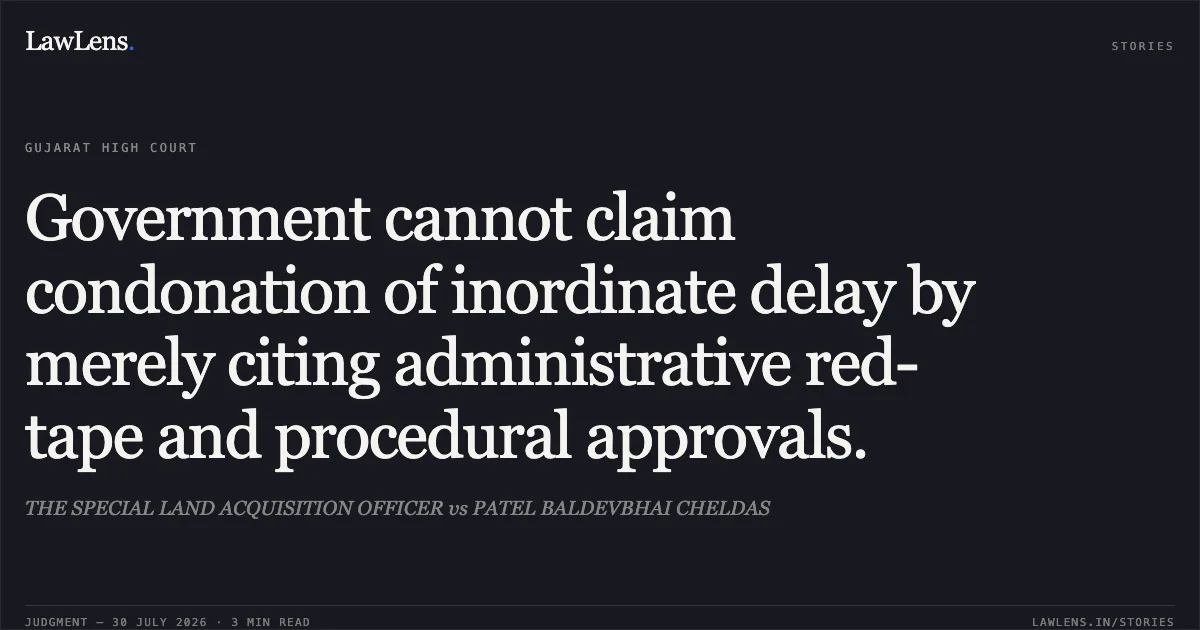
Source reference: para. 8Applying the Living Media precedent, the Court reasoned that the State is under a special obligation to act with diligence and cannot claim immunity from limitation based on "bureaucratic red-tape" or "procedural methodology"
Source reference: para. 14It concluded that the reasons cited were merely "lame excuses" rather than a "sufficient cause," and that condoning such a delay would prejudice the respondent by depriving them of the fruits of their decree for an indefinite period
Source reference: para. 13-15Holding
The Court held that the applicants failed to establish "sufficient cause" for the inordinate delay of 1248 days
The Court refused to exercise its discretionary power under Section 5, ruling that the law of limitation binds the Government as strictly as any private party
Source reference: para. 14Consequently, the Civil Application for condonation of delay was dismissed, and registration of the First Appeal was refused
Source reference: para. 16-17Acts & Sections Cited
2 provisions across 1 statute referred to in this judgment. Each provision opens on LawLens.
Original Court PDF
THE SPECIAL LAND ACQUISITION OFFICERvsPATEL BALDEVBHAI CHELDAS
Click to open original judgment
Original judgment, available to read, download and summarize on LawLens.in