Facts
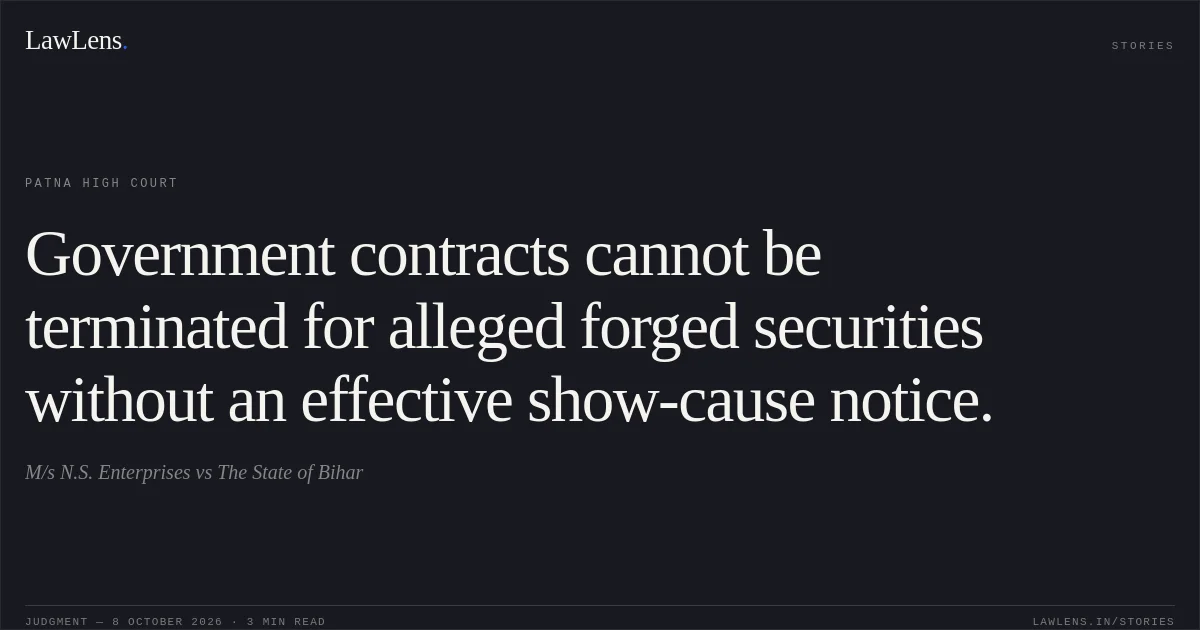
M/s N.S. Enterprises held 57 agreements with the Public Health Engineering Department for water-supply works in Araria district.
Source reference: paras. 3–6After the Executive Engineer received information from IndusInd Bank that fixed deposits furnished as security were either closed or not issued by the Bank, the Department cancelled the agreements, forfeited the security and recommended blacklisting.
Source reference: paras. 3–6The contractor challenged the cancellation on the ground that no show-cause notice or hearing had been provided.
Source reference: paras. 3–6In a connected petition, it sought payment of ₹1,85,98,200 for completed work.
Source reference: paras. 3–6The contractor relied on completion certificates and asserted that it had completed the remaining work pursuant to an interim court order.
Source reference: paras. 17, 24, 28–29The State maintained that the security documents were non-genuine, that fraud vitiated the contracts, and that the contractor should pursue the contractual arbitration mechanism.
Source reference: para. 17Issues
Whether the cancellation of the 57 agreements, forfeiture of security and recommendation for blacklisting were invalid for want of prior notice and a reasonable opportunity to be heard.
Source reference: paras. 5–7, 23–26Whether the contractor was entitled to payment of the admitted amount for work completed and accepted by the Department.
Source reference: paras. 28–30, 35–36Law Applied
Administrative action is subject to judicial review for illegality, irrationality and procedural impropriety; the audi alteram partem rule ordinarily requires notice of the case against a person and a meaningful opportunity to respond before action with civil consequences is taken.
Source reference: paras. 8–10, 14–15Under UMC Technologies Pvt. Ltd. v. Food Corporation of India, a show-cause notice must identify the grounds for action and the proposed consequence; an order cannot travel beyond the notice.
Source reference: paras. 14–15State of U.P. v. Sudhir Kumar Singh addresses when prejudice must be shown, while Madhyamam Broadcasting Ltd. v. Union of India recognises procedural fairness as having inherent value.
Source reference: paras. 12–13Allegations of fraud require a factual basis linking the allegedly false document to the person’s knowledge and intention; subsequent discovery of a defect does not, by itself, establish fraud, particularly where the authority had an opportunity to verify the document.
Source reference: paras. 18–20Section 70 of the Indian Contract Act, 1872 obliges a person who voluntarily enjoys the benefit of a lawful, non-gratuitous act to compensate the person who performed it; State of West Bengal v. B.K. Mondal & Sons explains the conditions for that obligation, and Ramesh Kumar Jain v. BALCO recognises Section 70 as an independent restitutionary obligation.
Source reference: paras. 30–34Reasoning
The Department relied on the Bank’s verification to cancel the agreements and impose serious consequences, but did so without giving the contractor notice of the specific allegation of fraud or the proposed action.
Source reference: paras. 18, 25–27The Court held that the Bank’s communication warranted inquiry but did not, by itself, establish that the contractor knowingly submitted false securities or intended to deceive; the Department could consider the allegation afresh after following due process.
Source reference: paras. 18, 25–27The cancellation and recommendation for blacklisting were therefore procedurally unsustainable.
Source reference: paras. 18, 25–27As to payment, the Court relied on the completion certificates and the Department’s acceptance and enjoyment of the completed work and maintenance services.
Source reference: paras. 24, 29–35It held that the contractor’s services were not gratuitous and that retaining their benefit without compensation would result in unjust enrichment, attracting Section 70.
Source reference: paras. 24, 29–35Holding
The Court quashed and set aside Office Order No. 182, dated 10 February 2025, contained in Memo No. 1786, dated 10 September 2025, for violation of natural justice.
It expressed no opinion on the merits of the security-document or fraud allegations and left the competent authority free to proceed in accordance with law after following due process.
Source reference: paras. 26–27The Court also directed the respondents to pay the contractor the admitted amount of ₹1,85,98,200 within two months of receipt or production of the order, taking account of the completed work and completion certificates.
Source reference: paras. 35–37The writ applications were allowed; no separate award of the claimed 12% interest appears in the operative directions.
Source reference: paras. 35–37Acts & Sections Cited
1 provisions across 1 statute referred to in this judgment. Each provision opens on LawLens.
Indian Contract Act, 18721
Original Court PDF
M/s N.S. EnterprisesvsThe State of Bihar
Click to open original judgment
Original judgment, available to read, download and summarize on LawLens.in